

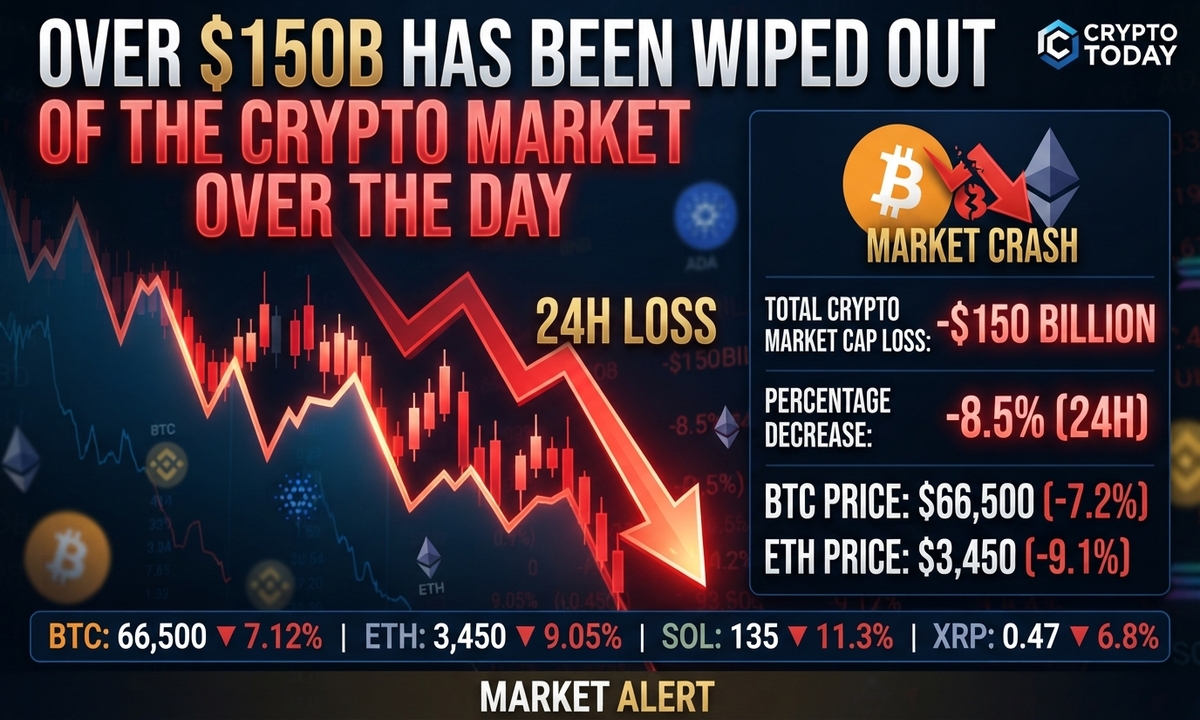
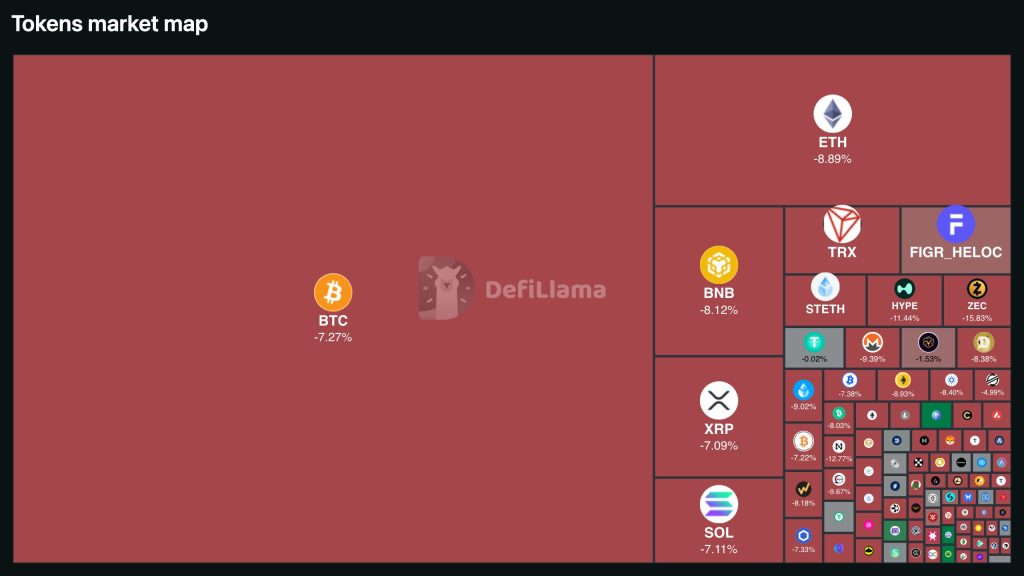
The crypto market just took another heavy hit. On November 20, 2026, more than $150 billion in total market value vanished in a single day, according to data shared by DefiLlama.
Bitcoin slid hard, briefly testing levels near $55,000–$58,000 and marking its weakest point since September 2024.
Ethereum and most major altcoins followed lower.
Liquidations across exchanges climbed past $1.5 billion and in some tallies reached $2.7 billion, with long positions making up the bulk of the forced sales.
What Triggered the Sudden Crypto Market Drop?
A mix of factors lined up at once. Technology stocks, especially artificial intelligence (AI)-related names, sold off sharply and pulled risk assets lower.
Rising real yields and a more cautious Federal Reserve outlook added pressure.
Spot Bitcoin ETF flows flipped negative for days, removing a key source of demand that had supported prices earlier in the cycle.
High leverage made everything worse. Once Bitcoin broke key support levels, margin calls cascaded through perpetual futures markets.
Open interest dropped quickly as positions were closed out.
Stablecoin supply has also contracted notably in recent weeks, tightening available liquidity on-chain.

How Does This $150 Billion Wipeout Compare to Past Crypto Market Crashes?
This daily loss stands out even by crypto standards. The broader market has already shed roughly $2.3 trillion since the October 2025 peak near $4 trillion-plus.
Bitcoin itself sits more than 50% below its all-time high above $126,000.
Yet the recent liquidation total, while painful, ranks outside the top historical events.
The October 2025 cascade still holds the record by a wide margin. The current move feels more like a continuation of a months-long de-risking than an isolated blow-up.

What Does the Crypto Market Wipeout Mean for Everyday Investors?
Many retail and leveraged traders absorbed the biggest immediate losses.
Longs that rode the previous uptrend faced forced exits.
Spot holders who bought higher now sit on unrealised losses that analysts estimate in the hundreds of billions for Bitcoin alone.
At the same time, periods of heavy liquidation often clear excess leverage from the system.
Once open interest resets, markets can find firmer footing if genuine demand returns.
Fear readings have plunged deep into extreme territory, a zone that has sometimes preceded medium-term stabilisations in prior cycles.

Is This the Bottom for the Digital Assets Sector, or Could Further Declines Follow?
No one can call a precise bottom in real time. Technical supports around recent lows will face tests.
Macro conditions—interest-rate expectations, equity market direction, and liquidity—remain the bigger drivers right now.
If ETF outflows slow and risk appetite improves across traditional markets, crypto could stabilise.
Continued pressure from stocks or further leverage flushes would keep prices vulnerable.
Historical patterns show that sharp one-day drops of this size rarely mark the exact end of a corrective phase, yet they often exhaust the most aggressive sellers.

Looking Ahead in the Digital Assets Industry
The November 20 wipeout shows how tightly crypto still trades with global risk sentiment.
Leverage amplifies every move, both up and down.
Traders watching funding rates, open interest, and stablecoin flows will find clearer signals than pure price action alone.
For longer-term participants, the episode serves as a reminder of volatility’s persistent role.
Capital that survived the cascade now sits in stronger hands, though recovery will depend on broader financial conditions improving.
Data from DefiLlama, CoinGlass, and on-chain trackers will remain essential for tracking the next phase.
