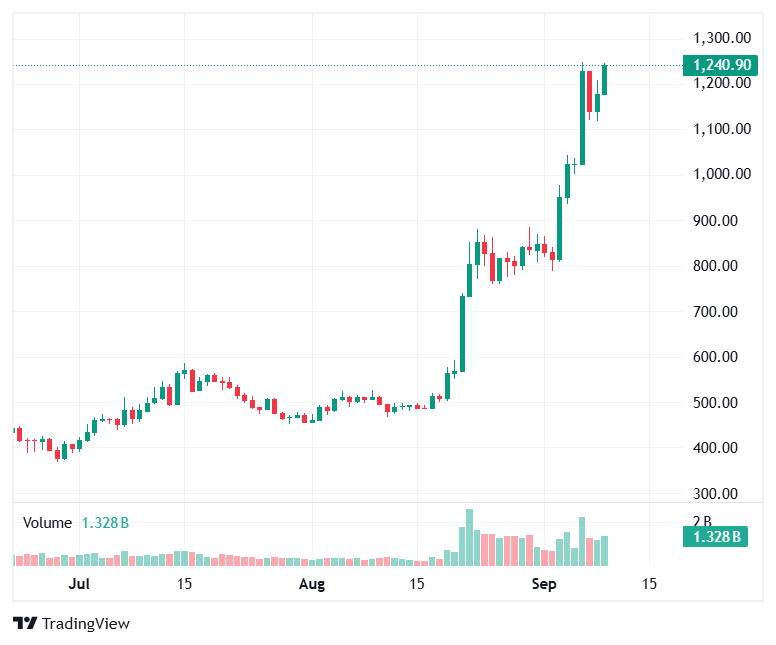

ZCash has stormed back into the spotlight after massive gains in September 2026.
The privacy-focused cryptocurrency recently punched through multi-year highs, climbed into the upper ranks of market capitalisation, and forced traders to reopen an old debate: can this token still deliver life-changing returns, or has the easy money already left the building?
The question carries real weight right now.
ZCash (ZEC) sits near the $1,100–$1,200 zone with a market value hovering around $19–20 billion.
That places it among the larger digital assets, far removed from the obscure privacy coin that once traded in the double digits.
Yet, the same fixed-supply design that echoes Bitcoin, the rising use of its shielded pools, and fresh institutional access through a Grayscale product keep the “millionaire maker” label alive in some circles.
This article examines the claim from every practical angle. It draws on on-chain figures, institutional moves, technical upgrades, and market structure so readers can judge the opportunity for themselves.
Can ZCash (ZEC) still 10x (or more) from current levels and make early/late investors millionaires?
The core appeal of any high-conviction token rests on asymmetric upside.
A 10x move from today’s prices would push ZEC toward the $11,000–$12,000 region and produce a market capitalisation well above $180 billion.
That outcome remains mathematically possible because the maximum supply stays capped at 21 million coins, the same hard limit Bitcoin carries.
Roughly 80% of that supply already circulates, so future issuance slows further with each halving.
Early buyers who accumulated below $100 or even $300 enjoyed the bulk of the recent multi-thousand-percent run.
Latecomers face steeper math. An investor who puts $50,000 to work at $1,150 would need ZEC to reach roughly $23,000 simply to turn that position into a seven-figure result.
The required capital therefore climbs quickly once the price has already advanced this far.
Nevertheless, the privacy narrative continues to attract capital that views ZCash as insurance against both fiat surveillance and the transparent ledger of Bitcoin itself.
Naval Ravikant’s earlier framing of ZCash as “Bitcoin insurance” still circulates among longer-term holders.
Institutional vehicles such as Cypherpunk Technologies have disclosed sizable positions, while Grayscale’s spot product has opened a regulated doorway for traditional money.
These flows can support higher valuations even if pure retail FOMO cools.
A true 100x from here looks far less probable under present conditions.
That kind of expansion would demand ZCash capture a meaningful slice of global private wealth and push its market value into the hundreds of billions.
History shows privacy coins rarely sustain that scale without broader regulatory acceptance and deeper everyday use of shielded transactions.
The more realistic path for millionaire outcomes now favors investors who already hold meaningful size rather than those just arriving.
Will ZEC reach $2,000–$2,500 (or higher targets like $4,000 / $8,100) in this cycle or by 2030?
Price targets multiply once a coin breaks long-standing resistance.
Technical analysts have pointed to cup-and-handle formations on the weekly chart that project measured moves into the $2,200 area.
Short-term traders watching September futures also flag $2,200 as a level that could force additional short covering.
Longer-horizon models stretch further. Grayscale research has floated scenarios in which ZCash captures 2 percent of Bitcoin’s market value, implying prices near $1,600, or 10 percent, which would land closer to $8,100.
Separate commentary from figures associated with Cypherpunk Holdings has sketched $4,000 outcomes if the token attracts even a modest share of offshore wealth and gold-like private stores of value.
Arthur Hayes previously floated a $10,000 figure in a lighter moment that still gets repeated.
These numbers rest on assumptions rather than guarantees.
A sustained push past $2,000 would first require the current open interest in perpetual futures to remain constructive and for ETF inflows to continue.
The Ironwood upgrade, which replaced the older Orchard shielded pool and introduced stronger verification features, removed one major technical overhang.
Rising shielded supply—now near 30 percent of circulating coins—adds another constructive signal because it shows actual privacy usage rather than pure speculation.
Still, reaching the higher multi-thousand targets by 2030 would demand that financial privacy becomes a mainstream institutional priority rather than a niche preference.
Competition from other privacy designs and possible regulatory friction could slow that process.
The $2,000–$2,500 zone looks more attainable within this cycle if momentum and ETF demand persist; the $4,000–$8,100 band belongs to a longer and more uncertain horizon.
Is the recent rally sustainable (fundamentals + ETF + privacy narrative), or is it mostly a narrative-driven short squeeze / overextended move?
Momentum has been dramatic. ZCash posted gains exceeding 1,000 percent over the past year and more than doubled in recent months, briefly entering the top ten by market capitalisation.
That kind of advance always invites skepticism. F2Pool co-founder Chun Wang described the move as a “narrative bid,” arguing that a large market cap alone does not prove the network has earned its ranking relative to higher-utility chains.
Counter-evidence exists on several fronts. Grayscale converted its ZCash trust into a listed spot product (ZCSH) that has already attracted hundreds of millions in assets.
The Ironwood upgrade closed a serious vulnerability in the older shielded pool and improved long-term auditability.
On-chain data show shielded balances climbing to roughly 30 percent of supply, a meaningful rise from single-digit levels in prior years.
Transaction privacy rates have also increased, indicating that holders are using the core feature rather than simply parking coins on exchanges.
Open interest in futures expanded sharply during the rally, and short liquidations added fuel. Those mechanical factors can exaggerate any move.
Yet, the combination of regulated product access, protocol hardening, and measurable privacy adoption supplies a fundamental backbone that pure narrative squeezes usually lack.
Sustainability therefore hinges on whether ETF inflows continue and whether shielded usage keeps expanding.
If both remain intact, the rally can transition into a more durable re-rating.
If either fades, a deeper consolidation becomes likely.
Chun Wang’s comments were reported by several crypto outlets. ETF asset figures and Ironwood details appear in many portals as well as Grayscale announcements.
Is it too late to buy ZCash after the massive run-up (1,000%–2,300% in the past year / multi-year highs)?
Timing questions intensify after parabolic advances. ZCash has already delivered the kind of multi-year breakout that leaves late buyers wondering whether they missed the window.
Market capitalisation near $20 billion removes the micro-cap upside that once defined the asset.
Yet “too late” depends entirely on time horizon and position size.
Investors seeking another 10x must accept lower probability and longer duration.
Those comfortable with more modest multiples—perhaps 2x to 4x over a multi-year period—still find a liquid, fixed-supply privacy asset with growing institutional rails.
The presence of a spot ETF reduces one historical friction: the difficulty traditional capital faced when trying to gain exposure.
Historical parallels offer mixed guidance. Bitcoin itself continued to produce substantial returns long after its first major parabolic phases, though the percentage gains moderated.
Privacy coins have shown sharper boom-bust cycles, so position sizing and risk management matter more here than in broader large-cap crypto.
Buying after a 2,000 percent run is rarely optimal for maximum returns, yet it is not automatically a poor decision if the underlying thesis of rising demand for confidential settlement continues to strengthen.
What are the realistic long-term price predictions for ZEC (2026–2030) and the key risks that could prevent further upside?
Forecast ranges vary widely because privacy assets remain high-beta.
Near-term models for the balance of 2026 often cluster between $900 and $1,500 under base assumptions, with bullish extensions toward $2,000 if momentum and inflows persist.
Looking into 2027, several desks project averages in the $1,200–$2,000 region.
By 2030, the spread widens dramatically: conservative cases stay below $2,000 while optimistic market-share scenarios reach several thousand dollars.
Key risks sit in plain view. Regulatory pressure on privacy-enhancing technologies continues in multiple jurisdictions and has previously prompted exchange delistings.
The 2026 Orchard vulnerability, although patched via Ironwood, reminded the market that complex cryptography can hide serious flaws.
Competition from Monero and newer privacy designs remains real.
Adoption of shielded transactions, while improved, still leaves a majority of supply in transparent addresses, limiting the full privacy network effect.
Valuation itself poses a risk; at current levels ZCash already prices in meaningful success.
Any broad crypto drawdown or loss of ETF momentum could reverse recent gains quickly.
Balanced forecasts therefore treat the higher targets as contingent on continued institutional acceptance of optional privacy and steady growth in shielded usage.
The lower targets assume a more cautious regulatory climate and slower real-world adoption.
ZCash has already proven it can deliver outsized returns for those who positioned early.
Whether it remains a millionaire-maker vehicle depends less on past performance and more on the durability of demand for private digital money.
The fixed supply, improving protocol resilience, and new institutional access create a credible foundation.
At the same time, the elevated starting price, regulatory overhangs, and competition introduce clear constraints.
Investors who size positions carefully, monitor shielded-pool growth and ETF flows, and treat the higher targets as low-probability outcomes will navigate the next phase with clearer eyes than those chasing the last leg of a narrative alone.