
Lighter has drawn sharp attention in early September 2026 after delivering roughly 35 percent gains for holders over a recent stretch.
The token trades near $4.69 with a market capitalisation around $1.17 billion and a circulating supply of 250 million out of a fixed one-billion maximum.
Trading volume has climbed alongside the move, and the project sits comfortably inside the top 60 by market value, as of this writing.
People noticing the climb quickly start digging into the same set of questions about what the platform actually does, how its token fits into the design, and whether the price strength rests on more than short-term momentum.
This article walks through those questions with current data, clear mechanics, and practical context so readers can form their own view.
What is Lighter (LIT) and how does the platform work?
Lighter operates as a decentralised perpetual futures exchange built on a custom zero-knowledge (zK) rollup that settles proofs directly to Ethereum.
The system matches orders and handles liquidations off-chain for speed, yet every critical step produces cryptographic proofs that anyone can verify on-chain.
Retail traders enjoy zero maker and taker fees while the platform targets latency and throughput that feel closer to traditional exchanges than most on-chain venues.
In practice, the architecture lets users open leveraged positions with high performance and still keep the transparency of a public ledger.
Notably, the design focuses on verifiable fairness so the operator cannot quietly reorder trades or manipulate liquidations.
Besides the core perpetual markets, the platform also supports experimental liquidity pools for pre-markets and real-world asset perps.
Overall, the combination of zk-proofs, Ethereum settlement, and exchange-grade speed positions Lighter as a specialised Layer-2 trading venue rather than a general-purpose chain.
What is the utility of the LIT token?
LIT functions as the infrastructure token that ties user access and platform incentives together.
Staking LIT unlocks capacity in the Lighter Liquidity Pool at a clear ratio—roughly one staked LIT grants up to ten USDC of deposit room.
That same staking also opens premium account tiers that deliver lower latency and better fee treatment for professional or high-volume traders.
Unstaking carries a short lockup of about three days so the system keeps liquidity committed.
In addition, holders can participate in governance discussions and earn a share of certain yield streams generated by the pool.
Interestingly, the token itself is not required for ordinary retail trading; standard accounts still operate at zero fees without holding any LIT.
The design therefore creates demand mainly from liquidity providers (LPs) and sophisticated desks that want the extra capacity and speed rather than from casual traders.
Crucially, this utility model turns LIT into a capacity and access asset instead of a simple fee-payment token.
What are LIT’s tokenomics, supply, and buyback/burn mechanics?
LIT carries a hard maximum supply of one billion tokens with no additional inflation. Circulating supply currently stands near 250 million.
At the December 2025 token generation event, the allocation split 50-50 between the ecosystem and the team-plus-investors group.
Roughly 25% went out immediately via airdrop to points-program participants from the earlier seasons, while another twenty-five percent remains reserved for future ecosystem incentives.
Team and investor portions sit behind a one-year cliff followed by multi-year linear vesting.
On the value-capture side the protocol channels trading revenue into open-market buybacks and permanent burns.
In July 2026, the team executed its first major revenue-funded burn, permanently removing about 15.5 million LIT—roughly 6.3 percent of the then-circulating supply—by sending the tokens to a burn address on Ethereum.
Furthermore, the buyback program continues to operate transparently so anyone can track the flow of fees into reduced supply.
This combination of fixed supply, clear vesting, and ongoing burns gives LIT a measurable scarcity mechanism linked directly to platform activity.
How does Lighter’s zero-fee model actually generate value for LIT holders?
Retail traders pay nothing in maker or taker fees on standard accounts.
The platform instead generates revenue by offering premium access and order-flow arrangements to institutional and professional firms that value the low latency and verifiable matching.
In essence, the design rebuilds a payment-for-order-flow model on-chain: sophisticated participants pay for priority and better execution while ordinary users trade free.
Protocol revenue from those premium streams then funds the open-market buybacks of LIT.
Once the tokens are purchased they are burned, permanently lowering circulating supply.
Moreover, the more volume the exchange processes, the larger the potential revenue pool available for those buybacks.
Holders therefore benefit when trading activity grows because a larger share of that activity converts into supply reduction.
At the same time, the zero-fee retail experience helps attract volume in the first place, creating a feedback loop between usage and token economics.
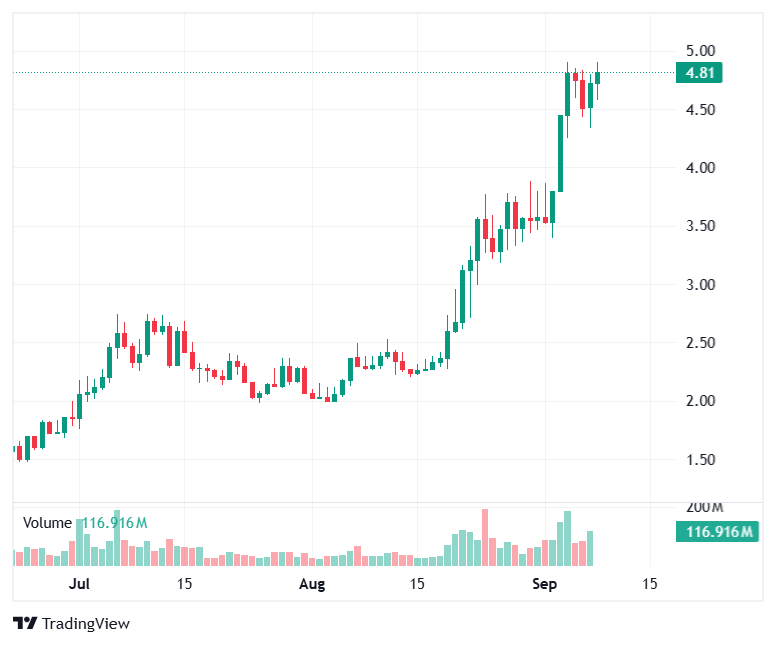
Why is Lighter (LIT)’s price up recently / what is driving the gains?
Recent price strength lines up with several observable factors.
Trading volume on the platform has expanded, giving the buyback program more revenue to work with.
Technical charts show the token holding above short-term moving averages with rising momentum indicators and solid buyer interest.
Broader market rotation into high-performance perpetual DEXs has also lifted attention toward venues that combine speed with on-chain verifiability.
In the meantime, the July burn and ongoing buyback activity have reduced float at the same time interest has increased.
Social discussion and search volume around zero-fee models and zk-based matching engines have climbed in parallel.
Although no single headline dominates the move, the combination of volume growth, supply reduction, technical structure, and sector interest explains most of the recent percentage gains.
Lighter continues to operate as a live, verifiable perpetual futures venue with a clear token utility and an active buyback mechanism.
The roughly 35% gains have brought fresh eyes to the architecture, the token’s capacity-gating role, the fixed-supply tokenomics, and the revenue loop that ties trading activity back to LIT.
Traders and investors can verify the latest LIT numbers on CoinMarketCap, the contract on Etherscan, and the project’s own documentation for further detail.
