


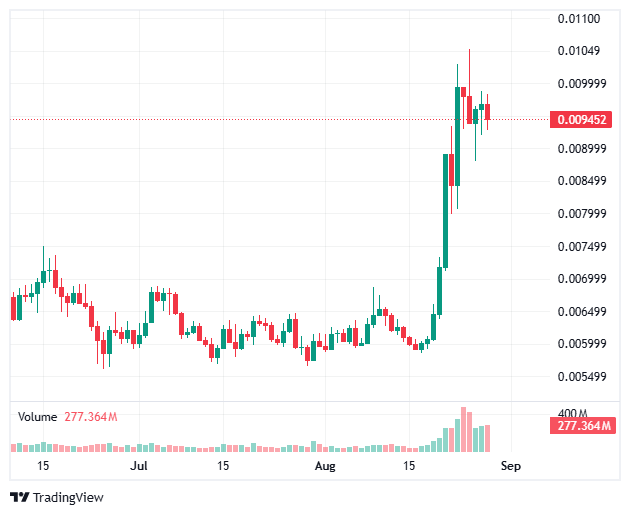
PENGU has captured fresh attention after climbing more than 60% in a single week during late August 2026.
This has pushed the token near the $0.01 level and lifted its market capitalisation toward $600 million.
Traders, holders, and observers keep asking the same core question: what exactly powers this move in PENGU?
Multiple overlapping forces appear to work together, ranging from social-media signals to real-world retail progress and exchange incentives.
The following sections unpack each major driver with clear context so readers can separate confirmed developments from market interpretation.
Did Luca Netz’s cryptic tweet spark the PENGU rally with IPO speculation?
On August 23, 2026, Pudgy Penguins CEO Luca Netz shared a short post containing only eyes, a penguin emoji, a building, and the word “SOON.”
Community members quickly connected the building image to a stock exchange and treated the message as a hint that an initial public offering (IPO) might advance sooner than expected.
Earlier remarks from Netz, made in August 2025, had already set a 2027 target for a public listing provided revenue goals were met.
The new post revived that narrative almost overnight and coincided with an immediate double-digit jump in PENGU.
Many market participants now view the tweet as the single most visible catalyst that shifted sentiment and brought new buyers into the token.

Is Pudgy Penguins actually preparing for an IPO or stock-market listing in 2027?
No formal filing or confirmed timeline for a 2027 IPO has appeared in public records as of late August 2026.
Netz has repeatedly expressed personal ambition to take the company public within two years of his 2025 comments, and he has linked that ambition to revenue milestones around $50 million.
The recent emoji post simply reopened the conversation rather than announcing any concrete step.
Holders should note that PENGU itself carries no equity rights, so any future company listing would sit outside the token’s direct economics.
Still, the speculation alone has proved powerful enough to influence short-term price behaviour.
How much is retail expansion (Target, Walmart, and new South Korea push) contributing to PENGU’s price rise?
Physical distribution continues to expand at a steady pace. Pudgy Penguins plush toys and collectibles already sit on shelves in thousands of Target and Walmart locations across North America.
In late August, the brand also announced its first major push into the South Korean retail market, adding trading cards, comics, and larger plush formats.
These steps reinforce the idea that the IP generates real consumer demand beyond crypto circles.
Each new store placement or regional launch supplies fresh talking points that traders often treat as positive fundamental news for PENGU.
The cumulative effect of wider availability appears to support longer-term brand confidence even while day-to-day price swings remain speculative.

What role did the LBank $500K promotional campaign play in the PENGU surge?
LBank launched a 500,000-dollar campaign around the same period that featured trading competitions, referral rewards, and a locked-earn product offering fixed yield for 30 days.
The locked products temporarily remove tokens from immediate circulation, which can tighten available supply when demand rises.
Trading volume and price both accelerated in the hours surrounding the campaign announcement.
Exchange-driven incentives of this size often act as short-term accelerants rather than permanent structural changes.
Yet, they clearly amplified the upward momentum already building around PENGU.
Is the PENGU rally just broader meme-coin momentum or something unique to Pudgy Penguins?
Other large meme tokens such as PEPE, DOGE, and BONK also posted solid weekly gains, confirming that risk appetite returned across the sector.
PENGU nevertheless outperformed many peers during the same window.
The combination of an established consumer brand, ongoing retail placement, and a recognisable leadership voice gives PENGU a narrative layer that pure meme assets lack.
Traders therefore appear to treat the token as a hybrid rather than a pure speculation vehicle, which helps explain its relative strength.

Did a short squeeze or liquidations amplify the upward move?
Reports of liquidated short positions surfaced during the sharpest daily advances. When price rises quickly, leveraged bearish bets can face forced closures that add further buying pressure.
Several outlets noted hundreds of thousands of dollars in short liquidations around the peak of the move.
While the exact size remains secondary to the primary catalysts, the squeeze effect likely magnified the speed of the climb once the initial buying wave began.
How significant is the jump in trading volume (300%+ in some reports) to the price action?
Daily trading volume for PENGU expanded by several hundred percent in multiple reports, reaching levels of more than roughly $400 million.
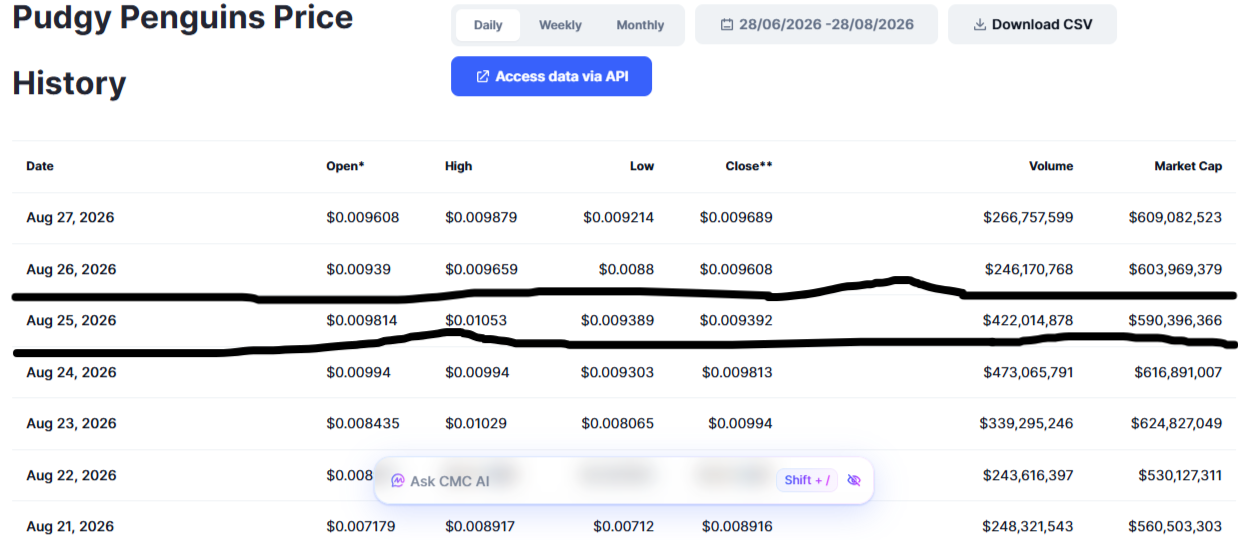
Elevated volume supplies liquidity that allows larger orders to execute without extreme slippage, and it also signals that new participants have entered the market.
The volume spike arrived alongside the social and retail catalysts, reinforcing the impression of genuine demand rather than thin-order-book noise.
Sustained high volume remains one of the clearer confirmations that the move attracted real capital.
Are new product launches (larger plush toys, trading cards, comics, Schleich figurines) driving fresh buying?
Product announcements continue to arrive in parallel with the price advance.
Larger 14-inch plush toys, expanded trading-card lines, comic releases, and a partnership involving Schleich collectible figurines all received attention in the same window.
Each release expands the brand’s physical footprint and gives the community new visual content to share.
While these launches do not transfer revenue directly to token holders, they keep the Pudgy Penguins name visible in mainstream retail channels and supply ongoing positive headlines that traders often interpret as supportive of PENGU.
Does the PENGU token actually benefit from Pudgy Penguins company revenue or a future IPO?
PENGU holders possess no equity stake in Igloo Inc. or any contractual claim on merchandise sales, licensing income, or future share proceeds.
The token functions primarily as a social and ecosystem currency rather than a revenue-sharing instrument.
Any IPO of the operating company would therefore create a separate equity asset.
Market participants who treat PENGU as a pure proxy for company success should keep this structural separation in mind.
The price can still respond to brand momentum, yet the economic link remains indirect.
Is whale accumulation or on-chain activity supporting the PENGU pump?
On-chain observers reported large wallet purchases during the rally, including notable accumulation through major venues.
Technical breakouts above recent resistance levels coincided with these flows.
Whale activity does not guarantee continued upside, yet concentrated buying from sizable holders often provides an additional layer of demand that can stabilize or extend a move.
Monitoring exchange inflows and large-transfer alerts remains useful for anyone tracking the sustainability of the current trend in PENGU.
Taken together, the recent advance in PENGU reflects a convergence of social signalling, retail progress, exchange incentives, and classic market mechanics.
The cryptic post from Luca Netz supplied the most discussed spark, while expanding store presence and promotional campaigns supplied ongoing fuel.
At the same time, the absence of direct revenue or equity rights for token holders introduces a clear boundary between brand success and token economics.
Readers who follow PENGU closely will want to watch both the next set of product and partnership announcements and any further commentary from leadership regarding longer-term corporate plans.
