

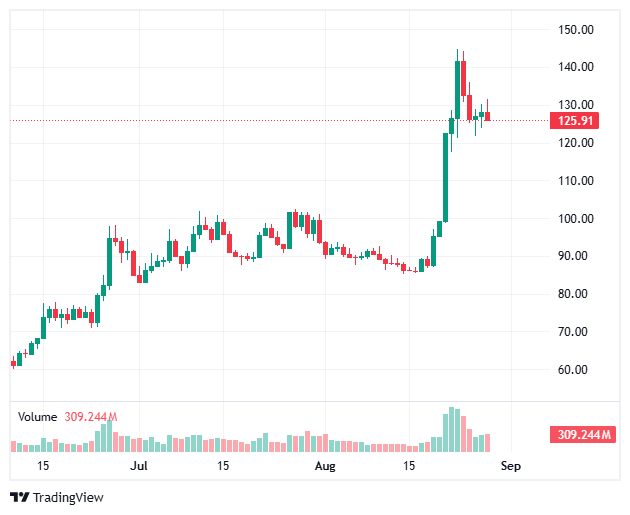
Aave has posted gains exceeding 30% across recent weekly windows in mid-to-late August 2026, with individual sessions delivering double-digit advances that lifted the token into the $120–$140 range in multiple reports.
Traders and observers continue asking what combination of forces sits behind this strength in Aave.
Protocol-level upgrades, revenue-sharing signals, real-world asset progress, and market technical appear to reinforce one another.
The article examine each major driver so readers can evaluate the relative weight of every factor with clearer context.
Why is AAVE up more than 30% this week?
Several overlapping developments have supported the advance. Progress on tokenomics reforms, expanding deposits on the newest protocol version, and fresh real-world asset proposals arrived alongside stronger decentralised finance (DeFi) sector flows and technical breakouts.
Volume expanded notably during the strongest sessions, while larger wallets showed accumulation patterns.
Broader market conditions provided a constructive backdrop, yet Aave-specific catalysts gave the move a more distinct character than pure beta exposure.
The combination produced sustained buying interest that carried the token through prior resistance zones.
Did Aavenomics 3.0 and automated buybacks drive the AAVE rally?
Aavenomics 3.0 has emerged as one of the clearest narrative catalysts.
Founder Stani Kulechov highlighted work on an automated buyback mechanism that would channel protocol and GHO revenue toward AAVE holders in a more systematic way.
Earlier statements also reaffirmed that 100% of relevant protocol revenue belongs to the token and the decentralised autonomous organisation (DAO).
Market participants treated these signals as constructive for long-term value accrual, and the discussion coincided with accelerated price action.
The shift from discretionary to more automated capital returns helped reframe AAVE as an asset with clearer economic linkages to network activity.
How much is Aave V4 deposit growth contributing to the price rise?
Aave V4 deposits have climbed steadily, with reports citing figures moving from under $50 million earlier in the year toward $400 million and higher milestones across multiple hubs.
The hub-and-spoke architecture isolates risk while expanding multi-chain reach, including deployments beyond Ethereum.
Rising deposits demonstrate capital returning to the protocol and improving capital efficiency.
Traders often interpret such growth as evidence of strengthening product-market fit, which in turn supports demand for the governance and value-accrual token.
The expansion has supplied a tangible fundamental backdrop for the recent advance.
What role are RWA proposals (like HINC/Securitise) playing in AAVE’s move?
Real-world asset integration continues to draw attention. Securitise and partners advanced proposals to list tokenized high-yield products, including the HINC fund, as collateral on Aave Horizon.
These steps position the protocol to support institutional-grade credit and fixed-income assets alongside traditional crypto collateral.
Horizon’s focus on permissioned environments and tokenized funds broadens the addressable market.
Coverage of these proposals arrived in parallel with the price strength and reinforced the narrative that
Aave is building bridges into larger traditional finance use cases.
Is the AAVE surge mainly broader DeFi rotation or protocol-specific catalysts?
Capital has rotated toward established DeFi blue-chips during periods of improved risk appetite.
Aave has participated in that broader flow. At the same time, protocol-specific developments—tokenomics reform, V4 growth, and RWA progress—have given the token additional differentiation.
The combination of sector tailwinds and unique catalysts helps explain why AAVE has at times outperformed pure market beta.
Distinguishing the two layers remains useful for anyone assessing sustainability beyond short-term momentum.
Did Stani Kulechov’s comments on revenue sharing and buybacks spark buying?
Public statements from the founder addressing revenue allocation and rejecting discounted sale rumours arrived near periods of stronger price action.
Kulechov emphasised that protocol and GHO revenue accrues to AAVE holders and previewed more systematic buyback mechanisms under Aavenomics 3.0.
These remarks reduced uncertainty around potential token overhang and reinforced a holder-aligned stance.
Market participants frequently cited the comments when discussing renewed interest in the token.
How significant are whale accumulation and volume spikes to the recent action?
Large-wallet activity and elevated trading volume have accompanied the advance. Reports noted increased whale transactions and sizeable exchange outflows during key sessions.
Volume expanded by substantial percentages relative to prior averages, confirming that fresh capital engaged with the token rather than price drifting on thin liquidity.
These flow metrics supplied confirmation that demand was present at higher levels and helped sustain momentum once technical levels gave way.
What impact did technical breakouts above key resistance have on AAVE?
AAVE cleared several previously stubborn resistance zones, including levels near $100–$125 that had capped earlier recovery attempts.
The breakouts occurred on expanding volume and shifted short-term structure higher.
Momentum indicators moved into stronger territory, attracting trend-following participants.
Once price established itself above those bands, the path toward subsequent targets opened more clearly.
Technical resolution often amplifies fundamental catalysts by improving market structure and reducing overhead supply.
Are institutional developments (Standard Chartered targets, Kraken talks) still supporting AAVE?
Earlier institutional research, including long-term price targets from Standard Chartered that highlighted Aave’s dominant lending share, continues to circulate in market discussions.
Reports of exploratory stake conversations involving Kraken’s parent were later clarified by the founder, who rejected deep-discount framing while acknowledging broader partnership dialogue.
These narratives keep institutional interest visible even if no definitive transaction has closed.
The ongoing presence of such coverage supplies an additional layer of longer-term credibility.

Does AAVE benefit directly from protocol revenue and GHO activity?
Governance and tokenomics frameworks increasingly direct protocol revenue and GHO-related activity toward AAVE holders and the DAO.
Automated buyback mechanisms under discussion aim to make that linkage more consistent.
Rising deposits, active loans, and fee generation therefore feed into the economic case for the token.
While AAVE remains a governance asset rather than a pure equity claim, the evolving revenue-sharing design strengthens the connection between protocol success and tokenholder outcomes.
Taken together, the recent strength in Aave reflects a blend of tokenomics evolution, expanding protocol usage through V4, real-world asset progress, founder signalling, and constructive market technicals.
Automated buyback discussions and revenue alignment under Aavenomics 3.0 have supplied a clear narrative anchor, while deposit growth and RWA proposals add fundamental texture.
Traders and investors following Aave will want to monitor both the formal implementation of buyback mechanisms and the persistence of deposit and loan growth across V4 hubs.
