

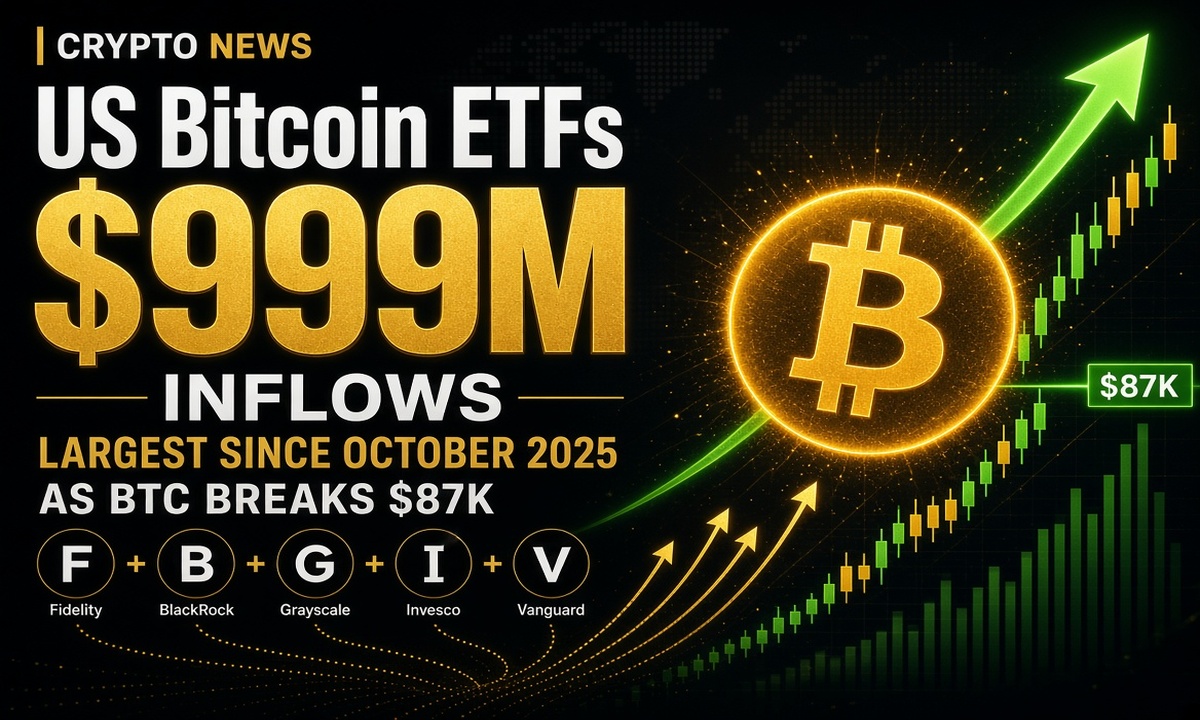
US Bitcoin ETFs (exchange-traded funds) just pulled in nearly a billion dollars in a single session.
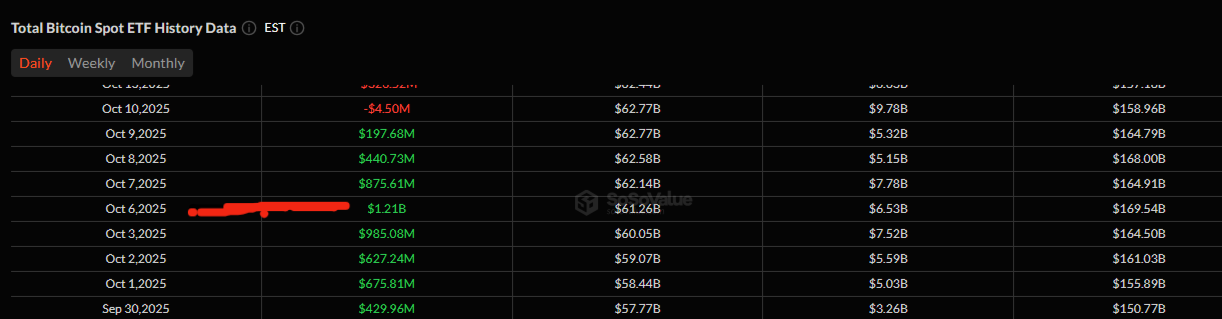
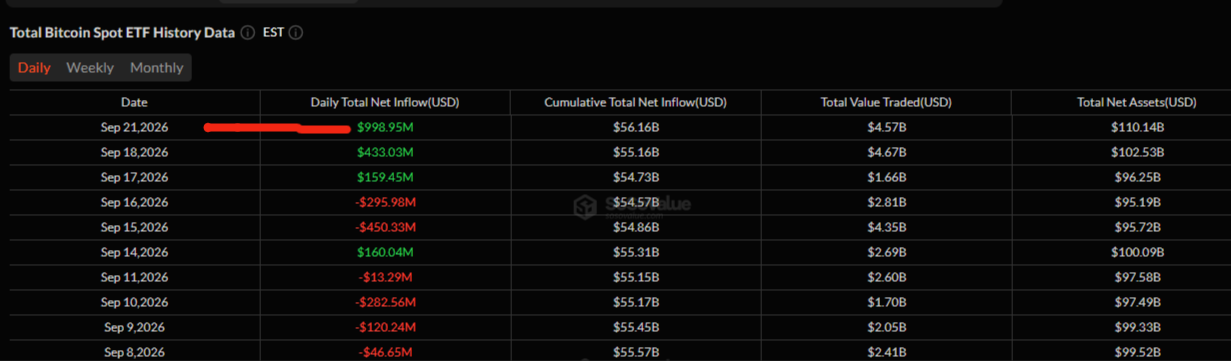
On Monday, September 21, 2026, the group of spot products recorded $999 million in net inflows—the strongest daily haul since October 6, 2025’s $1.2 billion.
At the same time, Bitcoin briefly pushed past $87,300 and marked a multi-month high.
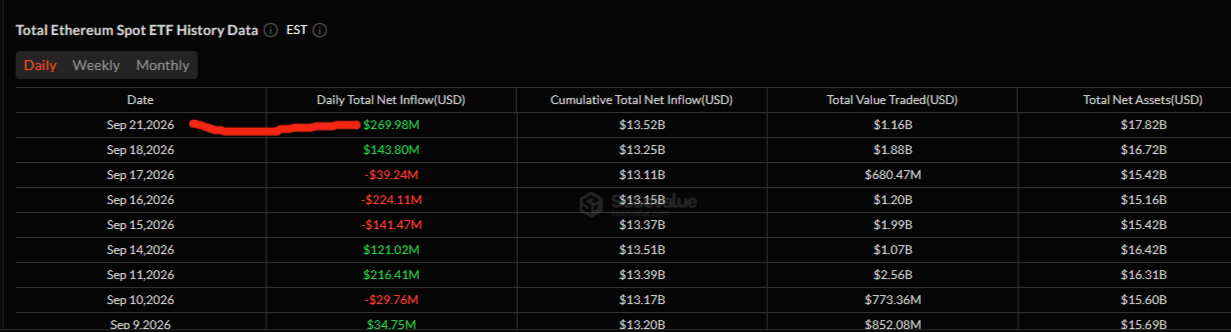
Spot ether ETFs joined the party with $270 million of their own, the biggest one-day total for those funds since early October 2025.
The numbers arrive after several choppy weeks of mixed flows and macro headwinds. Investors appear ready to put fresh capital to work again.
What Exactly Happened With US Bitcoin ETFs on Monday?
Authorised participants created a large volume of new shares across the twelve major funds.
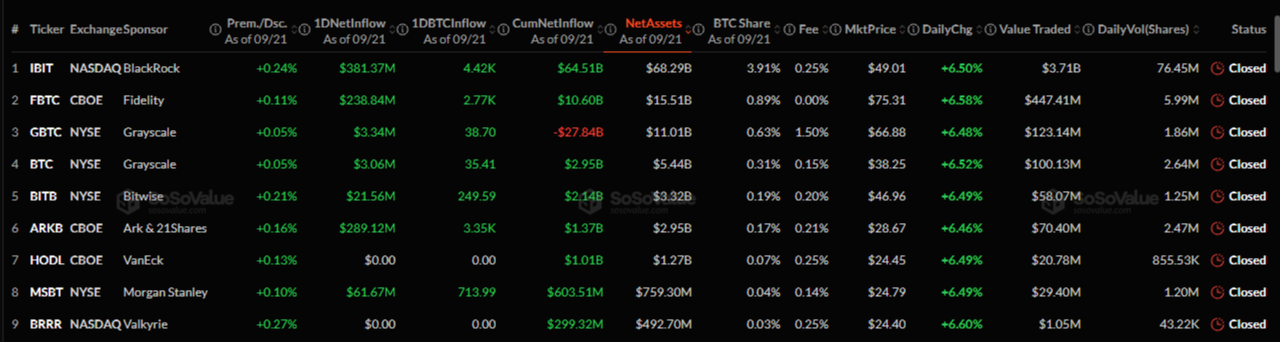
BlackRock’s IBIT led the charge with roughly $381 million. ARK 21Shares’ ARKB followed close behind at about $289 million, while Fidelity’s FBTC added another $239 million.
Smaller products from Bitwise, Morgan Stanley, and others contributed the rest.
Meanwhile, Bitcoin itself ripped higher. The price moved from the low $80,000s into the mid-$87,000 range before settling a bit lower.
Liquidations of short positions accelerated the move, yet the simultaneous ETF buying supplied genuine spot demand rather than pure leverage.
Why Do These Inflows Matter for the Broader Market?
Every dollar that enters a spot Bitcoin ETF forces the issuer to purchase actual BTC on the open market.
Large creation days therefore remove coins from circulating supply and place them into regulated custody.
Over the past two and a half years, the category has accumulated more than $56 billion in cumulative net inflows and now holds well over one million bitcoin.
Assets under management (AUM) sit near $105–110 billion depending on the exact price snapshot.
In particular, the latest session stands out because it reverses recent caution.
Mid-September saw consecutive days of heavy redemptions after a failed Senate vote on market-structure legislation and a Federal Reserve rate hike.
Friday, September 19, 2026’s earlier $433 million inflow already hinted at stabilizing demand.
Monday, September 21’s near-billion-dollar surge confirms that institutions remain willing to buy dips and chase strength.

How Do US Bitcoin ETFs Actually Work Behind the Scenes?
An investor buys shares of IBIT or FBTC on a regular stock exchange. The ETF issuer then works with an authorised participant who delivers either cash or bitcoin to create new shares.
When redemptions occur, the process runs in reverse and the fund sells bitcoin. This creation-redemption mechanism keeps the share price tightly linked to the underlying asset while giving traditional finance (TradFi) desks a familiar wrapper.
Beyond that, the products differ mainly by fee schedule and sponsor. BlackRock charges 0.25%, Fidelity matches that rate, and a few smaller funds undercut them slightly.
Grayscale’s GBTC still carries a higher expense ratio and has posted persistent outflows since conversion, yet the newer lower-fee vehicles continue to attract the bulk of fresh capital.

What Role Did Ether ETFs Play in the Same Session?
Spot ether products also posted their strongest day since October 7, 2025, with $270 million of net creations.
The parallel move suggests capital is rotating into the broader digital-asset complex rather than treating Bitcoin as a one-off safe haven.
Several market observers noted that simultaneous strength in both major ETF categories often signals improving risk appetite across the sector.
At the same time, the absolute dollar amounts still favour Bitcoin by a wide margin.
The larger liquidity pool and longer track record of the Bitcoin products continue to dominate institutional allocation decisions for now.
How Have Cumulative Flows Evolved Since Launch?
Since the January 2024 debut, the US Bitcoin ETF complex has absorbed tens of billions of dollars.
Cumulative net inflows reached a peak near $63 billion in late 2025 before giving back some ground during subsequent drawdowns.
Even after those periods of redemption, the running total still sits above $56 billion.
BlackRock’s IBIT alone accounts for the majority of that figure and has become one of the fastest-growing ETFs in U.S. history by assets.
Looking ahead, many analysts must watch the ratio of ETF holdings to total bitcoin supply.
The funds already control roughly 6% of circulating BTC.
Sustained multi-hundred-million-dollar days push that share higher and further tighten available float on exchanges.

Frequently Asked Questions About US Bitcoin ETFs and the Latest Inflows
Which funds captured most of the $999 million?
BlackRock’s IBIT, ARK 21Shares’ ARKB, and Fidelity’s FBTC together accounted for the clear majority.
Smaller products filled in the remainder.
Does a big inflow day always lift the Bitcoin price?
Practically, this does not happen automatically. Price still responds to leverage liquidations, macro news, and overall sentiment.
Yet, consistent ETF buying removes coins from the market and tends to provide a structural bid over longer periods.
How much bitcoin do the ETFs hold right now?
Across all products, the figure exceeds one million BTC, or roughly 5% of the eventual 21-million coin supply.
Exact numbers shift daily with creations, redemptions, and price.
Are these inflows permanent?
No, investors can redeem shares at any time. The creation-redemption process works both ways, which is why the market still experiences occasional multi-hundred-million-dollar outflow days.
What does the concurrent ether ETF strength tell us?
It points to broader institutional interest in regulated crypto exposure rather than a pure Bitcoin-only trade.

Could regulatory developments still disrupt the flow picture?
Yes, further delays on market-structure bills or unexpected Securities and Exchange Commission (SEC) actions remain possible headwinds.
So far, the products have absorbed those risks without collapsing demand.
The $999 million session ranks among the strongest single days since the funds launched.
It arrives as Bitcoin reclaims levels last seen months ago and as ether products also attract meaningful capital.
Whether the pace continues will depend on macro conditions, regulatory clarity, and the willingness of large allocators to keep adding exposure.
For the moment, the message from the US Bitcoin ETF complex is clear: institutional demand has returned in force.
