

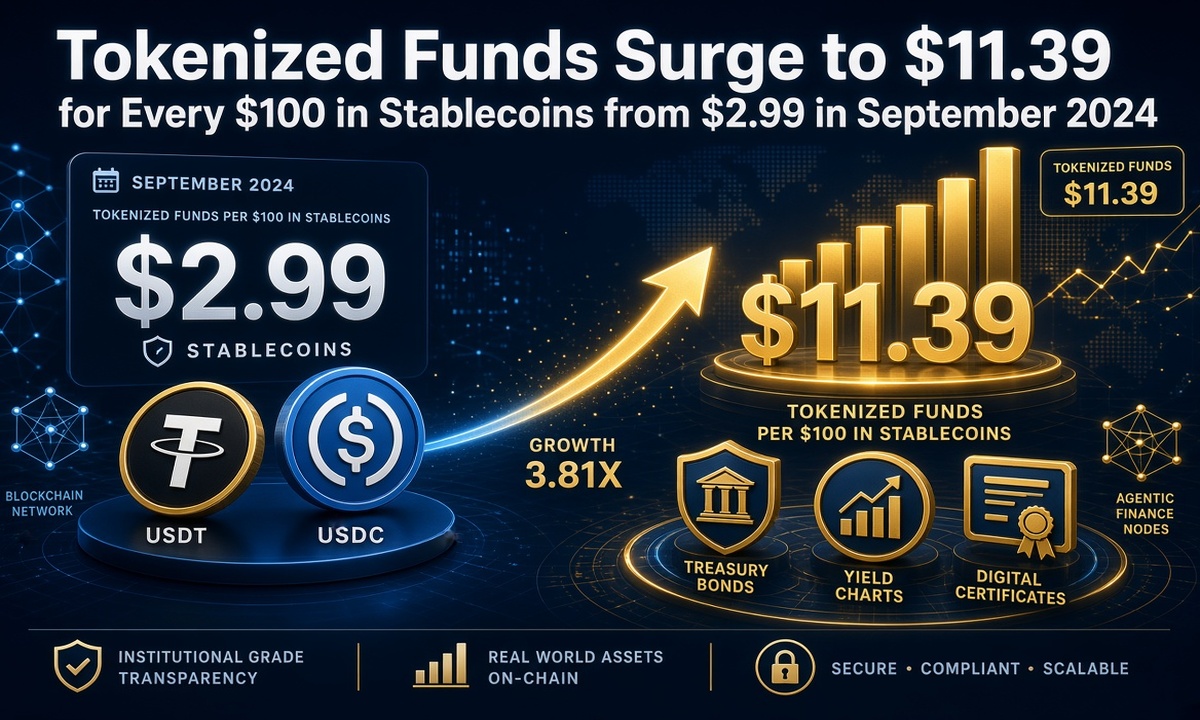
Tokenized Funds now claim a much bigger slice of the on-chain money stack.
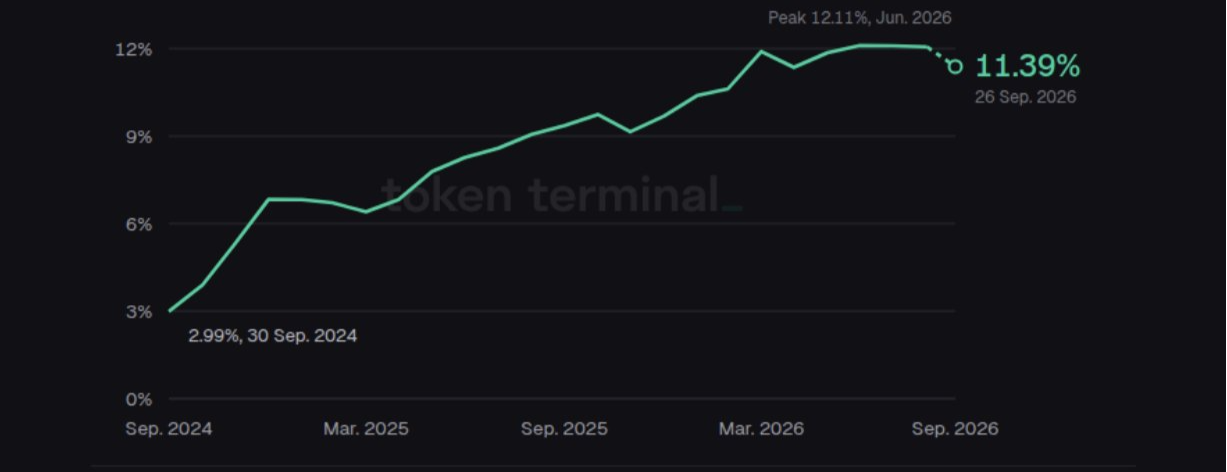
For every $100 sitting in stablecoins, the market holds $11.39 in tokenized funds. Two years ago, that ratio stood at just $2.99.
Token Terminal’s latest reading captures a clear shift toward yield-bearing products that still settle on the same rails.
Agentic systems will likely push the number higher still, since software agents can hold only the cash they need in stablecoins and park everything else in funds.
Why have Tokenized Funds grown so much faster relative to stablecoins?
Investors and protocols increasingly treat pure stablecoins as working capital rather than long-term holdings.
Meanwhile, tokenized funds deliver treasury or money-market yields without leaving the blockchain.
In addition, major issuers such as Circle already pair their stablecoin (USDC) with a matching fund product (USYC), giving users a seamless path from cash to yield.
Beyond that, the absolute size of tokenized funds has climbed into the tens of billions while stablecoin growth has slowed to a more mature pace.

What role will agentic finance play in Tokenized Funds adoption?
Programmable agents can monitor balances in real time. They keep a minimum viable amount in stablecoins for transactions and automatically sweep the surplus into tokenized funds.
At the same time, this behaviour reduces idle cash drag across wallets, treasuries and decentralised finance (DeFi) strategies.
On top of that, the same logic scales easily once agents manage larger portfolios.
Still, the trend depends on reliable on-chain liquidity and clear redemption paths for the underlying funds.

How do Tokenized Funds compare with other real-world assets right now?
Funds form one of the largest non-stablecoin categories inside the broader real world assets (RWA) universe.
For instance, products tied to U.S. treasuries and money-market strategies dominate the segment.
After all, they offer familiar risk profiles that institutions already understand.
Yet, they remain far smaller than the overall stablecoin market, which still exceeds $300 billion.
The rising ratio simply shows that capital is starting to move up the yield curve once it arrives on-chain.

Will the Funds ratio keep climbing?
The current $11.39 level already marks a nearly four-fold increase in two years.
In particular, the combination of better products, clearer regulation and agent-driven allocation creates a strong tailwind.
Even so structural limits exist: many funds carry securities-style restrictions that pure stablecoins avoid.
The next phase will reveal whether issuers can remove enough friction to let the ratio rise further without sacrificing accessibility.
