

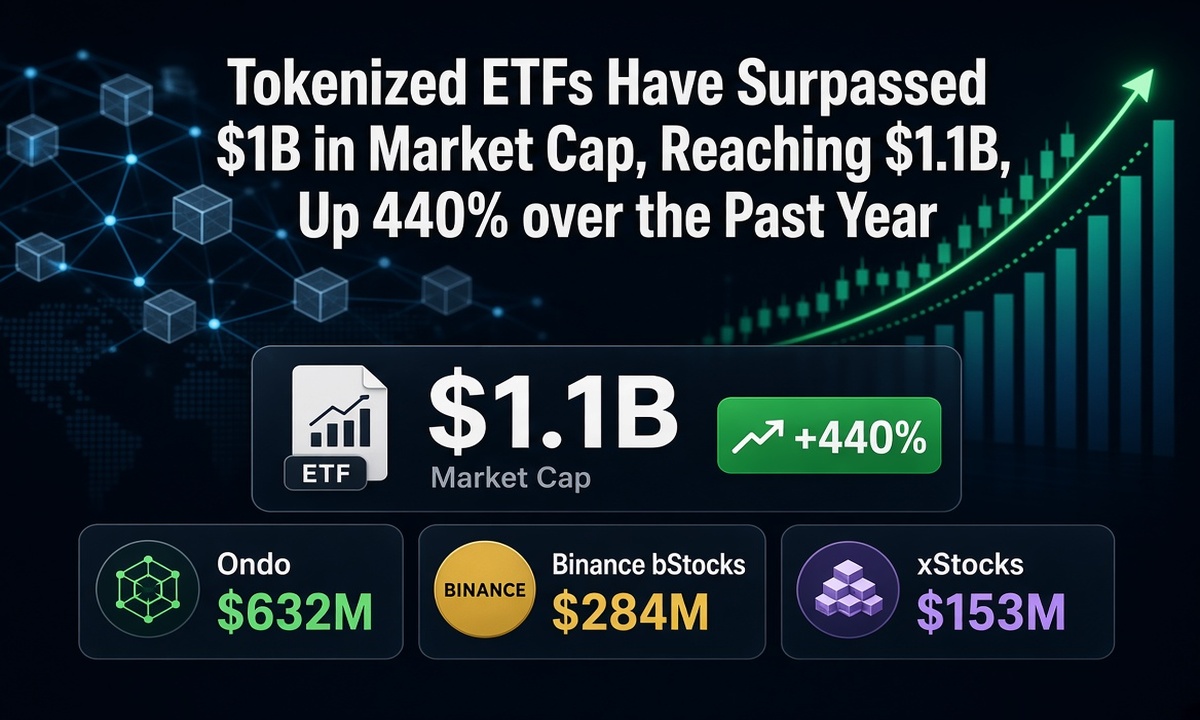
Tokenized ETFs (exchange-traded funds) just crossed a major threshold.
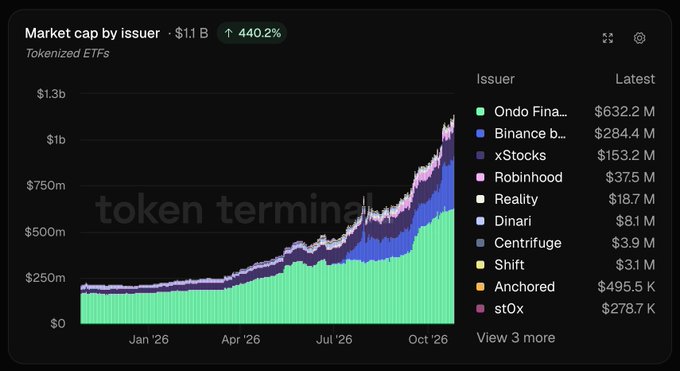
Data from Token Terminal shows their combined market capitalisation hit $1.1 billion, marking a 440% rise over the past year.
Ondo Finance leads with $632 million in issued assets. Binance bStocks follows at $284 million, while xStocks holds $153 million.
This milestone arrives amid broader momentum in onchain equities.
Tokenized stocks and ETFs together recently approached or exceeded $4 billion in total value across multiple chains.
What Exactly Are Tokenized ETFs?
Tokenized ETFs represent shares of traditional exchange-traded funds as blockchain-based tokens.
Holders gain economic exposure to underlying indexes such as the S&P 500 or Nasdaq-100 without needing a traditional brokerage account in every jurisdiction.
These tokens trade 24/7, support fractional ownership, and settle nearly instantly on networks including Ethereum, BNB Chain, and Solana.
In practice, platforms like Ondo Finance create securities-backed tokens that track real ETF holdings.
Investors outside the United States especially benefit from this model, since it opens access that conventional markets often restrict.
Why Have Tokenized ETFs Grown So Quickly?
Demand for always-available, borderless exposure to major equity indexes has driven the surge.
Meanwhile, major distribution channels expanded rapidly.
Binance’s bStocks product attracted hundreds of thousands of holders shortly after launch, even though its market-cap share trails Ondo’s.
In addition, lower barriers and the ability to move assets across chains encouraged both retail and larger positions.
Notably, holder counts for tokenized ETFs grew far faster than those for single-stock tokens earlier in 2026.
This pattern suggests many participants prefer diversified index exposure over individual names.
Furthermore, BNB Chain captured significant volume and address growth, helping push the overall category higher.

Who Currently Dominates the Tokenized ETFs Landscape?
Ondo Finance currently commands the largest share of market capitalisation at roughly $632 million.
Binance bStocks and xStocks occupy the next two spots.
Smaller issuers such as Robinhood, Reality, and others fill out the remainder, creating a concentrated yet expanding field.
Ondo’s lead reflects both first-mover advantages and institutional-sized holdings.
In contrast, Binance’s products show broader retail adoption through sheer number of wallets.
This split between capital concentration and holder distribution highlights two parallel growth paths inside the same category.

How Do These Products Compare with Traditional ETFs?
Traditional ETFs settle through centralised systems during market hours and often face geographic restrictions.
Tokenized versions remove many of those constraints while adding onchain transparency and composability with DeFi (decentralised finance).
However, they introduce new considerations around issuer custody, smart-contract risk, and regulatory status that vary by platform and chain.
Liquidity can differ as well. Some tokenized products enjoy deep secondary markets, while others remain thinner outside peak periods.
Investors therefore weigh convenience and access against these operational differences.

What Should Investors Watch Going Forward?
Continued issuer expansion and cross-chain bridges will likely shape the next phase.
Regulatory clarity in major markets remains a key variable.
At the same time, the rapid 440% climb already demonstrates strong product-market fit for onchain index exposure.
The $1.1 billion figure represents more than a round number.
It signals that tokenized ETFs have moved from experiment to meaningful market segment, led by a handful of platforms that continue to scale both capital and users.
