

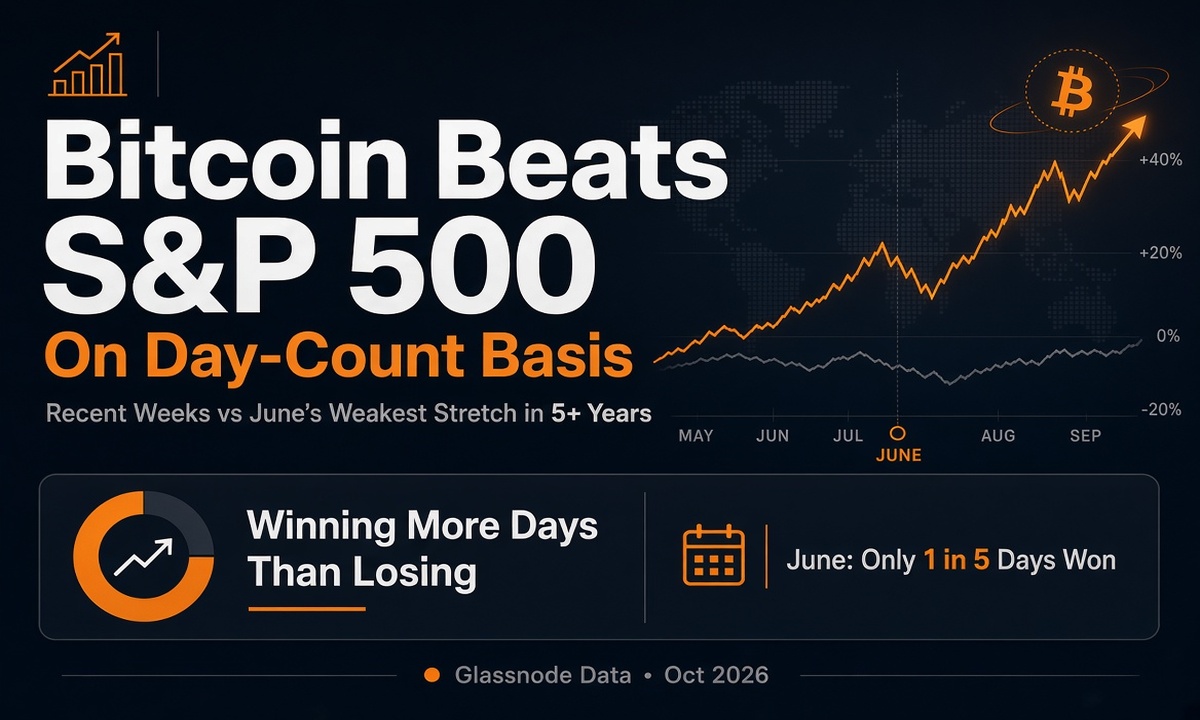
Bitcoin has returned to outperforming the S&P 500 on a simple day-count basis in recent weeks.
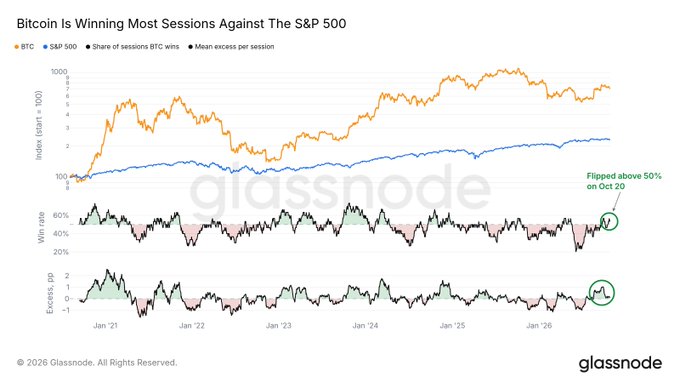
Glassnode data shows the leading cryptocurrency winning more trading days than it lost against the equity index, marking a clear shift from its earlier weakness.
What Does Day-Count Outperformance Mean for Bitcoin?
Day-count outperformance tracks how many sessions Bitcoin closes higher relative to the S&P 500 rather than measuring percentage gains alone.
In recent weeks, Bitcoin has secured more daily wins than losses.
Meanwhile, this metric offers a clean view of relative strength without the noise of absolute price moves.
In addition, it highlights periods when Bitcoin captures investor attention even while both assets trade below recent highs.
How Weak Was Bitcoin’s Performance in June?
June delivered Bitcoin’s weakest stretch against the S&P 500 in more than five years.
The asset won only one day out of every five during that period.
Further, such prolonged underperformance often leaves capital waiting for a clearer signal.
Still, the recent reversal shows Bitcoin reclaiming the upper hand on the daily scoreboard.
Why Can This Kind of Outperformance Become Reflexive?
Outperformance of this type can attract additional capital as investors rotate toward the stronger asset class.
When BTC consistently wins more days, portfolio managers and traders often increase exposure.
Moreover, the shift itself can reinforce momentum as more money follows the trend.
Even so, the process remains gradual and depends on sustained relative strength rather than a single week of data.
Bitcoin and S&P 500: What Should Investors Watch Next?
Market participants must monitor whether Bitcoin continues to post more daily wins than the S&P 500 in the weeks ahead.
A sustained edge on the day-count basis would support the case for ongoing rotation.
Next, price levels relative to recent highs will also matter, since Bitcoin remains well below its peak while the equity index trades closer to its own.
Later data will confirm if the current outperformance develops into a lasting trend.
