

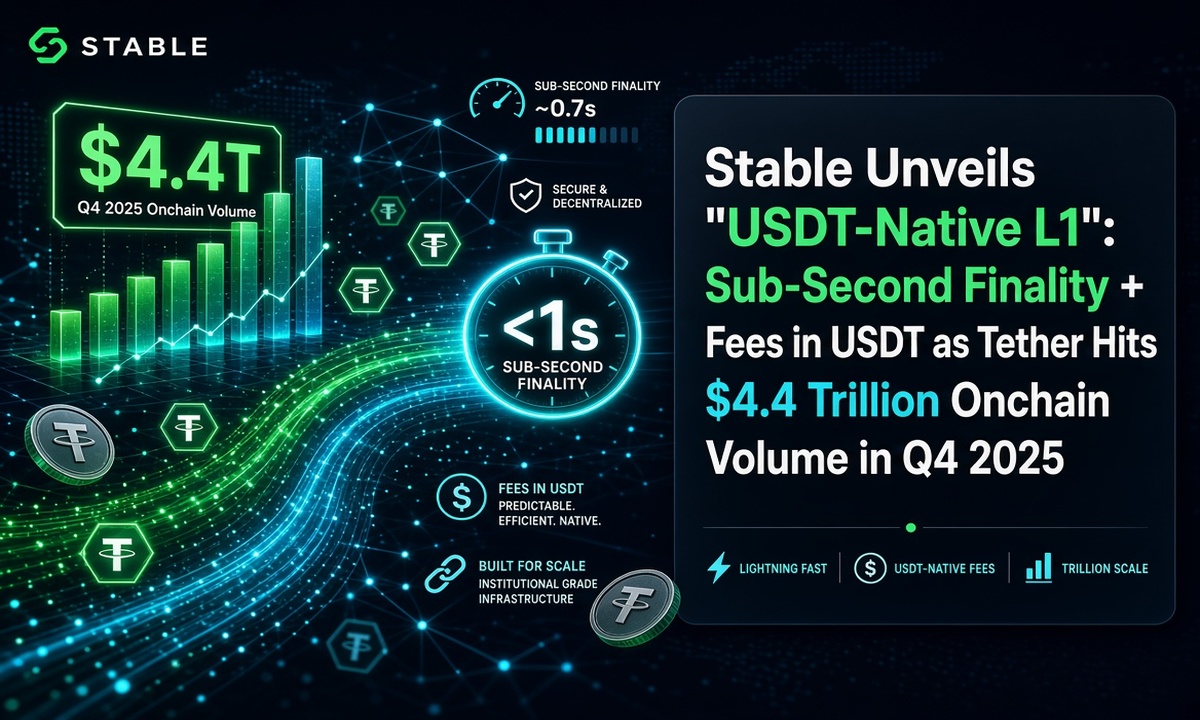
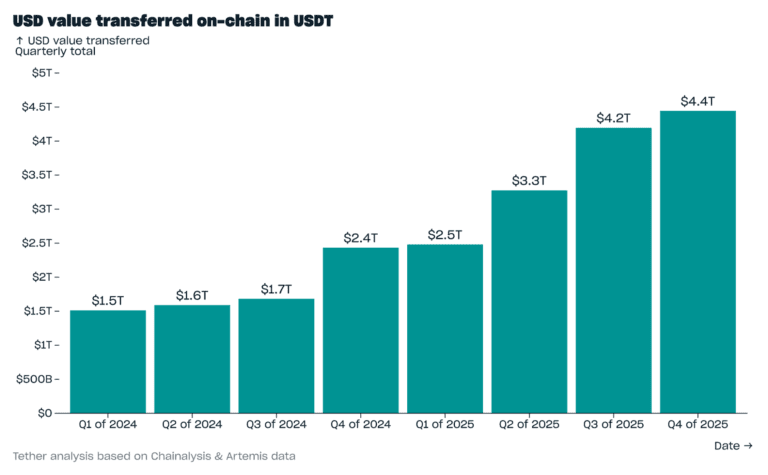
Tether’s USDT processed a record $4.4 trillion in onchain volume during the fourth quarter (Q4) of 2025.
About 88% of those transfers stayed under $1,000, showing that everyday payments now drive a large share of activity.
Meanwhile, most existing blockchains still treat stablecoins as secondary assets rather than core settlement tools.
Stable steps into that gap with StableChain, a purpose-built Layer-1 that places USDT at the centre of its design.
The network delivers sub-second finality, lets users pay fees directly in USDT, and reserves blockspace for payment flows.
Messari’s newly published initiation of coverage examines the architecture, tokenomics and roadmap in detail.
What Makes Stable’s USDT-Native L1 Different from Other Blockchains?
StableChain runs StableBFT consensus, StableEVM execution and a custom storage layer optimised for predictable settlement.
In addition, the network treats USDT0 as its native gas token, eliminating the need for a separate volatile asset.
Developers can deploy existing EVM contracts with familiar tooling while users avoid swapping into a gas token before every transfer.
Beyond the technical stack, Mainnet version 1.8.0 expands capacity and carves out reserved blockspace specifically for payment applications.
Apps covering payments, yield and account management already sit on top of the chain.
Also, the native $STABLE token handles staking and governance, while delegators receive a share of USDT fees.
Why Does Sub-Second Finality Matter for USDT Payments?
Payment rails demand deterministic settlement measured in fractions of a second rather than minutes.
StableChain targets sub-second finality so merchants and consumers can treat onchain transfers like traditional card authorisations.
At the same time, the design reduces the risk of chain reorganisations that can disrupt settlement certainty on general-purpose networks.
Next, the combination of speed and dollar-denominated fees removes two major friction points that have limited stablecoin adoption outside pure trading.
In the meantime, institutional and retail flows can share the same infrastructure without competing for unpredictable gas markets.

How Do Fees Paid in Tether Improve the User Experience?
When fees settle in USDT, users hold only one asset for both transfers and network costs.
Still, the fee market follows an EIP-1559-style mechanism, so base fees adjust with demand while remaining expressed in a stable unit.
Moreover, the absence of a volatile gas token simplifies accounting for businesses and reduces failed transactions caused by insufficient native-token balances.
Furthermore, Stable’s dual-token model keeps $STABLE focused on security and governance while USDT handles everyday economic activity.
Also, fee sharing for $STABLE delegators aligns long-term network participants with the growth of payment volume.
Is the $4.4 Trillion Q4 2025 USDT Volume a Turning Point for Stablecoin Rails?
The sheer scale of USDT transfers in late 2025 demonstrates that stablecoins already function as payment infrastructure for millions of users.
Yet, most of that volume still travels across chains never designed for consistent, low-cost settlement.
Currently, Stable positions its L1 as infrastructure that matches the actual behaviour of USDT holders rather than forcing those holders to adapt to general-purpose constraints.
In short, the project pairs record USDT activity with a blockchain built from the ground up for that activity.
Sub-second finality, USDT-denominated fees and reserved payment capacity give developers and institutions a clearer path toward production-grade stablecoin rails.
