
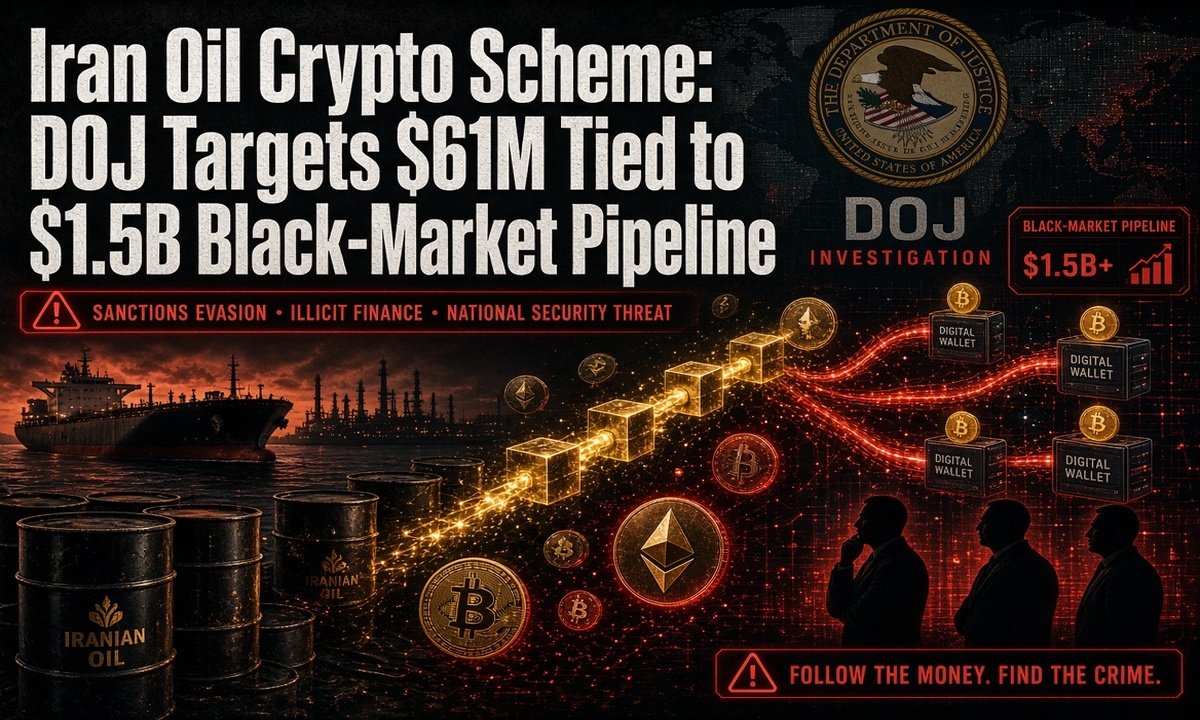
U.S. prosecutors in the Southern District of New York filed a civil forfeiture complaint targeting roughly $61 million in cryptocurrency in what has largely been related to an Iran oil crypto scheme.
The funds, they allege, represent proceeds from black-market sales of sanctioned Iranian crude oil and petroleum products.
Chainalysis later confirmed it had tracked the same on-chain network for months, mapping how Iranian state oil money moved through a web of wallets and intermediaries.
The complaint paints a picture of a sophisticated pipeline designed to convert oil revenue into usable crypto while skirting international sanctions.
The action lands as part of broader efforts to disrupt financing for the Iranian government and the Islamic Revolutionary Guard Corps (IRGC).
Investigators describe a multi-layered system that moved more than $1.5 billion in illicit proceeds before the latest seizure.
How did Iranian oil money enter the crypto system?
Chinese buyers of sanctioned Iranian crude needed a quiet way to pay. Two Hong Kong-linked companies stepped into that gap.
Blessed Trust presented itself as a wealth-management and virtual-asset custodial firm. Hexa Whale held itself out as a commodities broker.
In practice, both firms supplied fiat-to-crypto on-ramp services, sometimes routing value through U.S.-based issuers.
They used trading accounts at Binance to convert payments into digital assets. Once on-chain, the funds entered a cluster of interrelated unhosted addresses that prosecutors labelled “Entity A.”
Those wallets then distributed the value onward. The structure allowed oil buyers in China to settle invoices without touching conventional banking channels that would have triggered sanctions screens.

What role did the $1.5 billion network play?
Entity A addresses received and moved more than $1.5 billion linked to Iranian oil sales.
The cluster funnelled value toward IRGC-related money-services businesses, IRGC-linked crypto wallets, and at least one Iranian cryptocurrency exchange.
Blessed Trust and Hexa Whale facilitated large portions of the flow. Their transactions often appeared designed to obscure the original source and the ultimate beneficiaries.
Chainalysis researchers had already identified the same rails in earlier work, noting how state oil proceeds travelled through successive layers of unhosted addresses before reaching final destinations inside Iran’s financial orbit.
Why target only $61 million when the network moved $1.5 billion?
Prosecutors focused on assets they could freeze and seize under U.S. jurisdiction.
The $61 million sits in specific cryptocurrency holdings—primarily USDT across a set of TRON addresses—that investigators traced directly to the scheme and that Tether had already frozen.
The larger $1.5 billion figure reflects the total volume that passed through the Entity A network over time.
Recovering every dollar remains difficult once value leaves regulated platforms and enters unhosted wallets or foreign exchanges.
The current action therefore concentrates on the portion still within reach while signalling continued pressure on the remaining infrastructure.
How does this scheme connect to the IRGC and Iranian state financing?
Oil revenue has long served as a primary funding source for Iran’s military and related activities.
The complaint states that the laundered proceeds were intended to support the Government of Iran and its military components, including the IRGC, which the United States designates as a terrorist organisation.
By converting oil sales into crypto, the network created a pathway that avoided traditional financial chokepoints.
Funds reached IRGC-linked entities and an Iranian exchange, closing the loop between sanctioned energy exports and domestic spending power.
U.S. officials describe the pattern as part of a sustained effort to sustain military and other programs under sanctions pressure.
Iran Oil Crypto: What happens next for the seized digital currencies and the wider network?
Tether has already frozen the targeted addresses. A seizure warrant allows the FBI to take custody, after which the tokens are expected to be burned and replaced with equivalent value under court supervision. The civil forfeiture process will determine final ownership.
Meanwhile, the broader Entity A infrastructure remains under scrutiny. Chainalysis and other analytics firms continue mapping related addresses.
Binance has stated that it previously removed the two Chinese firms after detecting suspicious activity.
Further enforcement actions against additional wallets, intermediaries, or counterparties remain possible as investigators expand the trace.
The $61 million action exposes a concrete slice of a much larger Iran Oil Crypto pipeline.
By combining traditional financial intelligence with detailed blockchain tracing, U.S. authorities have turned visibility into enforcement.
The case shows how sanctioned oil revenue still finds routes into digital assets—and how those routes can be interrupted once the on-chain trail becomes clear.
