
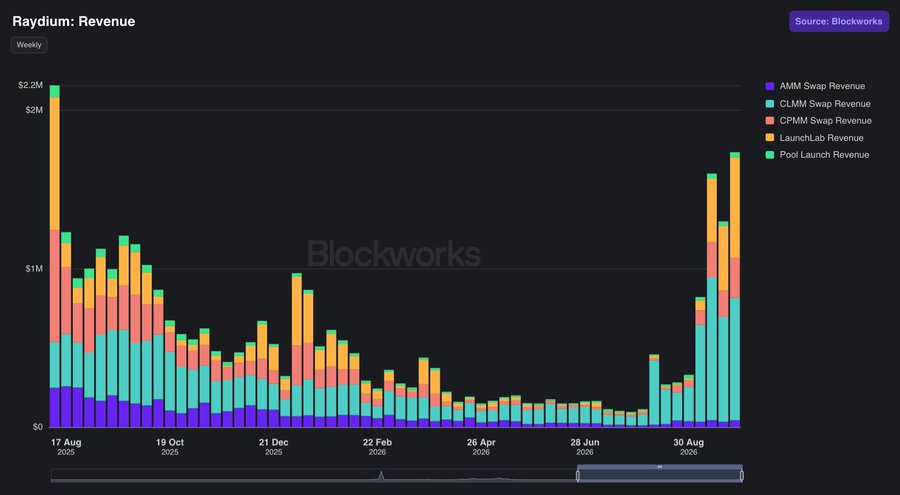
Raydium just delivered its strongest weekly revenue since last summer. Data from Blockworks, shared via Messari, shows the Solana decentralised exchange (DEX) climbing back to levels last seen in August 2025.
The recent bars on the weekly chart stand out clearly after months of quieter activity. Swap fees from concentrated liquidity pools and LaunchLab activity supplied most of the lift.
This rebound arrives after a long stretch of softer volumes across Solana DEXes.
Raydium’s product mix has shifted in helpful ways. Concentrated liquidity market maker (CLMM) pools now contribute a larger share of swap revenue, while LaunchLab has regained momentum through lower-cost integrations.
What Drove Raydium’s Latest Revenue Spike?
Several factors lined up at once. LaunchLab volume rose sharply after StonkFun cut token deployment costs dramatically and began routing launches through Raydium.
At the same time, tokenized equity trading (xStocks and similar assets) continued to flow through Raydium pools, adding steady fee income.
CLMM pools, which offer tighter spreads for active traders, captured a growing portion of overall swap activity.
These streams together pushed weekly revenue to multi-month highs.
Meanwhile, the protocol’s fee structure continues to feed value back to the ecosystem. A set percentage of trading fees funds open-market RAY buybacks, while another portion supports liquidity providers (LPs) and the treasury.
How Does the Current Revenue Compare With Earlier Peaks?
The latest weekly figure sits near the tallest bars recorded in August 2025, when memecoin activity and LaunchLab launches were running especially hot.
After that peak, revenue cooled through much of 2026 as overall Solana trading volumes normalised.
The recent upturn therefore marks a genuine recovery rather than a one-off spike.
Holders revenue over the trailing 30 days has also climbed into the multi-million-dollar range, reflecting the same underlying activity.
In addition, the composition looks healthier than some prior peaks. CLMM now carries more weight relative to older constant-product pools, and LaunchLab no longer depends on a single dominant memecoin platform.
Why Does Raydium Revenue Matter for the Broader Solana Ecosystem?
Raydium remains one of the primary liquidity hubs on Solana.
When its fee generation rises, it signals stronger on-chain trading demand and healthier secondary markets for newly launched tokens.
Higher revenue also increases the pace of RAY buybacks, which can tighten circulating supply.
Tokenized real-world assets (RWA) and lower-cost launch platforms further expand the user base beyond pure memecoin speculation.
These trends help diversify Solana’s application revenue away from pure cyclical hype.
Still, concentration risk remains. A large share of recent LaunchLab volume has come from specific partners, so any change in those relationships could affect near-term numbers.
What Next for Raydium?
As a stakeholder, you must watch the weekly revenue breakdown for sustained CLMM and LaunchLab contributions.
Track daily or weekly RAY buyback volumes, since they scale directly with fees.
Monitor tokenized-asset volume share, as that vertical has shown resilience even when memecoin activity softens.
Finally, keep an eye on overall Solana DEX market share; Raydium’s ability to retain or expand its portion will determine how much of any broader recovery it captures.
Raydium’s return to summer-2025 revenue levels shows the protocol can still generate meaningful fees when product features and external integrations align.
The current mix of concentrated liquidity, launchpad activity, and tokenized assets offers a more balanced foundation than earlier cycles.
Whether the uptrend continues will depend on sustained trading demand and the protocol’s ability to keep attracting both new launches and serious liquidity.
