

SharpLink Gaming just locked in another large batch of Ethereum (ETH). On-chain trackers spotted the company staking 42,074 ETH valued at roughly $112.8 million in a single move.
The fresh deposit pushes SharpLink’s total ETH position to 892,127 tokens, now worth about $2.4 billion at recent prices near $2,680–$2,690.
Cumulative staking rewards have climbed to 27,945 ETH, equal to roughly $75 million.
This latest stake continues a clear pattern. SharpLink treats ETH as a productive treasury asset rather than a static holding.
Nearly all of its ether sits in staking arrangements, including native deposits and liquid-staking tokens such as those from Lido.
The company has built one of the largest corporate ETH positions in the market while generating steady yield for shareholders.
Why Is SharpLink Adding More ETH to Staking Right Now?
SharpLink views staking as the core of its strategy. Management has repeatedly emphasised that ETH generates ongoing rewards while remaining under institutional-grade custody and risk controls.
By deploying additional capital into protocols such as Lido, the firm keeps earning yield without fully sacrificing liquidity.
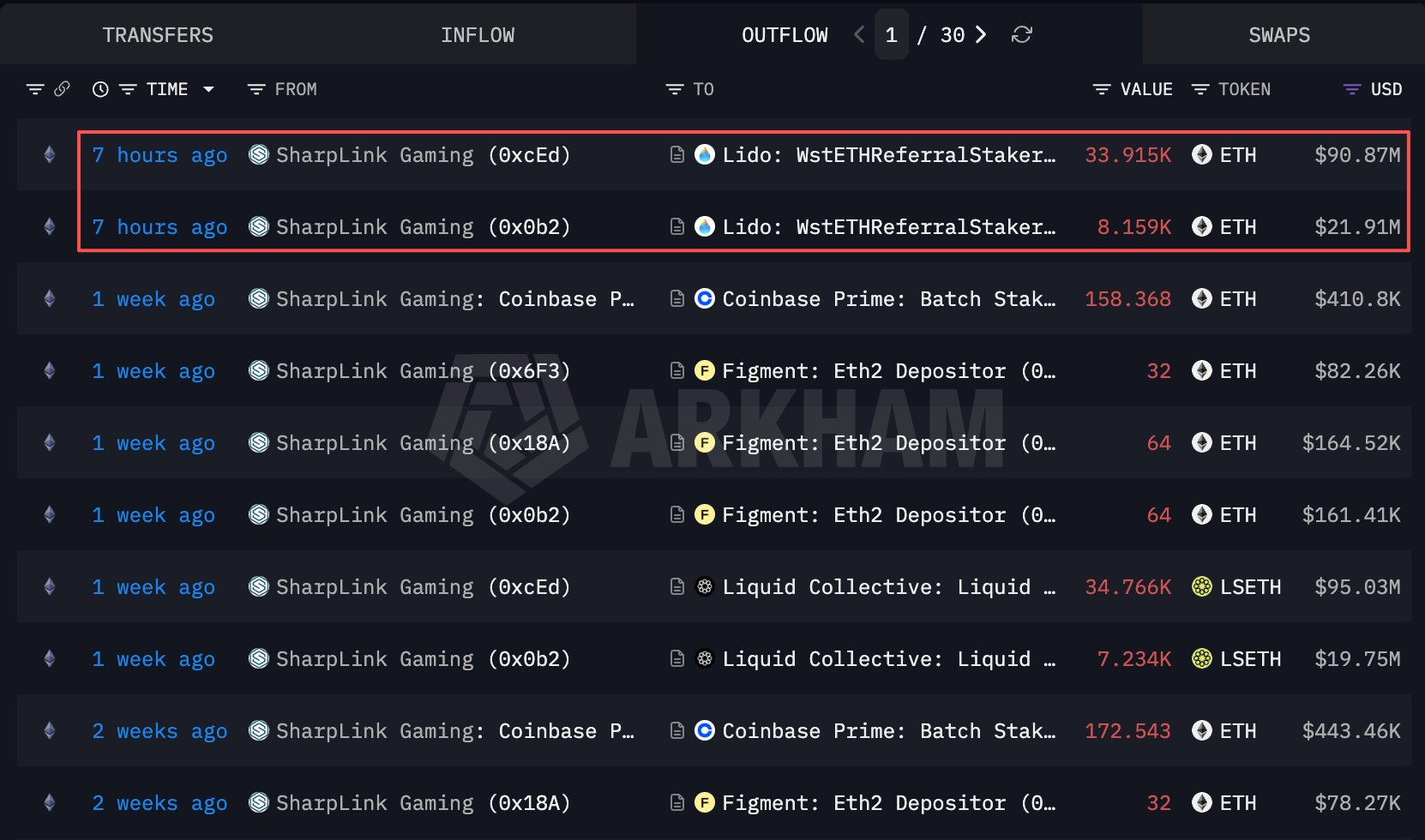
Recent transfers visible on Arkham show tens of thousands of ETH moving into Lido’s staking contracts within hours of one another.
That activity aligns with earlier commitments, including a planned $200 million deployment through the same protocol.
In the meantime, the rewards keep compounding. The $75 million already earned represents pure yield generated since the treasury strategy launched in mid-2025.
Those rewards accrue to the company’s balance sheet and ultimately benefit shareholders through higher ETH concentration per share.
How Does SharpLink’s ETH Position Compare With Other Corporate Holders?
SharpLink ranks among the top public-company holders of ETH worldwide.
Its nearly 900,000-token stack sits well ahead of most corporate treasuries and trails only a small handful of specialised entities.
The firm’s approach differs from pure accumulation strategies because it prioritises productivity.
Almost 100% of the holdings remain staked, producing daily rewards that have averaged hundreds of ETH in stronger weeks.
Institutional ownership of the stock has also risen over time, reflecting investor interest in a transparent, yield-focused ETH vehicle.
Further, the company mixes native staking with liquid-staking tokens. This blend lets SharpLink capture base-layer rewards while retaining flexibility to deploy capital into additional on-chain opportunities when conditions favour it.

What Risks Come With Large-Scale ETH Staking?
Staking still carries smart-contract, validator, and regulatory considerations.
Liquid-staking protocols introduce additional layers of code risk, and any prolonged network issues could temporarily affect reward rates or liquidity.
SharpLink mitigates some of these factors through diversified providers and institutional custody partners.
Even so, the size of the position means ETH price swings directly affect reported net asset value and earnings volatility.
Shareholders accept that trade-off in exchange for exposure to both price appreciation and ongoing yield.
At the same time, the strategy has delivered measurable results.
Staking revenue has become a meaningful line item, helping offset other costs even when ETH’s market price fluctuates.

What Should Investors Watch Going Forward?
Track SharpLink’s weekly dashboard updates for changes in total ETH, rewards accrued, and ETH-per-share concentration.
Any acceleration or slowdown in staking deployments will signal shifts in capital allocation.
Broader Ethereum network metrics, such as overall staking participation and reward rates, also matter because they influence the yield the treasury can generate.
Finally, monitor the stock’s reaction to major staking announcements, since the market increasingly prices SharpLink as a leveraged ether yield vehicle.
SharpLink’s latest $112.8 million stake reinforces its commitment to making ether work harder.
The combination of a $2.4 billion treasury and $75 million in already-realised rewards shows how a focused corporate strategy can turn a digital asset into a productive balance-sheet resource.
Whether this approach continues to attract institutional capital will depend on consistent execution and Ethereum’s ongoing ability to deliver reliable staking yields.
