

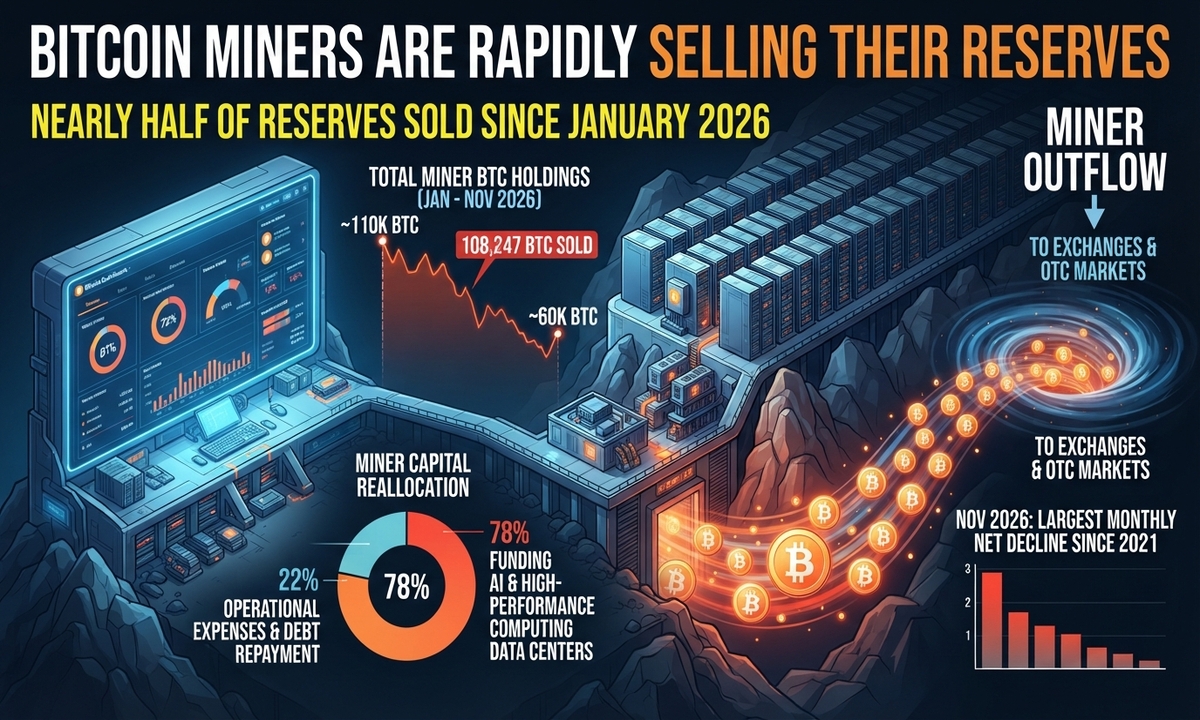
Bitcoin miners have changed course in a decisive way.
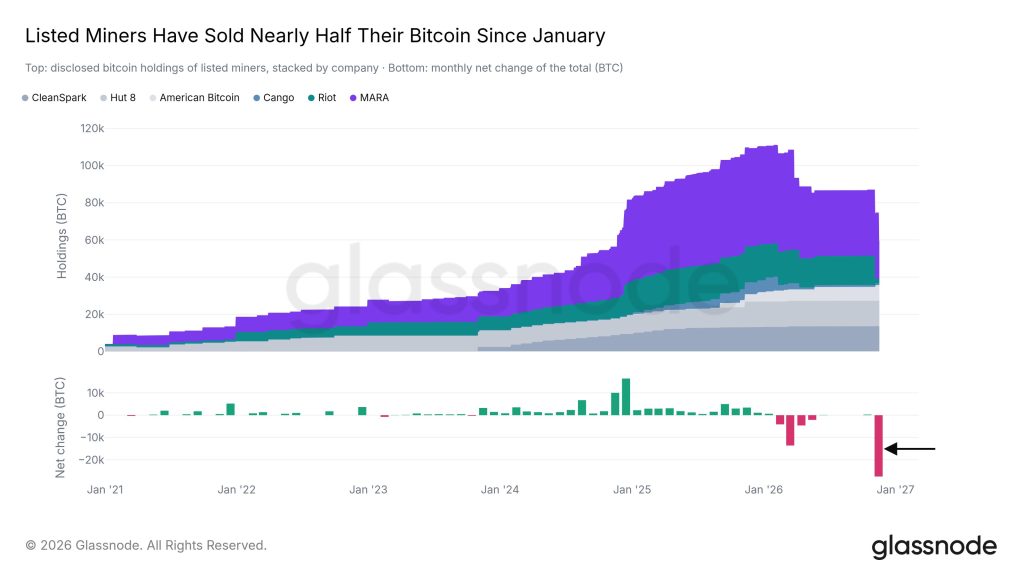
Glassnode data shows publicly listed operators sold nearly half their Bitcoin holdings since January 2026.
For years, these companies kept most of what they mined and sometimes added more. That accumulation strategy has ended.
The coins now finance a different business. Miners are converting treasury Bitcoin into cash for artificial intelligence (AI) data-centre buildouts and related high-performance computing capacity.
The shift marks one of the clearest strategic pivots in the public mining sector this cycle.

Why Are Bitcoin Miners Selling Their Reserves So Quickly?
Mining economics tightened while demand for power and data-centre space soared.
Many operators already control large sites with contracted electricity.
Those assets look more valuable when leased or converted for AI workloads than when used solely for Bitcoin hashing.
Selling BTC provides the capital needed for rapid expansion without heavy new debt in every case.
Meanwhile, the companies keep mining as a core activity even as they reallocate balance-sheet Bitcoin.

How Much Have Bitcoin Miners Actually Sold?
Tracked listed miners, including MARA, Riot, CleanSpark, Hut 8 and others, reduced combined holdings from roughly 110,000 BTC earlier in the year.
November alone produced the largest monthly net decline on the Glassnode chart.
MARA sold more than 13,500 BTC after September at an average near $81,000, raising about $1.1 billion.
Riot disposed of over 20,000 BTC through the first nine months, generating roughly $1.5 billion and leaving the company with only a few thousand coins.
Other operators contributed smaller but steady outflows.
What Are Bitcoin Miners Funding With the Proceeds?
Cash from the sales covers debt repayment, especially Bitcoin-backed loans, and funds physical AI infrastructure.
Riot signed a long-term 910-megawatt lease at its Corsicana campus, widely linked to AI demand.
MARA has directed hundreds of millions toward loan paydowns while building liquidity for high-performance computing projects.
The pattern repeats across the group: Bitcoin treasury becomes growth capital for data-centre capacity that can serve both mining and AI customers.

Does This Selling Create Extra Pressure on Bitcoin’s Price?
Large, visible sales from known treasuries add supply that the market must absorb.
Glassnode noted that the two biggest sellers drove much of the recent treasury-company outflow while other corporate holders remained net buyers.
The scale is material yet still a fraction of overall daily volume.
Price impact depends on whether the selling continues at the same pace and whether new demand from elsewhere offsets it.

What Does the Pivot Mean for the Broader Mining Industry?
Public miners are evolving into hybrid power-and-compute businesses.
Sites once dedicated mainly to application-specified integrated circuits (ASICs) now carry dual-use potential.
Hashrate may still grow, yet the incentive to hold large Bitcoin inventories has weakened.
Operators that execute the transition well can diversify revenue; those that lag risk higher costs and thinner margins if Bitcoin prices stay soft.
The next few quarters will show whether AI leasing delivers the returns that currently justify the treasury reductions.
Bitcoin miners have moved from long-term holders to active sellers in order to chase the AI infrastructure opportunity.
Glassnode’s numbers and company filings make the scale of the change unmistakable. The industry is rewriting its capital-allocation playbook in real time.
