

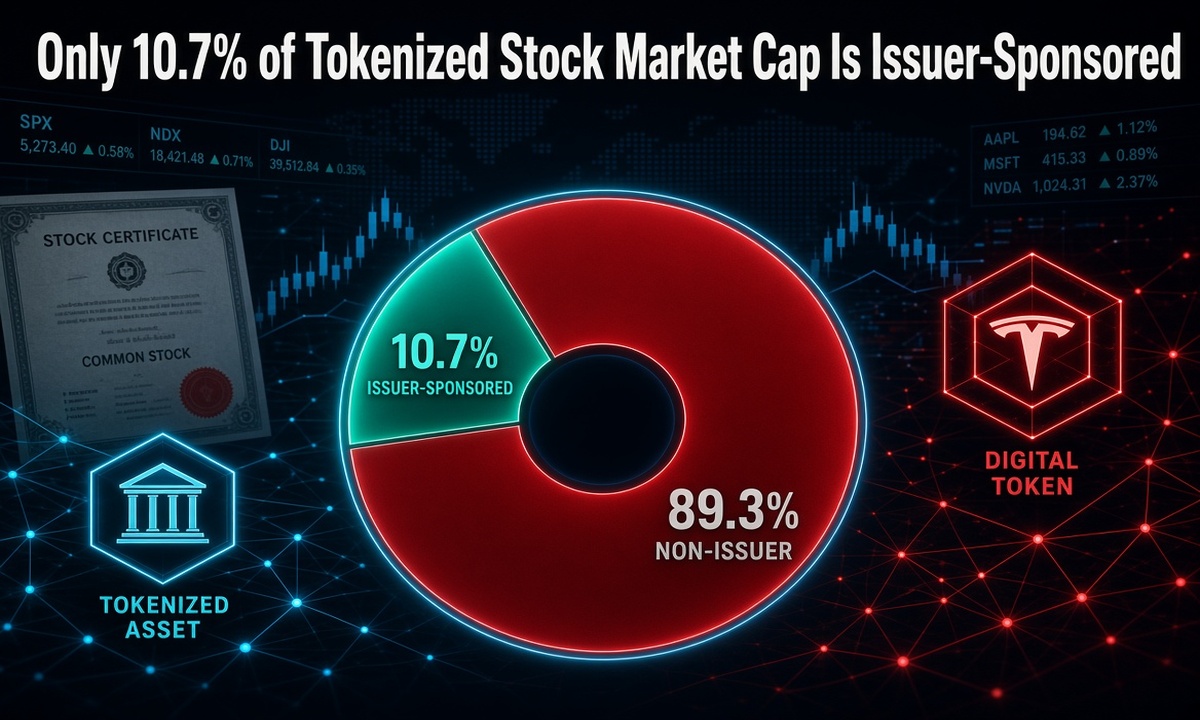
Tokenized stock market cap remains heavily skewed toward synthetic products.
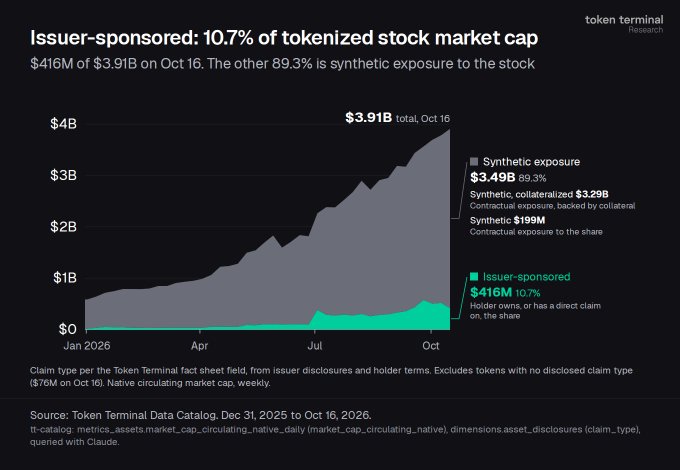
Token Terminal data reveals that just 10.7% of the total carries true issuer sponsorship, meaning the holder either owns the underlying share or holds a direct legal claim on it.
The remaining 89.3% offers only synthetic exposure.
What Does Issuer-Sponsored Mean for Tokenized Stock Market Cap?
Issuer-sponsored tokens give the holder actual ownership rights or a clear contractual claim against the real shares.
In contrast, synthetic versions simply track price without transferring legal title.
That distinction now defines the structure of the entire tokenized stock market cap.
How Large Is the Synthetic Share of Tokenized Stock Market Cap?
Synthetic exposure accounts for 89.3% of the current total. These products deliver price movement without the legal protections of direct ownership.
Traders gain easy access and deep liquidity, yet they hold no claim on dividends, voting rights, or the underlying equity itself.
The imbalance shows how quickly synthetic instruments scaled compared with fully backed alternatives.

Where Does Most Issuer-Sponsored Tokenized Stock Market Cap Come From?
Companies themselves drive the majority of the 10.7% issuer-sponsored slice. Many place their own shares onchain through platforms such as Securitize and Superstate.
These direct issuances create the purest form of tokenized ownership currently available and form the core of the genuine claim segment.
Why Does the 10.7% Figure Matter for Investors?
Legal ownership and synthetic tracking behave differently under stress. Issuer-sponsored tokens carry clearer recovery paths if a platform fails.
Synthetic products depend entirely on the issuer’s ability to maintain the peg and honour redemptions.
The small share of true ownership inside today’s tokenised stock market cap therefore signals both opportunity and residual risk for anyone treating these tokens as equity substitutes.

What Could Shift the Balance?
Wider regulatory clarity and more corporate onchain issuances would expand the issuer-sponsored portion.
Until that happens, synthetic products will likely continue to dominate volume and total market cap.
Market participants already watch the 10.7% figure as a key progress marker for the maturation of tokenized equities.
The current split makes one point plain: most of the tokenised stock market cap still delivers price exposure rather than ownership.
Only a thin layer offers the direct claim that traditional equity investors expect.
