

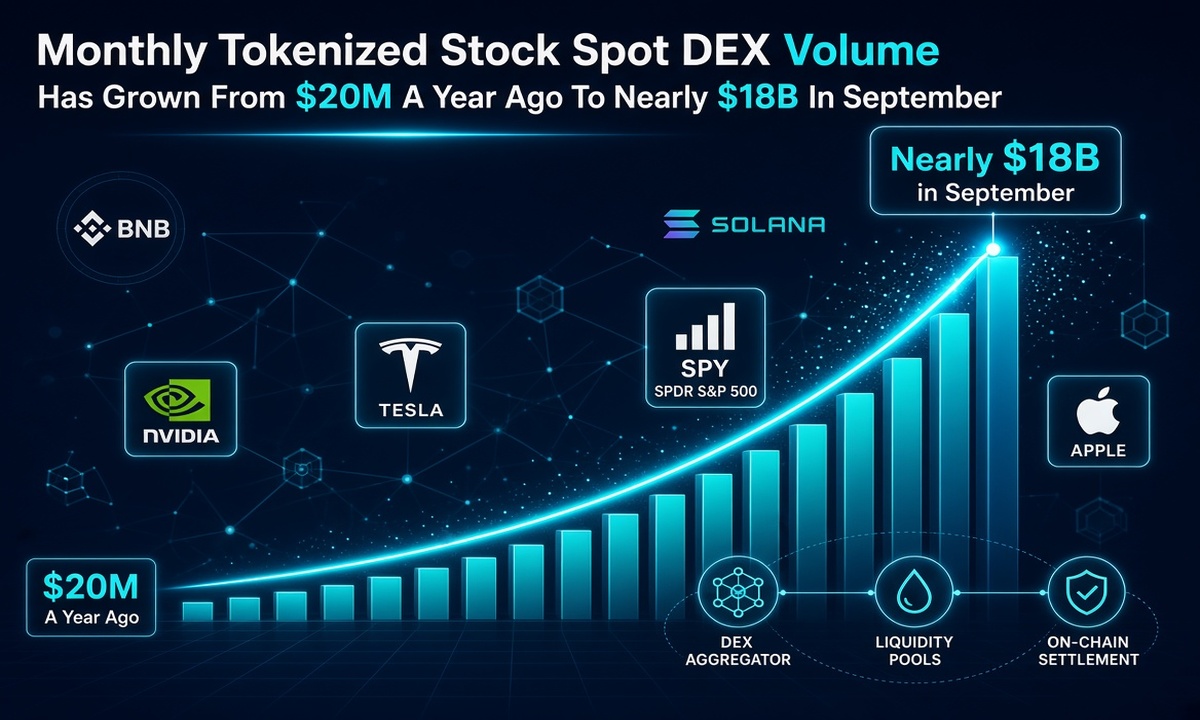
Tokenized stock trading on spot decentralised exchange (DEXs) has exploded in September 2026.
Token Terminal data shows monthly volume climbing from roughly $20 million twelve months ago to nearly $18 billion already in September 2026.
That jump marks one of the sharpest expansions in on-chain equity markets so far.
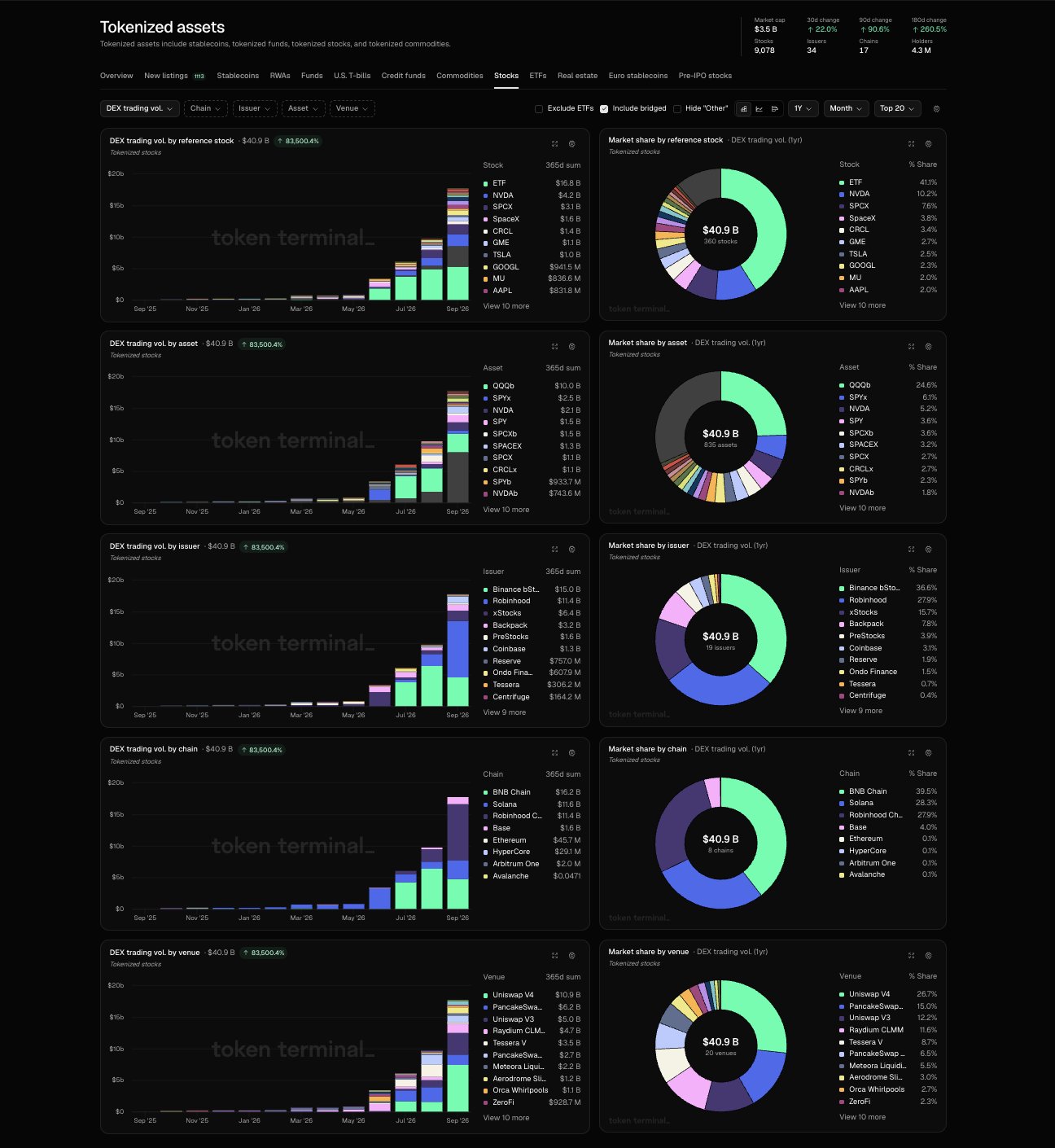
Looking closer at the numbers, the 365-day cumulative DEX volume for tokenized stocks now sits near $40.9 billion.
Exchange-traded funds (ETFs) lead the pack, followed by names like NVDA, SPCX, and others that have drawn heavy flow.
What Are Tokenized Stocks and Why Do They Trade on DEXs?
Tokenized stocks are blockchain-based representations of traditional equities or ETFs.
Issuers create these tokens so users can hold or trade exposure to companies such as Tesla, Nvidia, or broad indices without a traditional brokerage account.
On DEXs, the tokens swap freely 24/7, settle almost instantly, and often support fractional ownership.
In practice this removes market-hour limits and opens access to a global set of wallets.
How Did Monthly Volume Scale From $20 Million to Nearly $18 Billion?
In September 2025, there was not a lot of activity, then issuers expanded listings, chains improved throughput, and more wallets added direct support.
Meanwhile, platforms such as Binance bStocks, xStocks, Robinhood Chain products, and Backpack ramped secondary markets.
Next came stronger liquidity on Uniswap, PancakeSwap, Raydium, and Aerodrome.
Beyond that, traders began using the tokens for after-hours moves and cross-chain strategies.
By early September, the monthly total had already approached the $18 billion mark.
At this stage, BNB Chain carries the largest share of volume, with Solana and other networks following closely.
Issuers that offer simple 1:1 conversion and self-custody have pulled in the bulk of the flow.
Which Chains and Venues Drive Most of the Tokenized Stock Activity?
BNB Chain currently leads by a wide margin, followed by Solana and Base.
Looking at venues, Uniswap v4, PancakeSwap, and Raydium process the majority of swaps.
In the same breath, several specialised issuers concentrate liquidity around popular tickers such as QQQ, SPY, and individual tech names.
This concentration helps tighten spreads even as overall volume expands rapidly.
Tokenized Stock: What Does This Growth Signal for On-Chain Finance?
The scale-up shows traditional equity exposure is finding real secondary-market demand on public blockchains.
Traders gain continuous access, while issuers capture fees and data that traditional exchanges rarely share.
Still, market-cap figures remain modest relative to volume, which means much of the activity reflects active trading rather than long-term holding.
For anyone tracking real-world assets (RWA), the leap from $20 million to nearly $18 billion in monthly tokenized stock DEX volume stands out as clear evidence that on-chain equities have moved well past the experimental stage.
