

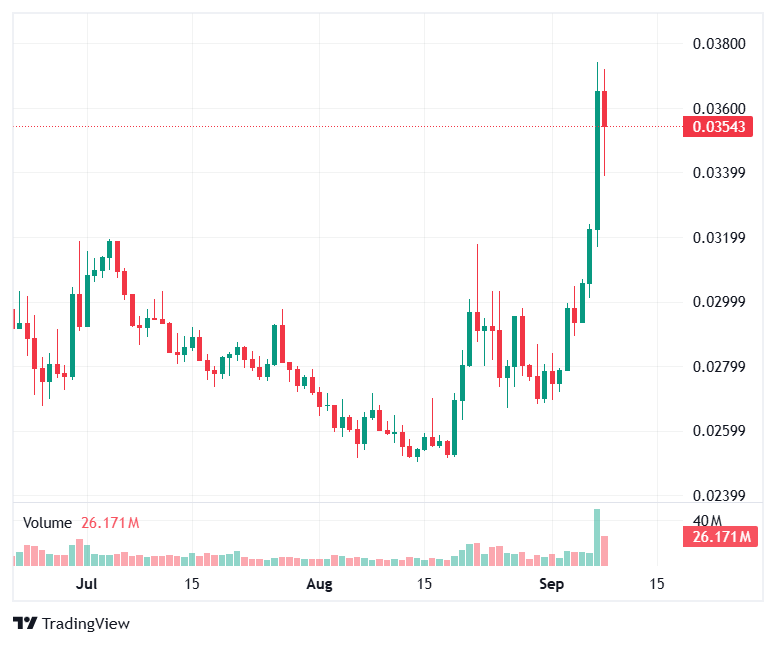
Kaspa has captured fresh attention after climbing more than 25 percent across a recent seven-day window.
The token trades near $0.03587 with a market capitalisation approaching $993 million and a circulating supply of roughly 27.68 billion coins against a fixed maximum near 28.7 billion.
Traders watching the move often dig past the short-term candles and start asking how the network actually functions, why it sticks with mining, and what its emission path looks like.
This article answers the questions that surface most often while laying out the practical details that matter for anyone evaluating the project.
What is Kaspa (KAS) and how does its blockDAG technology work?
Kaspa builds its ledger as a blockDAG rather than a single linear chain.
In a traditional blockchain, only one block can extend the tip at any moment, and competing blocks become orphans.
Kaspa instead allows multiple blocks to form in parallel and then orders them through the GHOSTDAG protocol.
The system treats the collection of blocks as a directed acyclic graph and reaches consensus on their sequence without discarding honest work.
Currently, the network produces ten blocks every second, delivering confirmation times limited mainly by internet latency.
Traders notice the difference because transactions settle far faster than on classic proof-of-work (PoW) chains while the protocol still inherits the security assumptions of Nakamoto-style mining.
Moreover the design keeps every valid block inside the ledger, so throughput scales without the usual orphan penalty.
Interestingly, this approach grows directly from earlier academic work on SPECTRE and PHANTOM protocols that sought to generalise Bitcoin’s consensus for higher block rates.
Is Kaspa proof-of-work, and why did it stay on PoW instead of switching to staking?
Kaspa runs exclusively on proof-of-work and has never signalled any intention to move toward staking.
The network launched in November 2021 under a pure fair-launch model with zero premine, zero initial coin offering (ICO), and zero insider allocation.
Every coin in circulation entered the market through competitive mining.
Supporters argue that mining creates a direct, physical cost for block production and voting power in a way that staking cannot fully replicate.
Furthermore, the high block rate of the blockDAG makes the security budget more continuous rather than episodic.
On the other hand, many newer projects have shifted to proof-of-stake for energy or capital-efficiency reasons.
Kaspa’s community continues to view the combination of proof-of-work plus parallel blocks as a deliberate technical choice that preserves decentralisation and censorship resistance.
Crucially, the absence of any pre-allocated tokens reinforces the same philosophy: the network treats miners and ordinary users as equal participants from day one.
What are Kaspa’s tokenomics, max supply, and emission schedule?
Kaspa caps its total supply at approximately 28.7 billion KAS.
The emission schedule splits into an early pre-deflationary phase that has already ended and the ongoing chromatic phase.
Inside the chromatic phase the block reward declines smoothly each month by a factor of one-half raised to the power of one-twelfth.
That mathematical step produces a gradual yearly halving without the sharp cliffs common on other networks.
By early 2026 more than 95 percent of the eventual supply had already entered circulation, so new issuance continues at a steadily shrinking rate.
In addition, the fair-launch design means no team or investor tokens sit behind vesting cliffs that could suddenly hit the market.
Traders therefore watch a supply curve that is both transparent and heavily front-loaded.
Specifically, the remaining emissions taper in a predictable geometric fashion that many describe as musically inspired because the monthly ratio matches the chromatic scale.
How is Kaspa mined, and what algorithm does it use?
Miners secure Kaspa with the kHeavyHash algorithm, a memory-and-compute intensive function built around Keccak hashing interleaved with matrix multiplication.
The design favours ASICs today while remaining compatible with earlier GPU participation during the network’s first years.
Because the blockDAG produces ten blocks per second, miners receive rewards more frequently than on slower chains, yet each individual block carries a smaller reward that continues to decline under the chromatic schedule.
In the meantime, the high block rate spreads mining revenue more evenly across participants and reduces the variance that single-block chains often create.
Network hashrate responds to price and electricity costs in the usual way, and recent reports note that certain older ASIC models have slipped toward unprofitability at current levels.
Overall, the mining ecosystem remains open and competitive, with no special privileges for any single hardware vendor.
Does KAS support smart contracts or programmability, and what are the upcoming upgrades?
The base layer currently focuses on fast, simple payments and UTXO transfers.
Recent hard-fork work has introduced covenants that let developers attach programmable spending rules directly to coins without a full global-state virtual machine.
Those covenants enable features such as delayed withdrawals, anti-theft vaults, and inheritance logic while still preserving the speed of the blockDAG.
At the same time, the community is advancing Layer-2 paths that include based zero-knowledge applications anchored to Kaspa’s sequencing.
The Toccata upgrade and related KIPs expand script capabilities and open the door for more expressive on-chain logic without forcing every node to execute heavy smart-contract code.
Looking ahead, developers continue testing zk verifiers and covenant tooling that could support more complex applications while the base layer stays lean and high-throughput.
Notably these upgrades aim to add programmability without abandoning the original proof-of-work and blockDAG strengths.
Kaspa continues to operate as a live, high-speed proof-of-work network with a nearly complete supply and an active mining base.
The recent price climb has brought new eyes to its blockDAG design, pure PoW stance, transparent emission curve, specialised mining algorithm, and gradual move toward native programmability.
As a trader or investor, you can verify the latest figures on CoinMarketCap, explore the blockDAG visualizer, and review the official website for further technical detail.
