


Wall Street’s biggest public BTC miners are walking away from Bitcoin production in favour of multi-year artificial intelligence (AI) and high-performance computing leases.
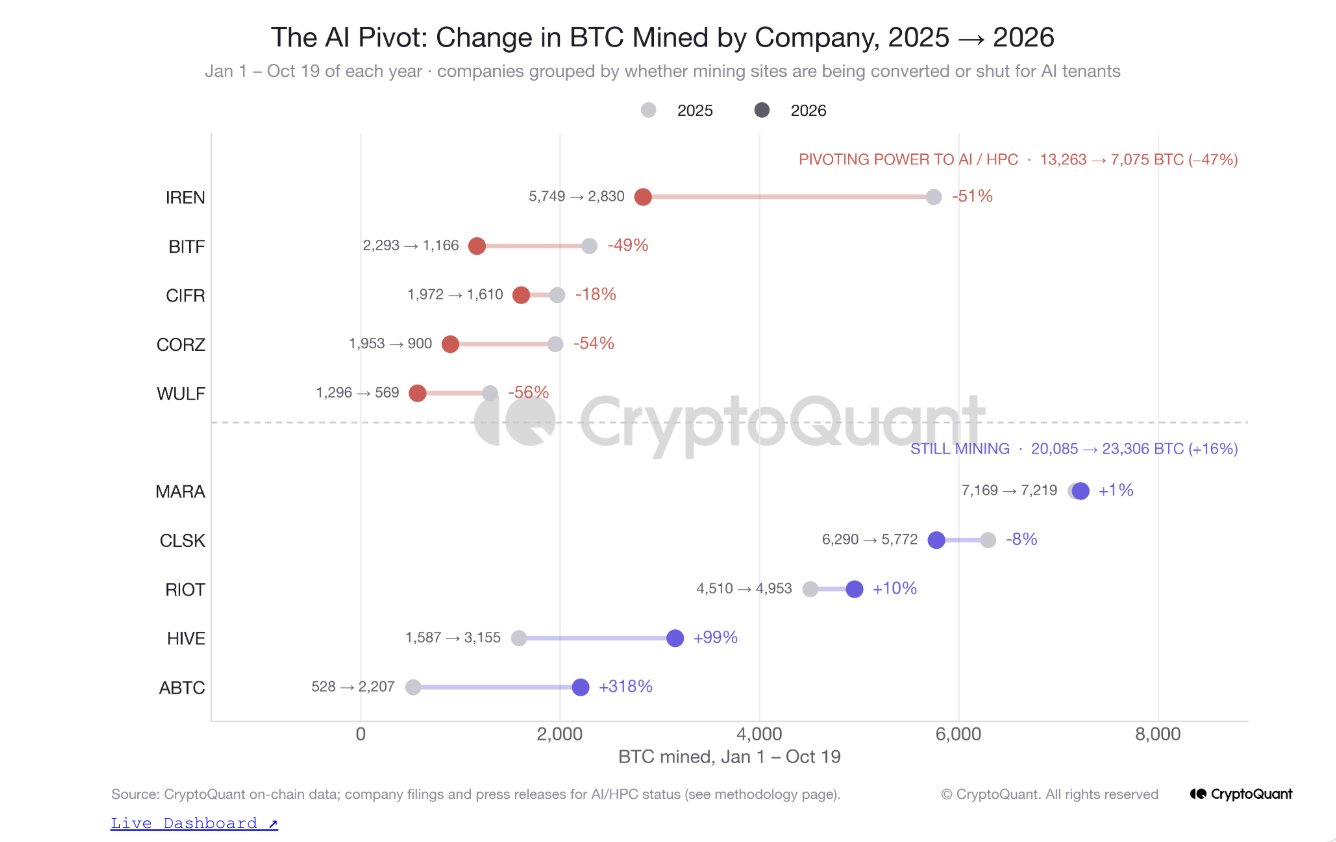
CryptoQuant’s latest research shows five firms—IREN, Core Scientific, Bitfarms, TeraWulf and Cipher—have already locked in more than $50 billion in those contracts while delivering 47% fewer coins so far this year.
Why Are Top BTC Miners Shifting to AI Leases?
Power sites once filled with ASIC (application-specified integrated circuit) machines now host GPU (graphic processing unit) clusters for AI tenants.
AI operators simply pay far more per megawatt than Bitcoin mining currently returns.
IREN cut its output 51%, Core Scientific dropped 54%, and TeraWulf fell 56% as they converted facilities.
Bitfarms closed every U.S. mining site in June 2026. Meanwhile, the remaining two in the group followed the same path.
Together, the five produced only 7,075 BTC from January 1 through October 19, 2026 down from 13,263 BTC in the same stretch of 2025.
How Much Bitcoin Output Have These Miners Cut?
The 47% decline is not industry-wide. Five pure-play btc miners—MARA, CleanSpark, Riot, HIVE and American Bitcoin—actually raised production 16% to 23,306 BTC.
Looking closer, the full ten-company group still mined 30,381 BTC, only 8.9% below last year’s figure.
Public miners as a whole now deliver about 91 BTC per day, roughly one-fifth of the network’s daily issuance. Beyond the headlines, the divergence inside the listed sector is sharp.

Is Bitcoin’s Hashrate Suffering From the Pivot?
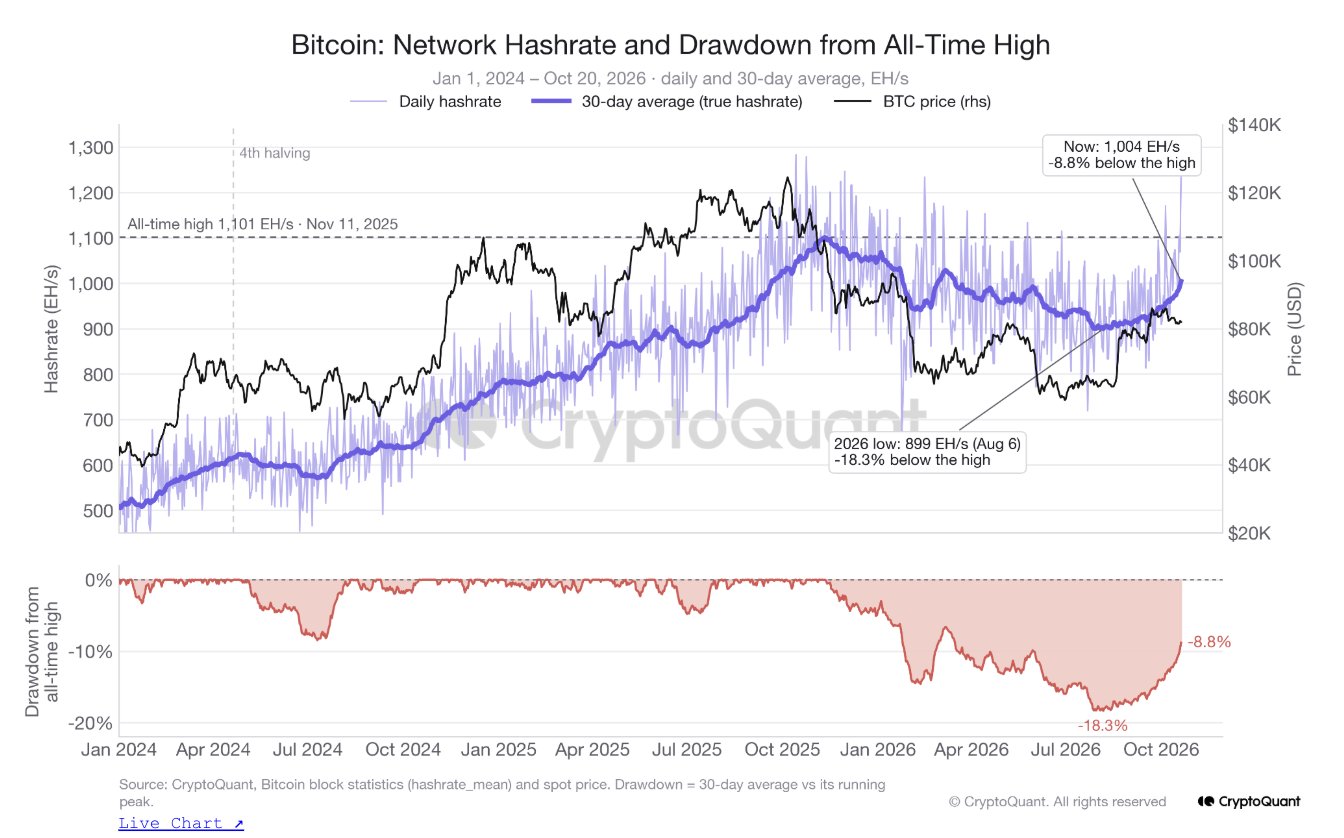
No, network hashrate climbed roughly 105 EH/s since the August low.
The 30-day average sat at 1,004 EH/s on the latest reading—just 8.8% under the all-time high (ATH) of 1,101 EH/s set in November 2025.
Even after an 18.3% drawdown earlier this year, the recovery has already erased most of the lost ground.
At the same time, difficulty continues to adjust upward, keeping competition intense for those still hashing.
Who Is Filling the Gap Left by Wall Street BTC Miners?
Private operators, sovereign-linked operations and non-U.S. firms are expanding capacity quickly.
They keep buying new machines and plugging them in while listed peers unplug ASICs for AI racks.
Interestingly, the network never paused; hashrate simply changed hands. Still the security budget remains robust because total computing power is near record levels.

What Does This Mean for Bitcoin’s Network Security?
Higher hashrate strengthens the chain’s defence against attacks and reinforces its store-of-value case.
Public BTC miners backed by traditional finance may be pivoting, yet the protocol itself keeps attracting capital from elsewhere.
For their part, investors watching listed mining stocks now face two stories: pure Bitcoin operators versus hybrid AI-hosting companies.
On the other side of the ledger, Bitcoin’s fundamentals look steadier than the equity narratives suggest.
The shift is real, the numbers are clear, and the network is adapting without missing a beat.
