

TRON continues carving out its place as the leading rail for stablecoin transfers.
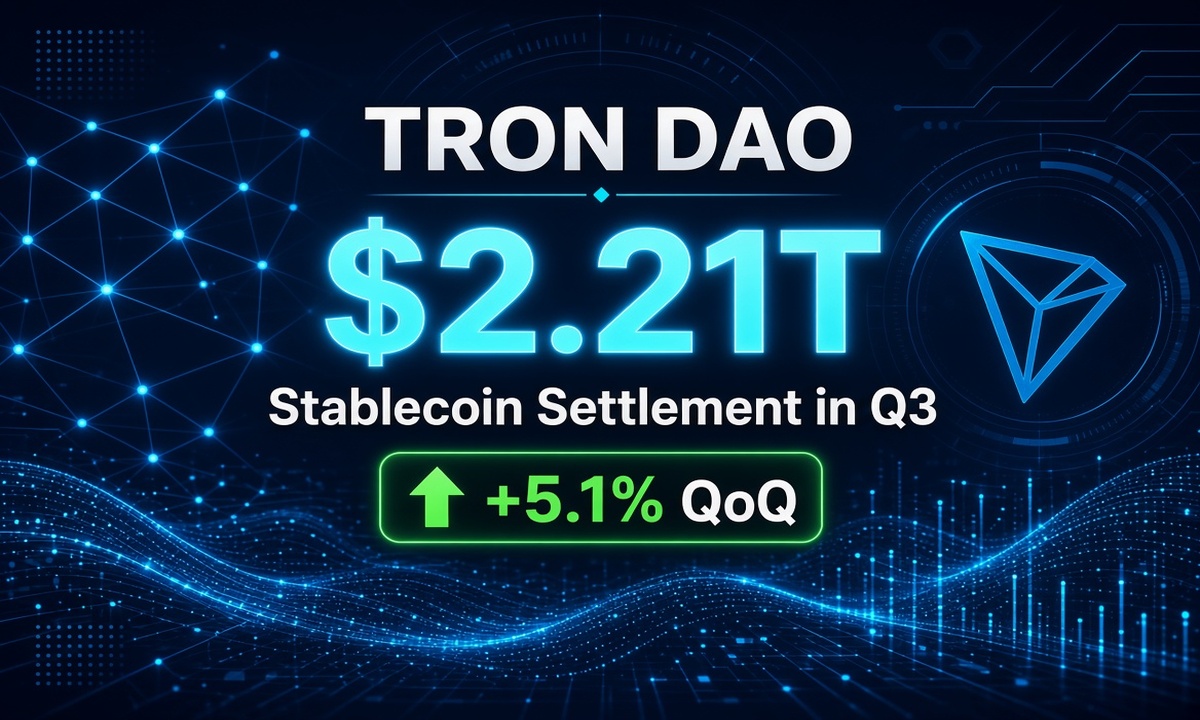
Nansen data shows the network settled $2.21 trillion in stablecoins during the third quarter (Q3) of 2026, marking a 5.1% rise from the previous quarter.
Average daily settlement climbed to roughly $24.05 billion while the network also cleared more than 1.07 billion transactions and maintained an average of 3.72 million daily active addresses.
At quarter-end, USDT and USDD supply on TRON stood near $93.9 billion.
What Does $2.21 Trillion in Stablecoin Settlement Actually Mean for TRON?
That figure shows TRON’s role as a high-throughput settlement layer rather than a pure smart-contract playground.
Most of the volume flows through USDT transfers, which still dominate activity on the chain.
In parallel, the network pushed its cumulative transaction volume past the $30 trillion mark by late September.
These numbers place TRON far ahead of competing chains in pure stablecoin settlement share, with some independent analyses putting its slice of global stablecoin transfer volume near 73% by the end of the quarter.

How Did User Activity and Network Scale Evolve in Q3?
Monthly active addresses rose 9.8% quarter-over-quarter (QoQ) to an average of 18 million, showing broader participation even as daily transaction counts held relatively steady.
Fees generated across the quarter totalled about $701 million, averaging $7.62 million per day.
Looking closer, the slight dip in average daily fees reflects lower per-transaction costs rather than weaker demand.
Beyond that, total value locked including staking reached $28.21 billion while pure DeFi TVL sat at $13.05 billion.

Why Did Institutional Access Expand During the Same Period?
Two developments stood out. Canary Capital launched the Canary Staked TRX ETF (TRXS) in the United States on September 9, giving traditional investors a regulated vehicle for exposure to staked TRX.
At the same time, Anchorage Digital expanded its TRON integration by adding native TRX staking and full TRC-20 custody support.
These steps open clearer pathways for institutional capital and custody solutions that previously faced friction.

How Does the TRON Stablecoin Supply Growth Fit Into the Bigger Picture?
USDT and USDD supply on the network increased 5.5% from the second quarter and nearly 15% year-over-year.
That expansion keeps TRON hosting roughly half of all circulating USDT at points during the quarter.
In addition, the combination of rising supply and sustained settlement volume creates a self-reinforcing liquidity loop that payment providers and remittance firms continue to favour for speed and cost.
Taken together, the quarter shows TRON operating less like a speculative chain and more like critical financial infrastructure.
Settlement volumes keep growing, the user base widens, and regulated access points are multiplying.
For anyone tracking real on-chain money movement, these metrics remain the clearest signal of where large-scale dollar transfers actually settle.
