

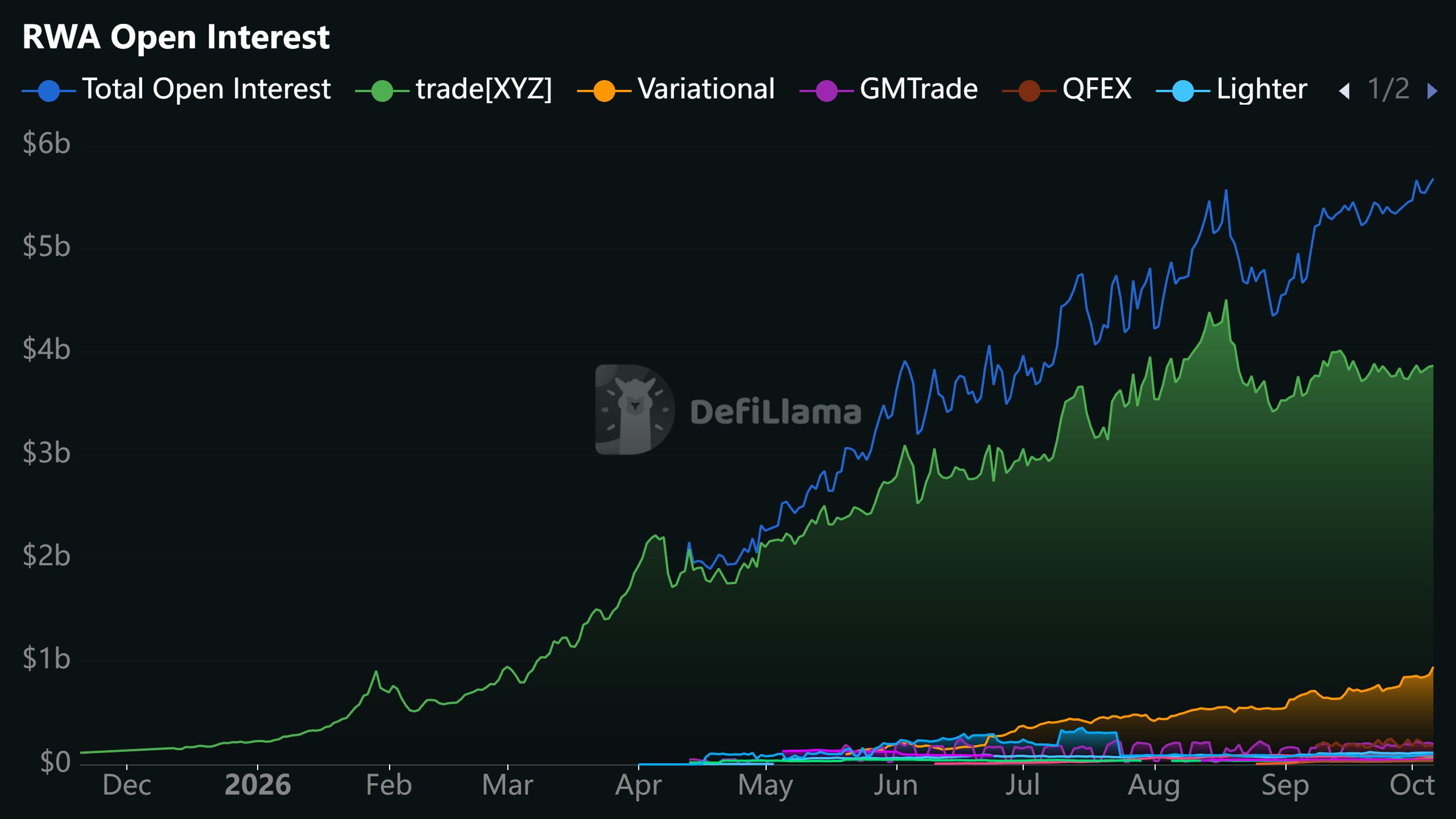
Open interest for onchain RWA perps just hit a fresh all-time high (ATH) of $5.68 billion. DefiLlama data shows the figure climbing from near zero roughly a year earlier, with trade[xyz] leading the charge.
This jump marks one of the clearest signals yet that traders are building and holding real exposure to stocks, indices, gold, oil and other traditional assets directly on blockchain rails.
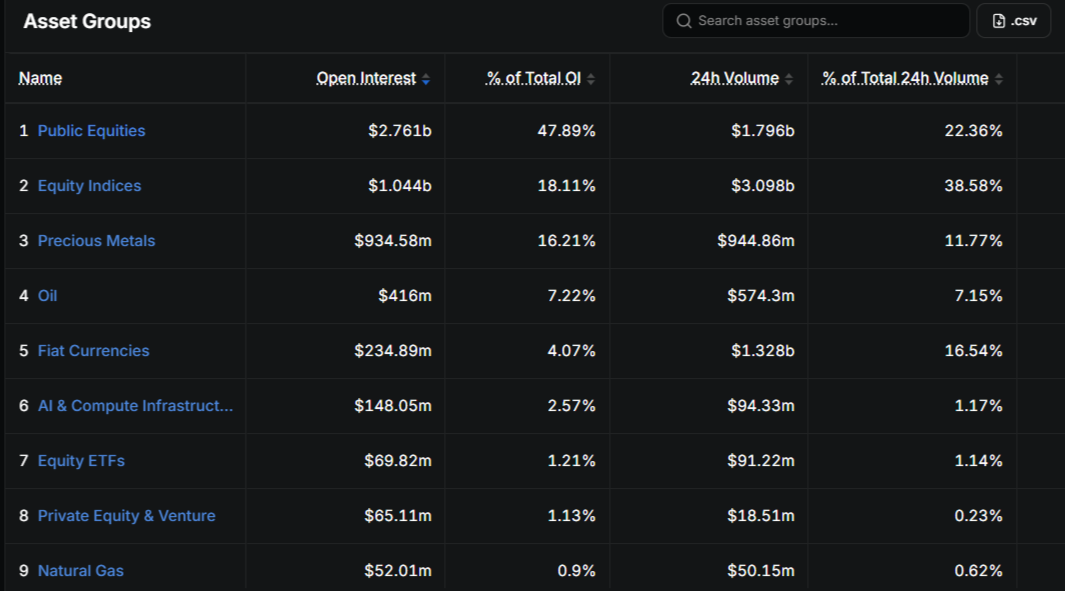
In the meantime, the market has moved far beyond early experiments. Public equities now account for nearly half the open interest, equity indices add another sizeable slice, and precious metals plus oil fill out a meaningful share.
Observing recent data clearly shows that the growth path continues to stands out. A year ago, the category barely registered. By mid-2026, open interest had already multiplied many times over, and recent weeks pushed the total past previous records.
Platforms such as trade[xyz] on Hyperliquid’s HIP-3 framework and newer entrants like Variational now dominate the landscape, together holding the large majority of outstanding positions.
What Exactly Are RWA Perps and Why Does Open Interest Matter?
RWA perps are perpetual futures contracts that track the price of real-world assets (RWA)—individual stocks, equity indices, gold, crude oil, foreign-exchange pairs and even some private or pre-initial public offering (IPO) names—without giving the holder any ownership, dividends or claim on the underlying.
Traders post stablecoin margin, take leveraged long or short positions, and settle gains or losses in crypto.
Funding rates periodically balance the contract price against the oracle reference so the synthetic stays close to the real-world market.
Open interest measures the total notional value of every contract that remains open at a given moment.
It rises when new positions open and falls when traders close them. Unlike volume, which counts every trade regardless of how quickly positions turn over, open interest reveals how much capital stays committed.
In this market, the recent climb signals that participants are not merely flipping contracts; many are holding directional or hedged exposure across traditional asset classes on a 24/7 basis.
Beyond the headline number, the composition tells a story of shifting preference. Public equities lead with roughly $2.8 billion in open interest, equity indices contribute about $1 billion, precious metals sit above $900 million, and oil adds several hundred million more.
Names such as SK hynix, Nvidia, gold and the S&P 500 and Nasdaq-100 contracts frequently rank among the largest individual markets.
How Did RWA Perps Open Interest Climb from Near Zero to Record Levels?
Early activity concentrated in commodities. Gold and oil contracts attracted the first wave of liquidity because those markets already trade around the clock in traditional venues and therefore fit more naturally with continuous onchain pricing.
Equity products lagged at first. Over subsequent months, however, single-stock and index perps gained traction as platforms listed deeper menus and liquidity providers (LPs) stepped in.
Meanwhile, infrastructure improvements accelerated the move. Hyperliquid’s HIP-3 upgrade let external teams deploy their own markets on the same high-performance matching engine.
Trade[xyz] used that capability to list dozens of equity, index and commodity contracts under a single account and margin system.
Later arrivals such as Variational expanded the set further, especially around popular index swaps.
In parallel, the appeal of continuous trading hours became clearer. Traditional stock and commodity markets close overnight and on weekends.
Onchain perps keep running. Traders can adjust positions during Asian or European sessions, react to weekend news, or maintain hedges without waiting for the next cash-market open. That flexibility draws both speculative flow and more patient capital.
Looking at the data from a different angle, open interest has proven stickier than volume. Monthly trading volumes have fluctuated—sometimes cooling after intense periods—yet outstanding positions have kept climbing.
That pattern suggests participants open contracts and leave them on, rather than simply churning for short-term gains.

Which Platforms and Asset Classes Drive the Current RWA Perps Open Interest?
Trade[xyz] still holds the largest share, often around two-thirds (2/3) of total open interest.
Variational has grown rapidly into second place and now commands a meaningful portion of the remaining market.
Smaller venues such as QFEX, GMTrade, Lighter and others fill out the rest, creating a more diversified venue map than existed earlier in the year.
On the asset side, the rotation toward equities is unmistakable. A year earlier, commodities dominated both volume and open interest.
Equity products first overtook commodities in open-interest terms and later in volume.
Today, public equities and equity indices together form the clear majority of outstanding positions, while metals and energy retain important secondary roles.
Individual contracts illustrate the point. Large open-interest markets frequently include the S&P 500, Nasdaq-100, gold, silver, SK hynix, Nvidia, Micron and various oil contracts.
Pre-IPO and private-equity-style names also appear, though in smaller absolute size.
What Risks Accompany Rising RWA Perps Open Interest?
Oracle dependence sits at the centre. Because the contracts track off-chain prices, any disruption, lag or dispute in the price feed can produce liquidations or basis risk, especially when traditional markets are closed and the reference price is stale.
Funding-rate dynamics can also amplify costs during prolonged imbalances between longs and shorts.
Regulatory uncertainty remains another layer. Synthetic exposure to equities and other securities sits close to traditional derivatives rules in many jurisdictions.
Platforms have so far operated primarily in crypto-native environments, yet the line between onchain derivatives and regulated products continues to evolve.
Liquidity concentration presents a further consideration. A handful of venues still hold the bulk of open interest.
While competition is increasing, a sudden reduction in activity on the leading platforms could temporarily thin markets and widen spreads.

How Does this Compare with Traditional Futures Markets?
Traditional equity-index and commodity futures markets still dwarf the onchain category in absolute size.
Monthly volumes on mature exchanges run into the trillions. Even so, the onchain share of RWA-style activity has expanded rapidly, with decentralised venues handling the large majority of tracked RWA perp volume in recent months.
The comparison also highlights structural differences. Onchain contracts offer continuous trading, self-custody of margin, and composability with other decentralised finance (DeFi) protocols.
Traditional contracts provide deeper institutional liquidity, clearer regulatory frameworks and established clearing mechanisms.
Many market participants treat the two as complementary rather than purely competitive.
What Does the Surge in this Metric Signal for the Broader Market?
Rising open interest indicates that onchain derivatives are capturing genuine demand for leveraged, always-on exposure to traditional assets.
It also shows that price discovery for certain names—especially those with limited traditional shorting avenues or after-hours interest—can migrate partially onto blockchain venues.
In the longer view, sustained growth could encourage more sophisticated hedging strategies, cross-asset portfolios managed entirely onchain, and tighter integration between crypto-native capital and traditional market signals.
At the same time, the market remains young. Further increases in open interest will depend on continued improvements in oracle reliability, risk engines, and the ability of platforms to attract and retain institutional-grade liquidity.
The jump from near zero to $5.68 billion in roughly twelve (12) months already ranks among the more striking expansions in decentralised derivatives.
Whether the next phase brings steadier institutional participation or continued retail-driven growth will shape how large this category ultimately becomes.
For now, the data make one point clear: traders are no longer treating RWA perps as a curiosity.
They are opening positions, holding them, and treating the contracts as a working part of the onchain toolkit.
