

Tokenized stocks have crossed a notable threshold inside decentralised finance (DeFi).
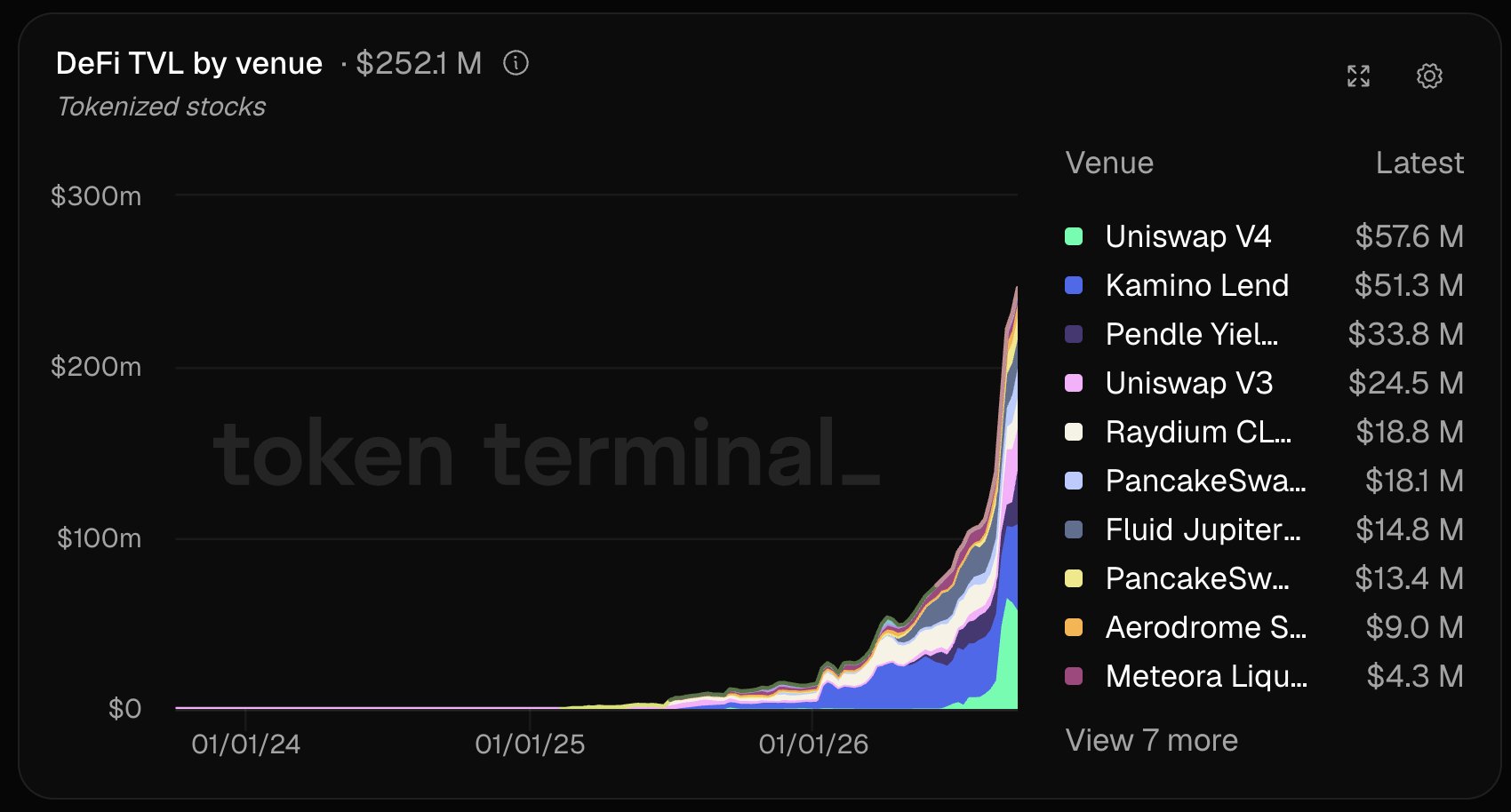
Token Terminal data shows $252 million worth of these assets now sit deposited across DeFi venues.
Uniswap leads the pack with $82.1 million across its v3 and v4 deployments. Kamino Lend follows at $51.3 million, while Pendle holds $33.8 million.
The remaining balance spreads across Raydium, PancakeSwap, and several other protocols. This figure reflects rapid adoption.
Just weeks earlier, the total hovered near $250 million after climbing nearly twenty fold over the prior year.
Users are no longer simply holding tokenized equities. They are putting them to work as liquidity, collateral, and yield-bearing positions.
Why Are Tokenized Stocks Moving Into DeFi Venues?
Holders gain practical utility once the assets leave wallets.
On Uniswap, they supply liquidity and earn trading fees. On Kamino, they serve as collateral for borrowing stablecoins. On Pendle, they feed into yield-trading strategies that separate principal and yield components.
These use cases turn passive equity exposure into productive capital.
Meanwhile, the 24/7 nature of on-chain markets lets participants manage positions outside traditional stock-market hours.
In the same period, issuers such as those behind xStocks have expanded the menu of available names, making it easier for users to deposit familiar large-cap equities and exchange-traded funds (ETFs).
Which Protocols Capture the Most Tokenized Stock Deposits?
Uniswap currently sits in first place. Its combined v3 and v4 pools hold roughly one-third of the entire $252 million.
Concentrated-liquidity designs allow tighter ranges around fair value, which attracts sophisticated liquidity providers.
Kamino Lend ranks second and dominates Solana-based lending of these assets.
Users deposit tokenized stocks and borrow against them inside isolated markets designed for the asset class.
Pendle occupies third place by letting depositors trade or lock yield on the underlying positions.
Further down the list, Raydium’s concentrated-liquidity pools and several multi-chain decentralised exchanges (DEXs) also show meaningful balances, illustrating that activity is not confined to a single ecosystem.
How Does This Growth Fit Into the Broader Tokenized Asset Landscape?
Tokenized stocks form only one slice of the real-world asset (RWA) sector, yet they have become one of the fastest-growing segments inside DeFi.
Total on-chain market capitalisation of tokenized equities sits in the low billions, while the portion actively deposited in DeFi remains a smaller but rising fraction.
Liquidity pools currently absorb the majority of deposits, with lending markets taking a substantial secondary share.
Yield tokenization accounts for a smaller but strategically important slice.
This distribution shows that market participants value both secondary trading depth and capital-efficient borrowing.
At the same time, regulatory clarity in certain jurisdictions has encouraged more issuers and venues to support these assets, reducing earlier friction around custody and transfer.

Tokenized Stocks: What Risks and Opportunities Should Participants Consider?
Smart-contract risk, oracle reliability, and redemption mechanics remain important.
Tokenized stocks inherit both the price volatility of the underlying equities and the technical risks of the DeFi protocols that hold them.
Isolated lending markets and permissioned pool designs help contain some of those risks.
On the opportunity side, deeper liquidity and broader collateral acceptance could eventually support more complex structured products.
Stakeholders must monitor whether borrowing utilisation against these assets rises and whether new venues continue to attract deposits.
Tokenized stocks have moved beyond simple issuance into active DeFi usage. The $252 million now deposited across Uniswap, Kamino, Pendle, and other venues demonstrates that equity exposure can function as productive on-chain capital.
Continued growth will depend on sustained liquidity, reliable infrastructure, and expanding utility for both retail and institutional participants.
