


Bitcoin Miner Revenue continues to face sustained pressure in 2026. July figures reached only $805 million, falling well short of the $1 billion threshold once again.
Moreover, this total sits significantly below the $1.7 billion recorded in July 2025. Furthermore, the month underperformed both June 2026’s $841 million and January 2026’s $1.2 billion, which remains the year’s highest monthly total. Therefore, the data reveals a clear pattern of softer earnings across the sector.
Miners generate revenue from block subsidies and transaction fees. However, post-halving economics and elevated network competition have compressed margins for many operators.
As a result, monthly totals have struggled to reclaim earlier peaks. In addition, Bitcoin’s price action and rising hashrate have combined to keep hash price under pressure.
Thus, even efficient operations must navigate tighter conditions than they faced a year earlier.
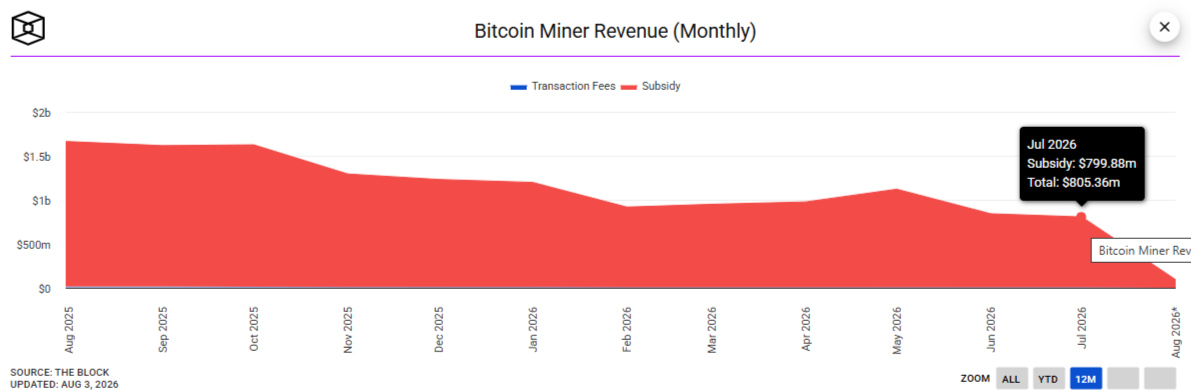
Bitcoin Miner Revenue: Comparing Recent Performance Trends
July 2026’s $805 million represents a noticeable step down from June’s $841 million.
Meanwhile, the gap versus January’s $1.2 billion highlights how early-year strength has faded.
In contrast, July 2025 delivered roughly double the current figure at $1.7 billion. Therefore, year-over-year (YoY) declines show the impact of the 2024 halving and subsequent hashrate growth.
Furthermore, the inability to breach $1 billion for several months signals structural challenges rather than temporary weakness.
In addition, lower transaction fee contributions during quieter network periods have limited upside.
As a result, miners increasingly rely on operational efficiency and alternative revenue streams to offset reduced block rewards.
Drivers Behind Softer Bitcoin Miner Revenue
Several factors explain the current environment. First and foremost, network hashrate has climbed steadily, spreading rewards across more competing machines.
Next, Bitcoin’s price has remained range-bound near recent levels rather than delivering strong upside.
Moreover, energy costs and hardware depreciation continue to weigh on profitability for less efficient fleets.
Meanwhile, the shift toward high-performance computing and artificial intelligence (AI) workloads offers partial relief for some public miners.
However, pure Bitcoin mining operations still dominate overall revenue calculations.
Therefore, traditional hash-based earnings remain the primary metric for industry health.
In addition, older generation application-specified integrated circuits (ASICs) face growing pressure as newer, more efficient models capture larger shares of the network.
Implications for the Mining Industry
Lower Bitcoin Miner Revenue accelerates industry consolidation. Weaker operators with high power costs or outdated equipment struggle to remain viable.
Furthermore, capital expenditure decisions become more cautious when returns stay constrained.
As a result, only well-capitalised firms with access to cheap energy and modern hardware maintain comfortable margins.
In contrast, diversified miners that lease capacity for AI and data-centre use gain alternative income.
Moreover, this dual-strategy approach helps smooth earnings volatility. Nevertheless, the core Bitcoin network still depends on healthy mining economics for long-term security.
Therefore, sustained low revenue periods raise important questions about future hashrate stability and network resilience.

Looking Ahead Into the Future: Efficiency and Adaptation
Miners must prioritise efficiency improvements and strategic positioning. For example, hydro-cooled and next-generation ASICs deliver better performance per watt.
In addition, securing long-term low-cost power contracts becomes essential. Meanwhile, some firms explore financial tools such as hashrate derivatives or treasury management to manage risk.
Furthermore, the gradual rise in transaction fees over successive halvings will eventually play a larger role.
However, fee revenue remains inconsistent in the near term. As a result, operators continue balancing short-term survival with long-term preparation for a fee-dominant future.
In summary, Bitcoin Miner Revenue of $805 million in July 2026 fell short of the $1 billion mark once more.
It trailed June’s $841 million, lagged far behind January’s $1.2 billion peak, and stood at less than half of July 2025’s $1.7 billion.
Moreover, the figures reflect ongoing pressure from higher hashrate, moderated prices, and post-halving realities.
Therefore, the industry must adapt through greater efficiency, diversification, and disciplined cost control.
By focusing on these areas, resilient miners can navigate the current environment while positioning for eventual recovery in Bitcoin Miner Revenue.
