

Token Terminal data shows that 105 stablecoins now carry a market capitalisation above $10 million.
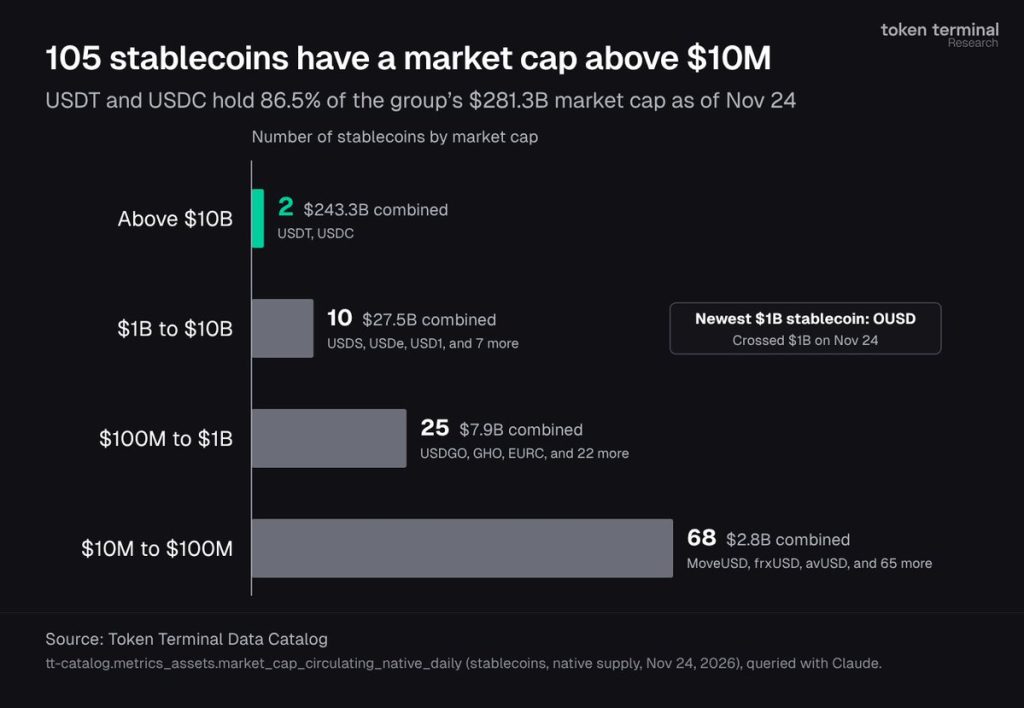
Together, these assets total $281.3 billion as of November 24, 2026. USDT and USDC alone control 86.5% of that sum.
The concentration stands out immediately. Two coins sit above the $10 billion mark and hold a combined $243.3 billion.
Ten more occupy the $1 billion to $10 billion range and add another $27.5 billion.
Twenty-five coins fall between $100 million and $1 billion for a collective $7.9 billion.
The remaining 68 tokens, each valued between $10 million and $100 million, contribute just $2.8 billion.

How is market value spread across these 105 stablecoins?
Look at the tiers and the picture becomes clearer. USDT and USDC form the only pair above $10 billion.
The next group includes names such as USDS, USDe and USD1, plus seven others.
OpenUSD (OUSD) recently joined the billion-dollar club after crossing the threshold on November 24.
Lower tiers feature USDGO, GHO, EURC and a long list of smaller projects that include MoveUSD, frxUSD and avUSD.
Most of the value still sits with the two largest issuers even though dozens of alternatives now clear the $10 million bar.
Why do USDT and USDC continue to dominate the stablecoin landscape?
Network effects explain much of the gap. Traders, exchanges and DeFi (decentralised finance) protocols already route liquidity through these two tokens, so new capital follows the same path.
Reserve transparency, regulatory progress and multi-chain availability reinforce the preference.
Other stablecoins compete on yield, specific chain integration or regional focus, yet they still capture only a thin slice of total supply.
Independent trackers place overall stablecoin market capitalisation near $280 billion in late November, confirming the same heavy tilt toward the top two.
What risks arise when two stablecoins hold most of the market?
Concentration creates single points of failure. Any sustained depeg, reserve question or regulatory action involving USDT or USDC would ripple across exchanges, lending markets and payment rails far more than similar trouble at a smaller issuer.
The long tail of 103 other coins above $10 million offers some diversification on paper, yet their combined weight remains modest.
Users and institutions therefore monitor reserve attestations and redemption mechanics of the leaders more closely than the rest of the list.

Which newer stablecoins are climbing toward meaningful scale?
OUSD’s recent move past $1 billion highlights continued experimentation.
Yield-bearing designs, tokenized treasury products and issuer-specific strategies keep attracting capital even while the overall market has contracted several percent in recent months.
Projects that solve clear pain points—faster settlement in particular regions, better on-chain yield distribution or tighter regulatory alignment—still find room to grow.
Their absolute size stays small next to the leaders, yet the existence of 105 coins above the $10 million threshold shows the category remains active.
The numbers paint a mature yet uneven market. A handful of established stablecoins carry the bulk of value while a much larger group of smaller issuers continues to test new models.
Data from Token Terminal, DefiLlama and other on-chain trackers will keep revealing whether the long tail gains ground or the duopoly simply absorbs the next wave of demand.
