

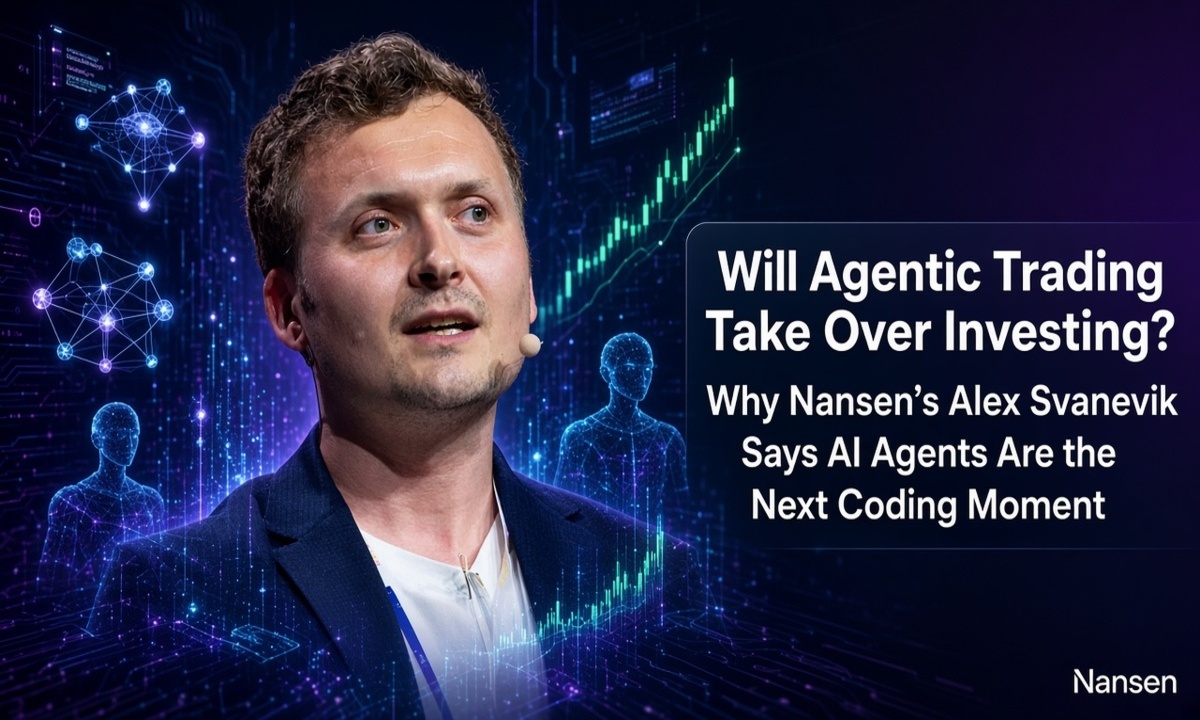
Nansen CEO Alex Svanevik has drawn a sharp parallel about agentic trading that many traders are now debating: coding experienced its artificial intelligence (AI) breakthrough, and investing stands next in line.
In a recent Nansen discussion, he stated that agentic trading will soon become standard practice.
Agentic trading refers to autonomous AI systems that research markets, form strategies, manage risk, and execute trades with limited human oversight.
What exactly is agentic trading?
Agentic trading goes beyond rigid algorithms. Traditional bots follow fixed rules such as “buy when the moving average crosses.”
In contrast, agentic systems reason across live data, news, and on-chain signals, then adapt their plans.
They perceive conditions, plan multi-step actions, and adjust when markets shift.
Svanevik highlights that Nansen’s approach equips these agents with proprietary on-chain intelligence drawn from more than 500 million labelled addresses, giving them visibility most retail tools lack.
Why does Svanevik compare this shift to coding’s AI moment?
Software engineers once wrote every line by hand. Tools like GitHub Copilot changed that reality almost overnight.
Svanevik argues the same transformation now hits trading.
“If you look at what’s happened with engineering and coding over the last few years, I think something very similar is gonna happen with investing and trading,” he explains.
Coding gained AI assistants that accelerate creation; trading gains agents that accelerate decision-making and execution.
He expects more trading agents than human traders within roughly two years.
How does agentic trading differ from classic algorithmic systems?
Classic algorithms execute predetermined logic. Agentic systems set goals, pull context from multiple sources, and revise strategies on the fly.
Moreover, they can coordinate with other agents for research, risk checks, and order placement.
Retail traders often move in herds. Agents, by design, draw on varied models and data streams, which Svanevik believes produces greater diversity and potentially more robust outcomes.
Nansen has already recorded early agent experiments, including cases where inference costs temporarily outweighed profits—an honest signal that the economics remain early-stage.

Will agentic trading fully replace human investors?
Complete replacement remains unlikely in the near term. Svanevik instead describes a “trust ladder.” Humans stay in the loop at first, approving suggested trades.
Trust builds gradually toward smarter automation and, later, greater autonomy.
On-chain environments suit this path especially well because agents can research, create wallets, and execute across chains through integrated tools.
Individual investors may gain the most, as sophisticated strategies once reserved for institutions become conversational and accessible.
What risks should investors watch?
Agents still face high inference costs, occasional uneven performance, and the need for clear guardrails.
Markets punish over-trading and poor risk controls. Responsible platforms therefore keep human oversight central while agents handle speed and scale.
Nansen’s vision centres on “trade everything on-chain with agents,” yet the company stresses measured progress over reckless autonomy.
Agentic trading is already moving from concept to product. Platforms that combine deep data with conversational interfaces stand to reshape how capital moves.
Whether it fully overtakes human decision-making depends on trust, economics, and results.
For now, the parallel Svanevik draws feels increasingly concrete: coding changed first, and trading follows close behind.
