

US XRP Spot ETF products delivered their strongest monthly performance of 2026 in August.
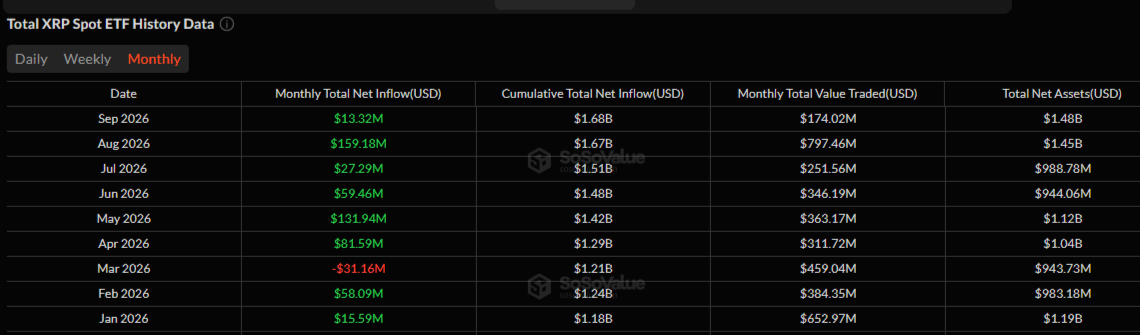
Net inflows climbed to $159.18 million that month, clearly surpassing the earlier high of $131.94 million recorded in May.
The surge pushed cumulative net inflows near $1.67 billion by the end of August and lifted total net assets to roughly $1.45 billion.
Trading volume also exploded, reaching $797.46 million for the month—more than double the activity seen in most prior periods.
These numbers reveal a market that continues to absorb regulated XRP exposure even while broader crypto prices swing.
September data available so far show a slower $13.32 million inflow and cumulative totals near $1.68 billion, with net assets holding around $1.48 billion.
Looking further back, July brought only $27.29 million, June added $59.46 million, and April contributed $81.59 million.
March stands out as the sole outflow month at –$31.16 million. The pattern shows institutional and retail capital flowing steadily into the product category across most of the year.
What is a US XRP Spot ETF and how does it work?
A US XRP Spot ETF functions as a regulated investment vehicle that holds actual XRP tokens in institutional custody.
The fund aims to track the spot price of XRP as closely as possible after fees.
Shares trade on traditional stock exchanges such as Nasdaq or NYSE Arca during regular market hours.
Investors buy and sell those shares through ordinary brokerage accounts rather than crypto exchanges.
Authorised participants create or redeem large blocks of shares by delivering or receiving XRP (or cash equivalent) with the fund’s custodian.
This creation-redemption mechanism keeps the share price aligned with the underlying asset’s value.
Daily net asset value calculations rely on established XRP reference rates, giving the product transparency that many traditional investors require.
In practice, the structure removes the need for private keys or wallet management while still delivering direct price exposure.
Multiple issuers now operate under this model after the regulatory pathway opened in late 2025.
Is a US XRP Spot ETF available / approved, and which ones are trading?
Yes, several US XRP Spot ETFs began trading after regulatory clearances in late 2025.
The product set expanded quickly once generic listing standards for commodity-based crypto exchange-traded products took effect.
Issuers that launched or listed funds include Bitwise, Canary Capital, Franklin Templeton, Grayscale, 21Shares, and REX-Osprey among others.
These vehicles now form a multi-fund complex whose combined assets and inflows the market watches closely.
August’s record $159.18 million inflow arrived after months of consistent, if smaller, positive flows.
Even the slower periods in January ($15.59 million) and July ($27.29 million) still added capital.
The single negative month in March did not reverse the overall upward trajectory of cumulative inflows.
Availability through standard brokerage platforms has broadened access beyond crypto-native investors.
How does buying this exchange traded fund differ from holding XRP directly?
Purchasing shares of a US XRP Spot ETF delivers price exposure inside a brokerage account.
The investor never takes custody of the tokens, never manages private keys, and never interacts with the XRP Ledger for sending or receiving.
Ownership stays within the securities framework—subject to exchange trading hours, brokerage settlement rules, and standard tax reporting.
Holding XRP directly, by contrast, places the tokens in a personal wallet.
That arrangement allows full on-chain activity: payments, transfers, participation in XRP Ledger features, and self-custody control.
It also carries the operational responsibilities of securing seed phrases and managing exchange or wallet risk.
Many traditional investors prefer the ETF route precisely because it removes those operational layers.
Others who value on-chain utility continue to hold the token itself.
Both approaches now coexist, and the steady rise in ETF assets under management shows that a sizeable group of capital chooses the regulated share structure.
What fees do XRP Spot ETFs charge, and which has the lowest expense ratio?
Expense ratios across the US XRP Spot ETF complex generally range from approximately 0.19 percent to 0.75 percent annually.
Franklin Templeton’s product frequently appears at the low end of that spectrum, often cited near 0.19 percent.
Other issuers price their funds between the mid-0.30 percent range and higher levels depending on structure and marketing strategy.
These fees come out of fund assets and therefore reduce net returns over time.
Competition among issuers has already compressed costs relative to earlier crypto ETF launches.
Investors comparing products routinely examine both the stated expense ratio and any temporary fee waivers that may apply during promotional periods.
How do inflows and assets under management affect XRP’s price?
Net inflows into US XRP Spot ETFs remove XRP from circulating supply because the funds lock tokens in custody.
August’s $159.18 million inflow, the largest monthly total of 2026, represented meaningful demand that exceeded May’s previous high of $131.94 million.
Cumulative inflows approaching $1.67–$1.68 billion by early September have steadily increased the quantity of XRP held inside these regulated vehicles.
Total net assets have fluctuated with both inflows and the underlying price of XRP.
Assets stood near $1.45 billion at the end of August and around $1.48 billion in the latest September reading.
Earlier in the year they moved between roughly $940 million and $1.19 billion depending on price action and capital flows.
Strong ETF demand can support price by reducing available float, yet the relationship is rarely one-to-one.
Broader market sentiment, escrow unlocks, and macroeconomic conditions still exert heavy influence.
Observers note that sustained positive flows even during quieter price periods suggest institutional accumulation rather than pure short-term speculation.
The contrast between August’s record inflow and the more modest figures in surrounding months shows how capital can concentrate when conviction rises.
US XRP Spot ETF products have matured rapidly since their late-2025 debut.
August’s $159 million inflow stands as the clearest signal yet of durable demand inside the regulated wrapper.
While monthly totals will continue to vary, the broader trajectory of cumulative inflows and rising assets under management shows that traditional market participants now treat XRP exposure as a standard portfolio option.
Investors watching the space will track whether future months can sustain or exceed that August benchmark while the underlying token navigates its own supply and demand dynamics.
