

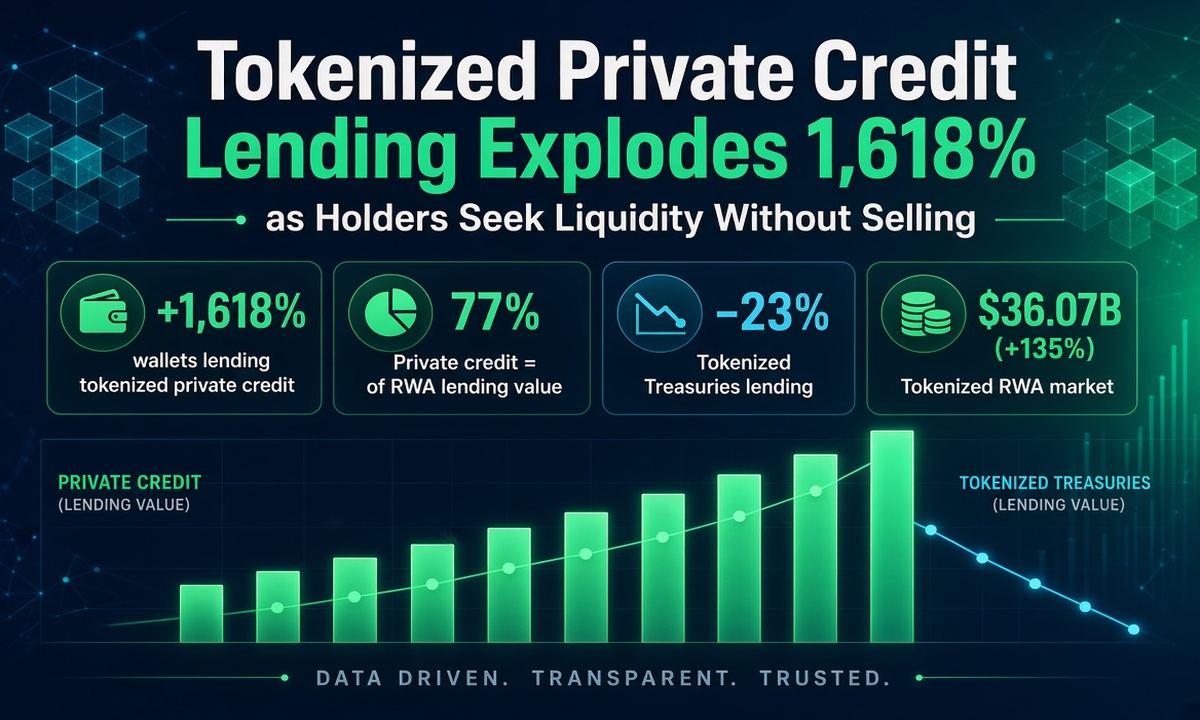
Holders of hard-to-sell private credit positions are turning to blockchain collateral in a big way in the form of tokenized private credit lending.
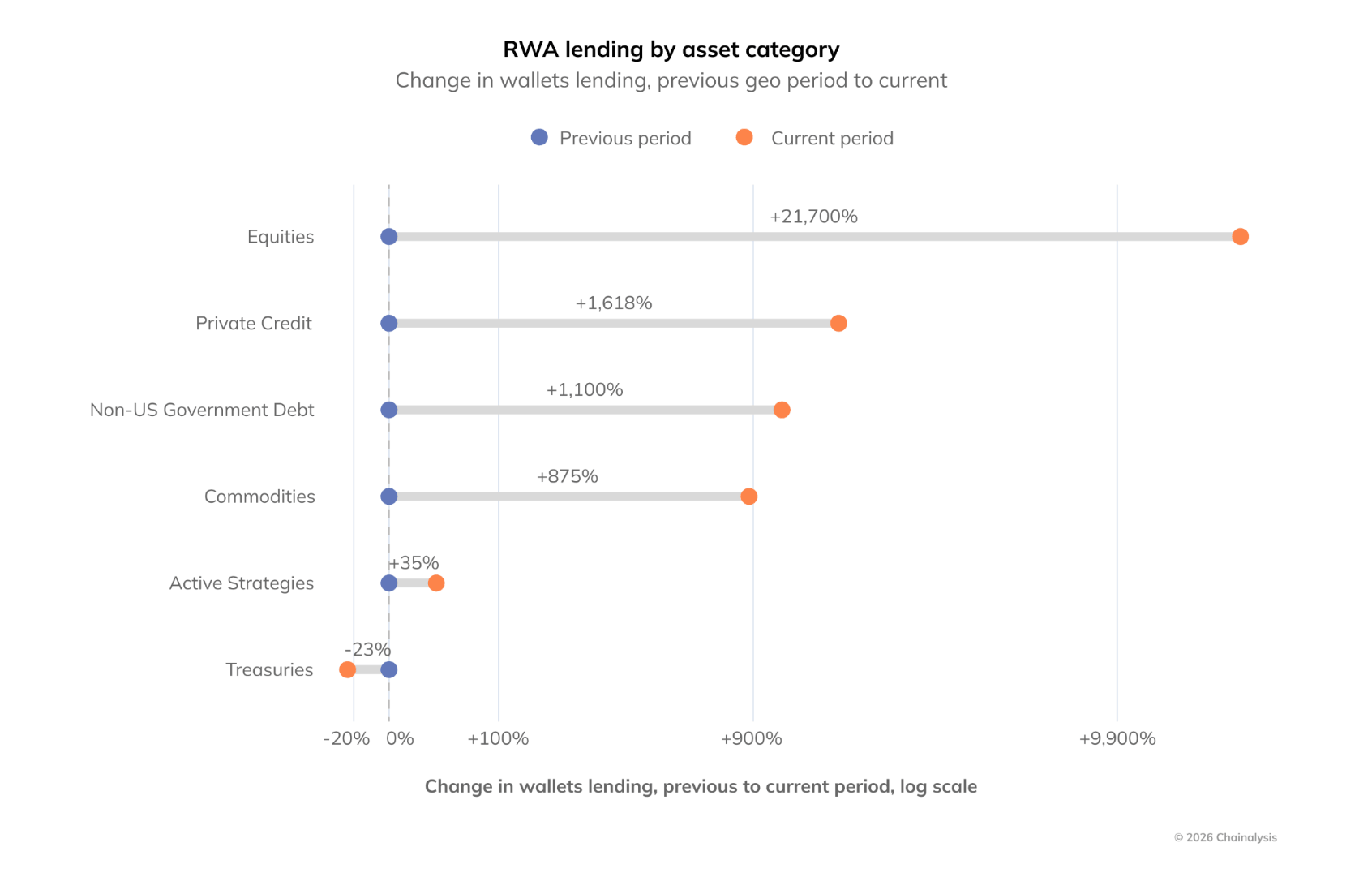
New Chainalysis data shows the number of wallets lending tokenized private credit jumped 1,618% during the 2026 reporting period.
Meanwhile, wallets lending tokenized treasuries dropped 23%.
The contrast highlights a clear shift: tokenization delivers the most value when it unlocks cash from illiquid assets without forcing a sale.
Private credit has long been difficult to exit quickly in traditional markets. Tokenization changes that by letting holders post the positions as collateral and borrow against them.
In practice, investors keep the underlying yield exposure while accessing liquidity on-chain.
Chainalysis notes that private credit already accounts for roughly 77% of the total value lent against tokenized real-world assets (RWA), showing how central this use case has become.
Why Are Holders Choosing Tokenized Private Credit Lending Over Selling?
Selling private credit often means accepting discounts, long settlement times, or limited secondary-market depth.
Borrowing against a tokenized position sidesteps those frictions. Holders maintain ownership of the cash-flowing asset and still receive the underlying returns, typically in the high single to mid-teens range depending on the structure.
At the same time, they free up capital for other opportunities. This dual benefit—yield plus liquidity—explains the sharp rise in wallet activity.
In contrast, treasury holders already enjoy deep, established financing channels in traditional markets.
That existing infrastructure reduces the relative appeal of on-chain lending for government securities, which is why activity there contracted.
Tokenization therefore adds the greatest incremental utility precisely where traditional liquidity is weakest.

How Does the Broader RWA Market Support This Trend?
Tokenized real-world assets overall reached $36.07 billion by the end of the second quarter of 2026, a 135% increase.
Corporate credit and private equity posted even steeper percentage gains, yet treasuries still contributed the largest absolute dollar growth.
Private credit’s outsized role in lending activity shows the market is not simply expanding; it is differentiating by use case.
Assets that are hard to sell off-chain are finding new life as on-chain collateral.
Beyond the headline wallet growth, the chart of RWA lending by category places private credit firmly among the strongest performers, trailing only equities on a percentage basis while far outpacing treasuries.
Commodities and non-U.S. government debt also expanded rapidly, reinforcing the pattern that less-liquid categories benefit most from tokenization’s collateral utility.

What Risks Should Participants Watch?
Borrowing against tokenized private credit shifts some of the liquidity challenge to lenders, who must be prepared to value and, if necessary, liquidate the position.
Valuation lags in the underlying private credit markets can create mismatches if on-chain loan terms move faster than the collateral’s marks.
Careful underwriting, transparent oracle design, and appropriate loan-to-value ratios remain essential.
Still, for many holders the ability to access cash without triggering a taxable or discount-heavy sale outweighs these considerations.
The data makes one point plain: tokenized private credit lending is no longer a niche experiment.
It has become a practical solution for investors who want liquidity without abandoning the yield and return profile that drew them to private credit in the first place.
As more platforms refine collateral frameworks and more traditional managers tokenize their books, this 1,618% surge may prove to be an early chapter rather than the peak.
