

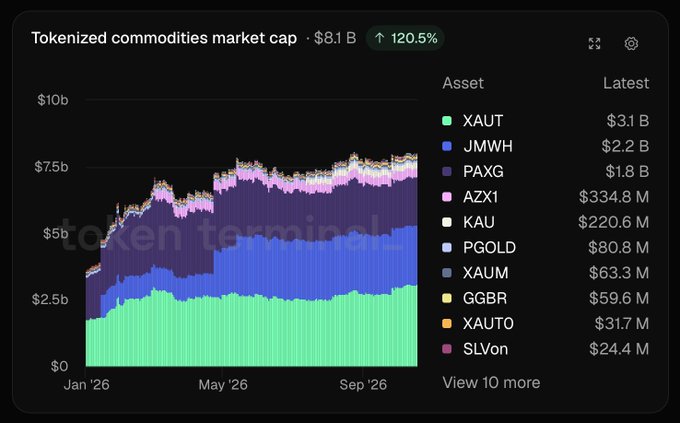
Tokenized commodity market cap now stands at $8.1 billion, climbing 120.5% year-to-date (YTD), per the latest Token Terminal snapshot.
Gold-backed tokens continue to anchor nearly the entire category, with physical-metal representations driving most of the expansion while other commodities lag far behind.
XAUT leads the ranking at $3.1 billion. JMWH follows with $2.2 billion and PAXG sits at $1.8 billion.
Together, XAUT and PAXG alone hold roughly $4.9 billion, or 60% of total value.
Smaller names such as AZX1, KAU, and PGOLD fill the remaining space yet remain distant from the top tier.
Why Do Gold Tokens Dominate Tokenized Commodity Market Cap?
Investors treat gold as a familiar hedge that already carries centuries of trust.
Tokenized versions simply add 24/7 transferability and fractional ownership without forcing users to leave digital wallets.
Meanwhile, the two largest gold products benefit from established issuers, regular attestations, and deep secondary liquidity across major exchanges.
In parallel, rising spot gold prices during 2026 lifted the dollar value of existing inventories even before new issuance arrived.
Next, crypto-native capital seeking stability during equity volatility flowed preferentially into these proven gold wrappers rather than experimental silver, oil, or copper tokens.

How Concentrated Is the Broader Tokenized Commodity Landscape?
Beyond the gold pair the market thins quickly. The next several assets combined still trail the leaders by a wide margin, leaving non-gold exposure comparatively thin.
Besides this concentration, most value still resides on Ethereum even as holder counts spread across additional chains.
At the same time the pattern reveals both strength and limitation. Gold products deliver reliable scale, yet the sector’s growth story remains narrowly focused.
Further along, any meaningful diversification into industrial metals or energy would require clearer demand signals from crypto users who currently prefer the simplicity of gold.
What Does the 120.5% Rise Signal for Future Adoption?
The jump from earlier 2026 levels to $8.1 billion shows tokenization can capture real-world commodity value when product design matches investor needs.
For instance, continuous settlement and decentralised finance (DeFi) composability give these tokens practical edges over traditional vaults or futures contracts.
Similarly, the heavy gold tilt suggests the category still functions more as a digital store-of-value layer than a full commodity suite.
Ultimately, the $8.1 billion mark, paired with 60% concentration in two gold tokens, shows both progress and the open question of how quickly other physical assets can follow the same path.
