


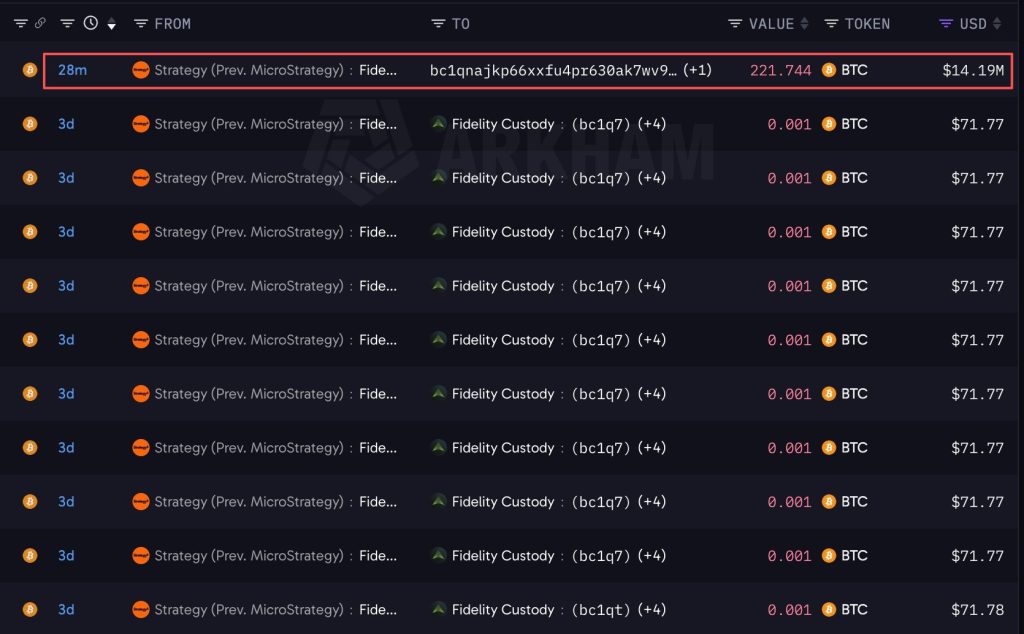
On-chain monitors spotted Strategy moving 221.74 BTC, valued at roughly $14.19 million, into a fresh wallet address.
Lookonchain flagged the transfer about 30 minutes after it hit the blockchain on Monday, November 16, 2026.
The coins left a Strategy-linked address tied to Fidelity custody and landed in a newly created wallet beginning bc1qnajkp66xxfu4pr630ak7wv9.
Strategy, the public company formerly known as MicroStrategy, still holds the largest corporate Bitcoin treasury.
As of its Sunday, November 15 filing, the firm controlled 850,849 BTC bought for an average of about $75,452 each.
This latest shift represents only a tiny slice of that stack.
What Does the Strategy BTC Transfer Mean?
The move itself changes nothing about Strategy’s overall exposure.
Blockchain explorers show the coins stayed inside the company’s known entity cluster rather than heading to an exchange deposit address. Large holders routinely refresh wallets.
In past cycles Strategy has rotated custody between Coinbase, Fidelity, and internal addresses purely for operational security and counterparty risk management.
Meanwhile Bitcoin traded near $64,000, well below Strategy’s average cost basis.
The transfer therefore arrives against a backdrop of unrealised losses on the treasury, yet the company continues buying on dips. Just days earlier it added 485 BTC for $33.4 million.

Is Strategy Selling Its Bitcoin Holdings?
No evidence points to a sale. The receiving wallet shows no immediate onward movement to known exchange hot wallets.
Strategy has sold small amounts of Bitcoin in the past to cover preferred dividends or rebuild cash reserves, yet those sales always appeared in SEC filings and involved clear exchange-linked addresses.
This transfer lacks those hallmarks.
At the same time, Michael Saylor and the company have repeatedly stated their long-term accumulation stance.
Historical wallet rotations in 2025 produced similar headlines and later proved to be custody housekeeping rather than liquidation.

Why Does the Company Move BTC to New Wallets?
Institutional Bitcoin holders face constant operational needs.
Fresh wallets reduce the risk surface of long-used addresses.
Custodians themselves periodically rebalance internal ledgers, treat deposits as fungible, and shift coins across their systems.
Strategy’s Arkham entity page already tracks more than 1,500 addresses and notes substantial holdings at Fidelity Custody.
A 221-BTC shift fits that ongoing pattern of quiet maintenance.
Furthermore, moving modest amounts first lets teams test new custody arrangements before larger migrations.
The company has executed multi-thousand-BTC rotations in previous quarters without ever selling the coins.

How Does This Fit the Company’s Overall Bitcoin Strategy?
Strategy treats Bitcoin as its primary treasury reserve asset.
It raises capital through equity and preferred stock sales, then deploys most of the proceeds into additional BTC while maintaining a multi-year cash buffer for dividends and interest.
The November 9–15 window showed the same approach: share sales funded both a small Bitcoin purchase and large preferred-share buybacks.
In parallel, the firm keeps refining custody infrastructure. Wallet hygiene forms part of that discipline.
Investors watching the ticker MSTR therefore see two parallel tracks—steady accumulation on the balance sheet and routine on-chain housekeeping that rarely alters the net position.

What Are the Company’s Current Bitcoin Holdings?
After the most recent disclosed purchase the treasury stood at 850,849 BTC.
Market value fluctuates with the Bitcoin price, yet the company reports total acquisition cost near $64.2 billion.
The 221.74 BTC transfer leaves that headline figure unchanged.
On-chain trackers such as Arkham continue to attribute hundreds of thousands of coins to Strategy across its verified addresses.
Market participants will keep monitoring the new wallet for any subsequent activity.
Until coins leave the Strategy cluster or appear in an exchange deposit, the simplest reading remains operational rather than directional.
Strategy continues to treat Bitcoin as a core long-term holding, and this modest transfer fits the quiet, methodical style the company has shown for years.
