

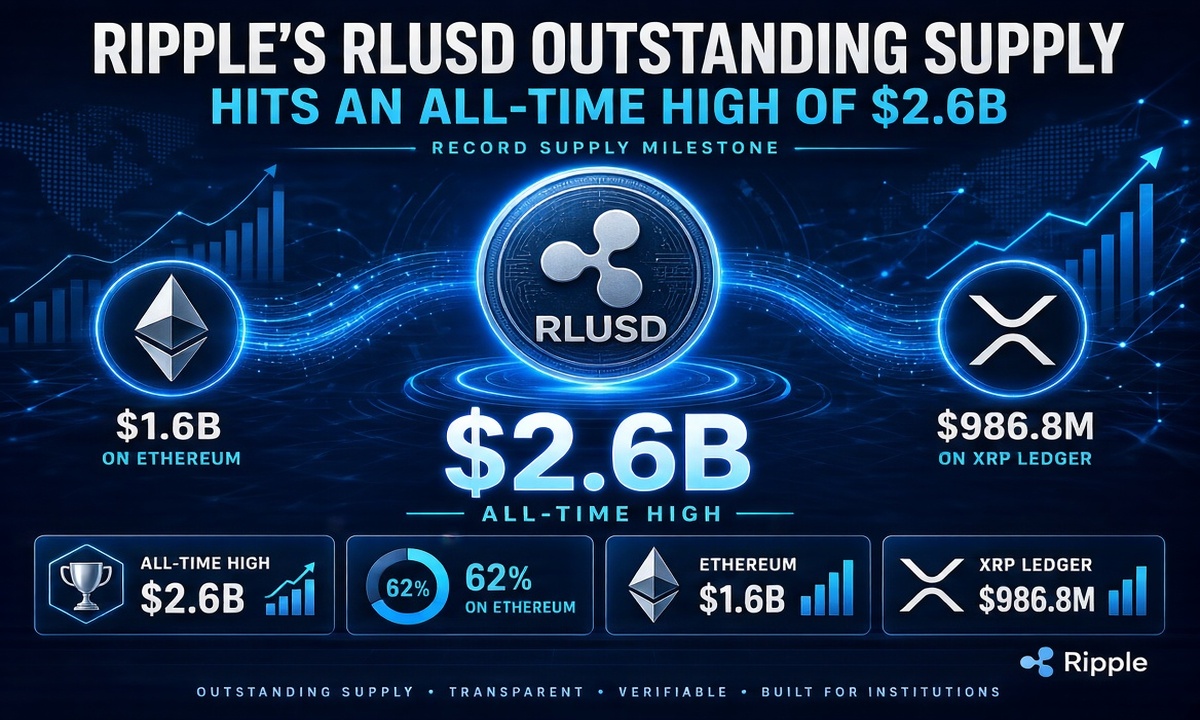
Ripple’s RLUSD stablecoin has pushed its outstanding supply to a fresh all-time high (ATH) of $2.6 billion.
The milestone arrives as the regulated dollar token continues to expand across two major networks.
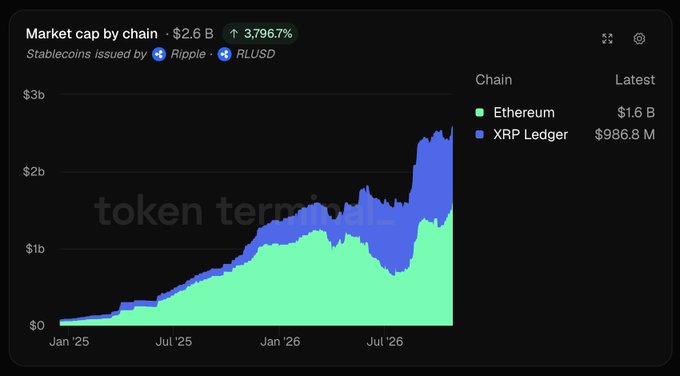
Ethereum currently hosts about $1.6 billion of the supply, while the XRP Ledger carries roughly $986.8 million.
In short, roughly 62% of all RLUSD now sits on Ethereum.
This dual-chain distribution gives the stablecoin access to both Ethereum’s deep DeFi liquidity and the XRP Ledger’s payment-focused infrastructure.
What Is RLUSD and How Does It Differ From Other Stablecoins?
RLUSD is a fiat-backed USD stablecoin issued under New York Department of Financial Services oversight.
Ripple designs it for institutional and enterprise use cases, with reserves held in cash, cash equivalents, and short-term U.S. Treasuries.
Monthly attestations and regulatory supervision form the core of its compliance framework.
At the same time, the token remains fully transferable on both Ethereum and the XRP Ledger, allowing users to move value between ecosystems without friction.
Unlike purely crypto-native stablecoins, RLUSD emphasises regulatory clarity and institutional-grade custody, which has helped it gain traction among banks, payment firms, and trading desks.

Why Has RLUSD Supply Grown So Quickly?
Supply growth reflects rising institutional demand and broader product integration. RLUSD now appears across major exchanges including Coinbase, Binance, Kraken, Robinhood, and OKX.
Meanwhile, Ripple continues to embed the stablecoin into its payments, treasury, and prime-brokerage offerings.
Partnerships with firms such as BNY, Mastercard, and Cross River further expand its real-world utility.
In parallel, recent approval for a national trust bank charter strengthens the reserve-management infrastructure behind the token.
Recent data also show steady net minting activity, with supply climbing more than 3% over the past 30 days even as occasional rebalancing occurs between chains.
How Does the Chain Split Affect Users and Liquidity?
The heavier concentration on Ethereum gives RLUSD easier entry into lending markets, decentralised exchanges (DEXs), and yield strategies that dominate that network.
On the XRP Ledger side, the token supports faster, lower-cost payments and settlement use cases.
Users can therefore choose the chain that best matches their needs, while issuers retain the ability to rebalance supply as demand shifts.
Still, the majority share on Ethereum shows where most secondary-market activity and DeFi composability currently reside.
The $2.6 billion mark positions RLUSD among the larger regulated dollar stablecoins.
Continued growth will depend on further institutional adoption, sustained reserve transparency, and the ability to maintain the peg across both networks during periods of market stress.
For now, the all-time high supply figure shows clear momentum for Ripple’s stablecoin strategy.
