

Public companies now hold roughly 1.3 million in Bitcoin treasury, a 31% rise over the past 14 months.
Yet, the headline growth masks a sharper reality. Nearly all the net addition came from one firm.
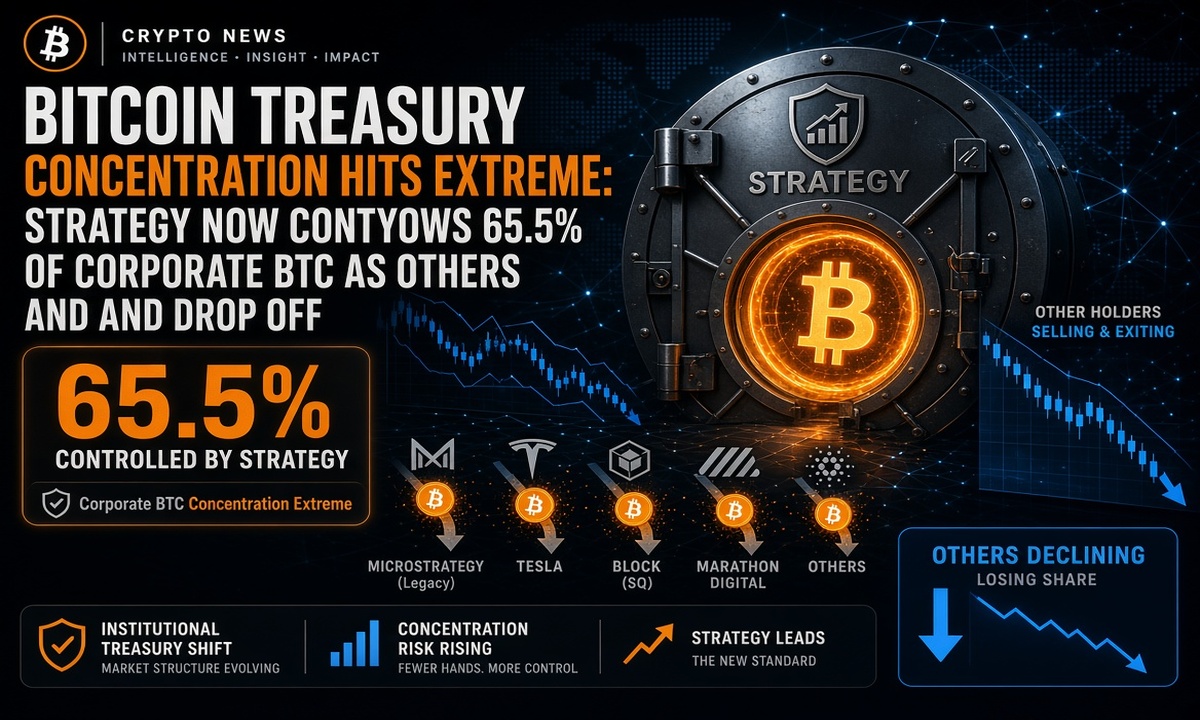
Strategy (formerly MicroStrategy) now controls 65.5% of all corporate Bitcoin treasury holdings with 848,517 BTC—more than 19 times the next largest public holder.
The rest of the sector tells a different story. Existing holders outside Strategy have reduced their stacks, new entrants have slowed to a trickle, and selling has become routine.

Why Has Bitcoin Treasury Growth Become So Concentrated?
Since mid-August 2025, total public-company holdings rose by about 304,000 BTC.
Strategy alone accounted for roughly 71% of that increase.
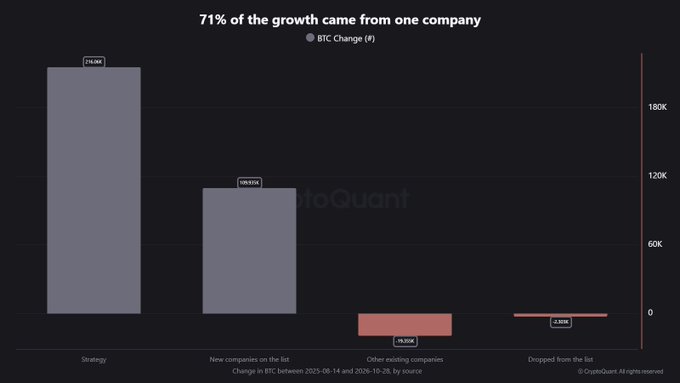
Meanwhile, companies already on the list (excluding Strategy) saw their combined holdings fall 5.4%.
Miners led the reductions, with MARA cutting more than 15,000 BTC and Riot trimming nearly 8,000.
In parallel, the wave of fresh treasury adopters has largely ended. New companies joining the list peaked at 23 in a single month in September 2025.
By late 2025, the monthly figure had dropped into single digits, and all of 2026 so far has produced only 11 new names.

How Much Have Non-Strategy Companies Actually Bought Lately?
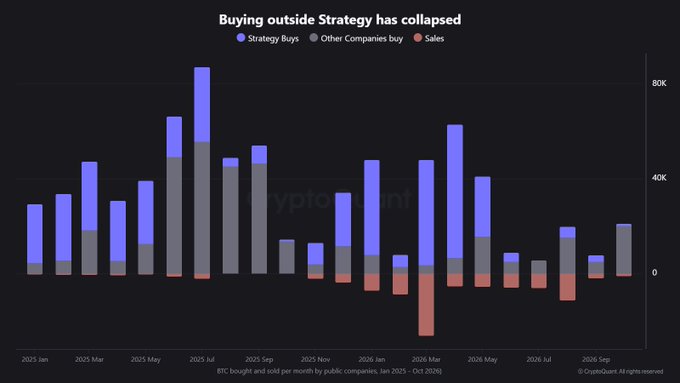
Buying activity outside Strategy has collapsed. In July 2025, other public companies purchased more than 55,000 BTC.
By September 2026, that figure had fallen to roughly 5,000 BTC—a 91% drop.
Only 50 of more than 200 companies with any Bitcoin history bought additional coins in the most recent six-month window.
At the same time, the number of monthly sale disclosures has risen steadily, and dozens of firms have reduced or fully exited their positions.
What Does Extreme Concentration Mean for the Broader Market?
The top ten corporate holders still control about 86% of all public-company Bitcoin, a share that has barely changed.
Inside that group, however, Strategy’s dominance has grown sharply.
This leaves the corporate Bitcoin treasury market leaning heavily on a single balance sheet and a single capital-raising strategy.
Other firms face higher funding costs, tighter cash constraints, or simply different priorities, which has limited their ability or willingness to keep accumulating.
For investors tracking Bitcoin treasury trends, the data show a clear shift.
The early phase of broad corporate adoption has given way to a more concentrated phase in which one company continues to expand while many others pause, sell, or quietly drop off the list.
Whether this concentration stabilises or intensifies will shape both the narrative and the actual supply dynamics of corporate Bitcoin holdings in the months ahead.
