

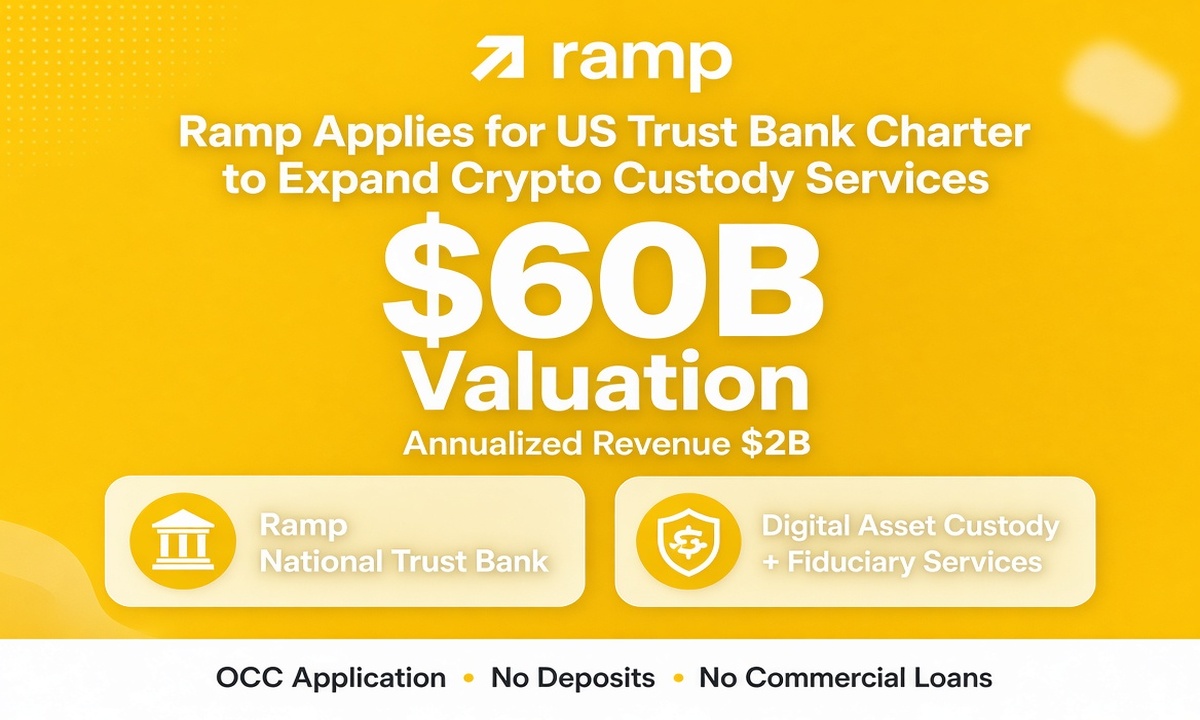
Ramp, a corporate payments platform, has applied for a US national trust bank charter to offer digital asset custody and fiduciary investment management.
The company submitted its application to the Office of the Comptroller of the Currency (OCC) on Friday, October 16, 2026.
Ramp announced the application on Monday, October 19, 2026 and named the proposed institution Ramp National Trust Bank.
If approved, the proposed bank would operate under federal supervision. However, it would not accept customer deposits or provide commercial loans. Instead, Ramp wants to bring investment management and digital asset custody under a consistent federal regulatory framework.
The company plans to develop financial products alongside its existing banking partners. Despite this, Ramp has not disclosed which digital assets the proposed bank would support. It has also not announced a launch date or confirmed whether the services would target existing business customers.
In addition, Ramp has not specified whether the institution would support stablecoins, cryptocurrency trading, or other services beyond custody. The application remains subject to regulatory review, so the proposed bank cannot begin operations without the required authorization.

Plans to Expand Its Financial Services Under Federal Oversight
Ramp currently provides checking and investment products through separate financial institutions. First Internet Bank of Indiana provides its business checking deposits, while Ramp Advisory LLC offers its Investment Account. Moment Advisors manages the investment portfolios, and Apex Clearing Corporation handles brokerage execution and custody.
The company’s existing investment options include government money market funds, short-term prime mutual funds, US Treasury securities and investment-grade corporate bonds. The selected portfolio determines which investments customers can access.
Ramp reported more than $5 billion in customer balances across its checking and investment accounts as of Tuesday, October 20. However, this figure does not represent assets held by the proposed trust bank.
In October 2026, co-founders Eric Glyman and Karim Atiyeh reported a $60 billion company valuation. Ramp also said it served 85,000 businesses and generated more than $2 billion in annualised revenue.
Meanwhile, other crypto companies are pursuing similar federal charters. Rain applied for a national trust bank charter in October to support digital asset custody and stablecoin reserve management.
Payward, the parent company of Kraken, filed its application in May. Its proposed trust company would focus on digital asset custody for institutional clients. Zerohash submitted a revised application in August after the OCC returned its initial filing in July.
The OCC has also issued conditional approvals to several digital asset firms, including Ripple, BitGo, Paxos and Fidelity Digital Assets. However, conditional approval does not grant final authorisation to begin operations.

Ramp Awaits OCC Decision Amid Legal Challenge to Trust Bank Rules
Ramp must complete the OCC’s review before launching its proposed trust bank. The regulator may request additional information or impose conditions before granting final approval.
However, a legal challenge has raised questions about the wider chartering framework. The Independent Community Bankers of America sued the OCC on October 2 over its national trust bank rules.
The association argues that the regulator exceeded its authority by allowing trust banks to conduct activities beyond traditional fiduciary services. The OCC maintains that its rules clarify existing authority for activities such as custody and safekeeping.
