


By late September 2026, metals had seized a commanding lead on Gate Exchange’s traditional finance desk.
CryptoQuant data shows metals holding roughly 65% of tracked TradFi volume while equities sat near 30%.
The shift marks a clear rotation inside one of the busiest crypto-native multi-asset platforms.
Why Are Metals Now Dominating Gate Exchange TradFi Volume?
Traders moved decisively into gold and silver contracts during the second half of September.
After a quieter summer, daily activity climbed and metals absorbed the bulk of the new flow.
The stacked volume chart from January through late September reveals a persistent orange band of metals trading that widened again in the final weeks.
Equities, which had briefly narrowed the gap earlier in the year, slipped back to about 29.6%. Oil and other commodities remained marginal at roughly 2.6%.
This concentration reflects macro positioning rather than pure speculation.
Investors used Gate’s contracts for difference (CFD) and tokenized metal products to express views on inflation risk, dollar strength, and geopolitical uncertainty while keeping positions inside the same account that holds their crypto.
CryptoQuant’s late-September snapshot captures the moment metals reclaimed majority status.
How Does the Metals 65% Share Compare with Earlier 2026 Trends?
Earlier readings told a different story. Mid-September data still showed metals at 54.2% of tracked volume with cumulative metals turnover already at $18.3 billion through September 22.
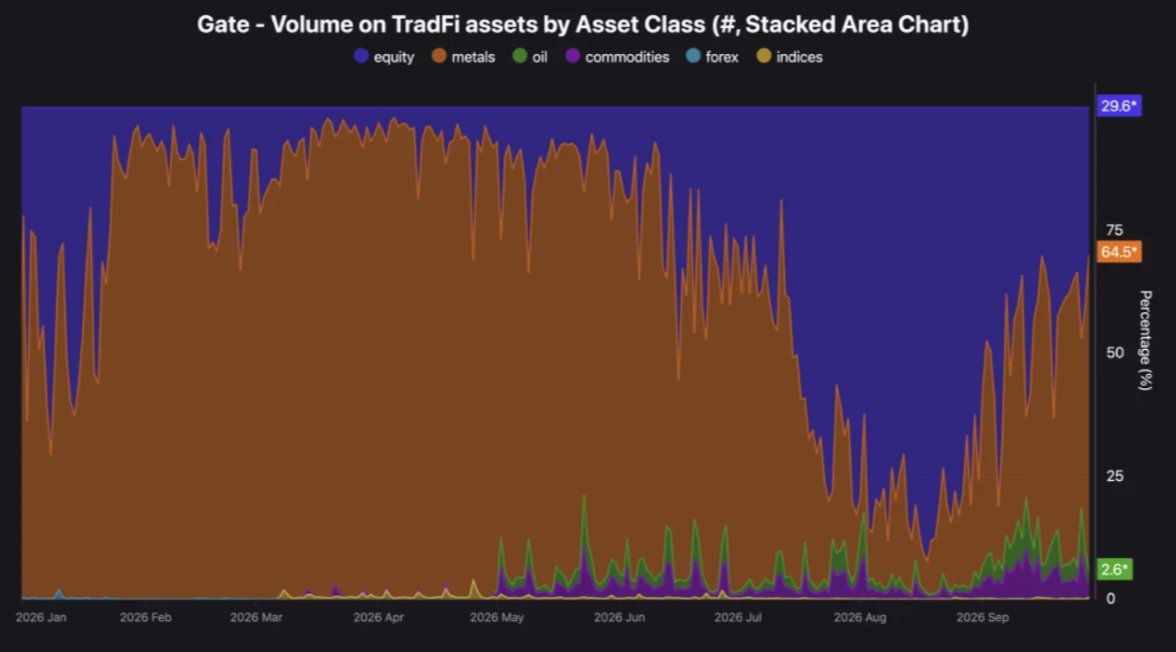
By month-end, the share had climbed another ten percentage points.
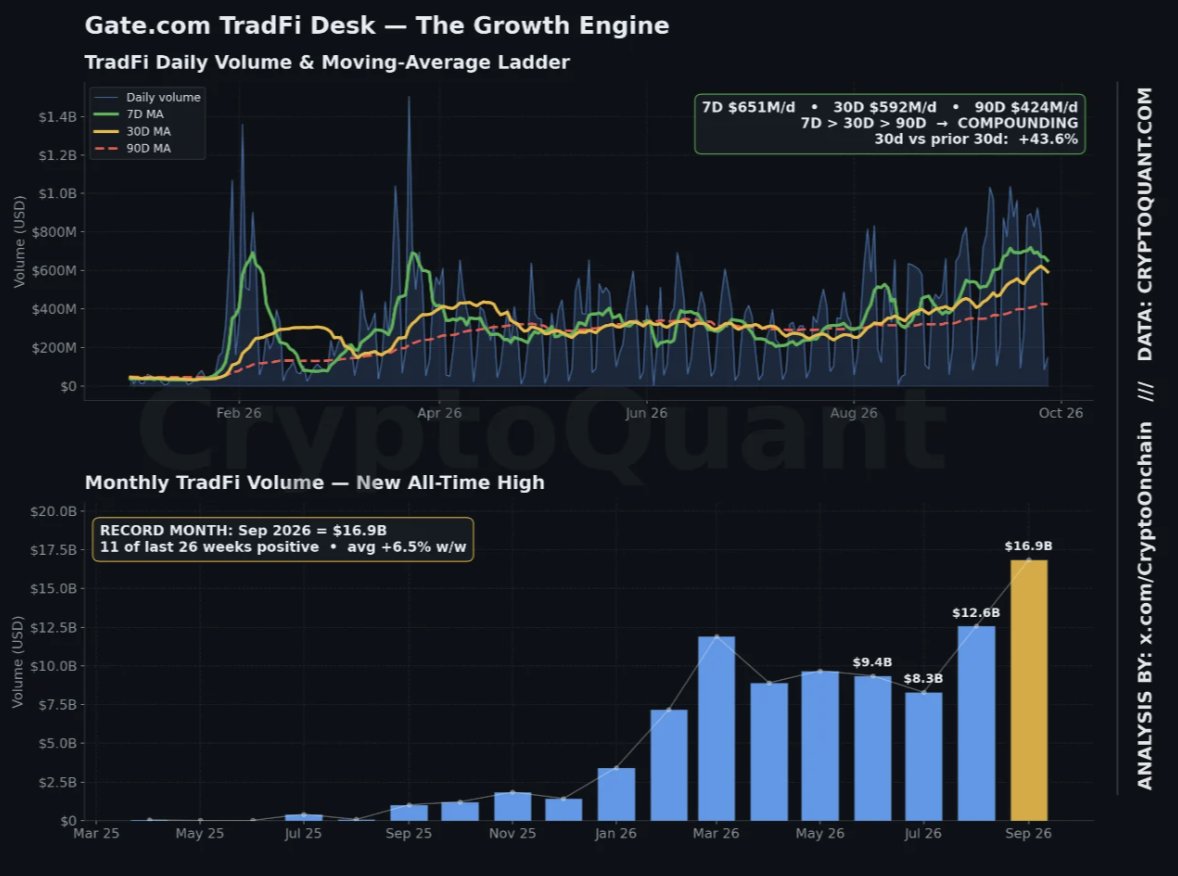
The path through 2026 formed a classic U-shape. Volume peaked near $2.4 billion daily in late March, sank to a $400–600 million trough in June–July, then recovered aggressively.
Metals kept a high single-digit to mid-50% share even during the quiet summer months.
When overall activity rebounded, metals simply captured most of the incremental dollars.
September overall TradFi volume on Gate had already cleared $16.86 billion by September 27 and was on track for a record month.
What Does This Mean for Traders Watching Gate Exchange TradFi Volume?
The dominance of metals changes the risk profile of the desk.
Liquidity concentrates in a handful of highly correlated instruments, primarily gold and silver.
That concentration can tighten spreads during quiet periods yet amplify moves when macro headlines hit.
At the same time, the broader platform remains balanced. Spot crypto and futures volumes continued to grow alongside the TradFi vertical, showing the new activity is additive rather than cannibalising core business.
Gate’s catalogue of more than 1,000 TradFi instruments—including CFDs, ETFs, and tokenized equities—gives users room to rotate between metals and equities without leaving the platform.
Market share data further shows the platform’s position. Gate held between 3.7% and 13.5% of the wider crypto TradFi market through 2026 and reached 10.7% in August, ranking it among the top three venues by volume.

Will Equities Regain Ground in Gate Exchange TradFi Volume?
History suggests leadership can rotate quickly. Pre-initial public offering offering (IPO) and artificial intelligence (AI)-related names drove sharp equity spikes earlier in the year.
US tickers still accounted for the majority of equity flow, while Korean and Hong Kong names showed episodic strength.
Nothing prevents a similar surge if equity volatility returns or if specific catalysts emerge.
Yet, the current metals lead looks structural rather than fleeting. The asset class held its share through both peak and trough, indicating sticky demand for commodity exposure among Gate’s user base.
Until equities deliver a sustained volume wave of their own, metals appear set to keep the majority share of Gate Exchange TradFi volume.
The late-September data therefore offers a clean signal: on this particular desk, traditional safe-haven assets currently outrank pure equity exposure.
Traders monitoring Gate’s multi-asset order books now treat metals volume as the primary pulse of the TradFi vertical.
