


Bitcoin advanced more than 20% in a single week and now trades near $77,000 after briefly approaching $80,000.
Traders and analysts continue to debate whether this sharp recovery can endure or whether it represents a temporary rebound.
The discussion centres on the quality of demand, technical structure, and broader market conditions.
What is driving the current Bitcoin rally?
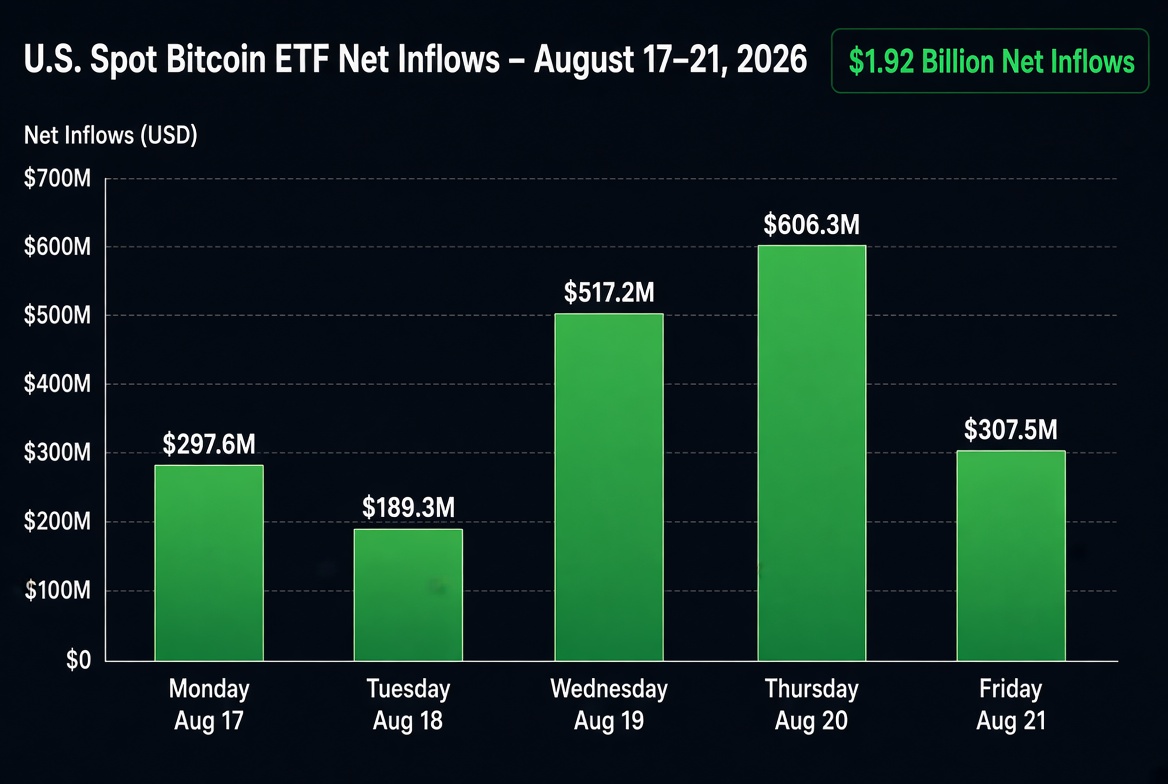
Multiple forces converged to lift Bitcoin higher. U.S. spot Bitcoin ETFs recorded nearly $1.9 billion in net inflows during the five sessions ending August 21.
Simultaneously, a large short-covering wave liquidated billions in leveraged positions.
Furthermore, the U.S. Treasury expanded longer-dated bond buybacks, which eased yields and improved risk appetite. Regulatory headlines and improved sentiment added further support.
These elements worked together to create the strongest weekly performance in recent months.
How much of the Bitcoin rally is from short squeezes vs real demand?
Forced liquidations provided powerful initial momentum. Data showed several billion dollars in short positions closed as price accelerated.
Meanwhile, spot ETF inflows introduced genuine buying pressure because authorised participants purchase actual Bitcoin.
In addition, some analysts note that fresh demand appeared after the squeeze phase.
The combination of forced covering and institutional capital created a stronger foundation than pure leverage-driven moves.
Can Bitcoin ETF inflows keep the rally going?
Continued inflows would supply ongoing demand and help absorb selling pressure. BlackRock’s product led recent activity, yet other funds also recorded positive flows.
Moreover, trading volume across the ETF complex rose sharply during the advance. Sustained institutional participation remains one of the clearest measurable sources of regulated demand.
Market participants will watch whether the inflow streak extends beyond the initial rebound.

Will Bitcoin reach $80,000 or higher this year?
Bitcoin has already tested the upper end of the $78,000–$79,500 zone. A decisive close above $80,000 would mark a psychological and technical breakthrough.
Likewise, some research notes have raised the possibility of higher targets if momentum and flows persist.
The path higher depends on follow-through buying and the ability to clear nearby supply.
What are the key risks that could end the Bitcoin rally?
Profit-taking presents a near-term concern after the rapid climb. Elevated short-term indicators also raise the chance of consolidation.
Importantly, any shift in macro sentiment or a return of heavy selling could challenge recent gains.
Thin weekend liquidity removes the ETF channel and leaves pure spot demand to defend the advance.
Is this BTC rally different from previous ones?
Earlier rebounds this year often faded when fresh buyers failed to appear. The current move combined a large short squeeze with measurable ETF inflows and a constructive macro signal.
Furthermore, the presence of regulated institutional vehicles changes the demand profile compared with purely speculative phases.
This distinction gives the recovery a different character from some earlier attempts.

How sustainable is the Bitcoin price above $75,000–$77,000?
Holding the $75,000–$76,000 region preserves the sequence of higher lows that developed during the rally. Price action above this band keeps the short-term structure intact.
Meanwhile, a sustained move through $80,000 would strengthen the case for continuation.
Traders monitor volume and order-flow data for confirmation that demand remains active at these levels.
What support levels need to hold for the Bitcoin rally to continue?
Immediate support sits near $76,000–$76,500, followed by the broader $75,000–$76,000 pivot. A deeper shelf appears around $73,500–$74,500.
In addition, the $70,000–$71,700 zone remains an important longer-term reference. Defending these areas would maintain the recovery narrative.

Could profit-taking reverse the Bitcoin rally soon?
Coins bought during the recent advance now sit in profit. Some holders may choose to realise gains near psychological round numbers.
Simultaneously, the volume of Bitcoin transferred to exchanges during the climb represents a potential source of supply.
Market participants watch these flows for signs of distribution.
What do analysts say about the sustainability of this BTC move?
Several observers describe the rally as more constructive than pure short-covering events because of the accompanying ETF demand. Others caution that one strong week does not yet confirm a durable new range.
Moreover, research notes emphasise the need for sustained spot buying after the initial squeeze exhausts.
Views remain divided between those who see structural improvement and those who wait for clearer confirmation.
How does the U.S. Treasury / macro environment affect the BTC rally?
The Treasury’s decision to expand longer-dated buybacks reduced pressure on yields and supported risk assets.
This liquidity signal arrived alongside the price advance and helped improve broader sentiment.
Likewise, ongoing discussions around fiscal conditions and regulatory clarity continue to influence positioning. Macro developments remain an important external driver for Bitcoin.

Is the Bitcoin rally still in a bull or bear market?
Some analysts note that Bitcoin remains below major long-term averages and prior cycle highs, keeping the broader structure open to interpretation.
Others view the reclaim of key shorter-term levels as evidence that a bottoming process is underway.
Furthermore, the quality of recent demand and the response at support will help clarify the larger trend. Market structure continues to evolve with each session.
BTC’s recent advance rests on a combination of institutional flows, positioning dynamics, and macro support.
The sustainability of the move depends on whether genuine demand persists after the initial surge and whether key technical levels continue to hold.
Traders and investors will monitor ETF activity, support zones, and broader liquidity conditions for clearer signals in the sessions ahead.
