


Bullish stock put on a remarkable run in August 2026 after trading alongside the price patterns of blue-chip cryptocurrencies such as Bitcoin and Ethereum.
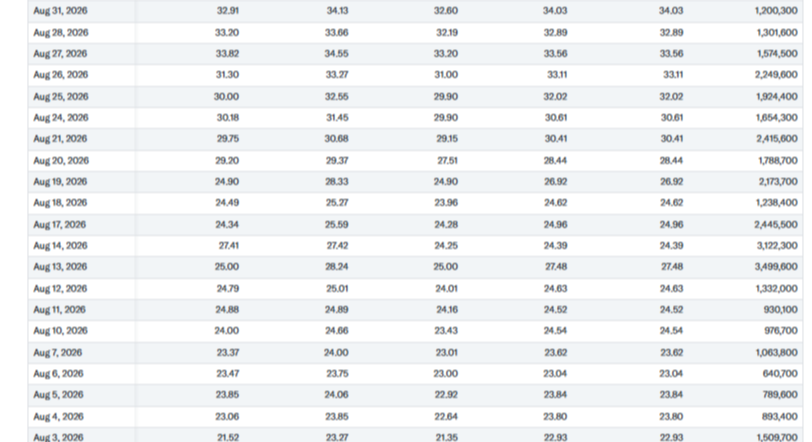
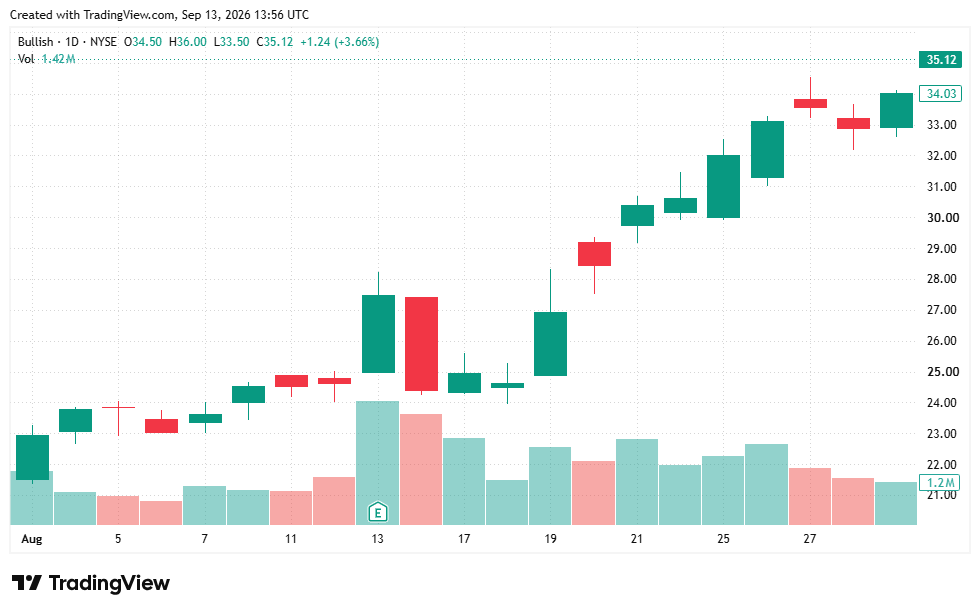
Shares opened the month near $21.52 on August 3 and climbed all the way to a high of $34.55 before settling at $34.03 by month-end.
That move delivered roughly a 58% gain and turned heads across both traditional finance (TradFi) and crypto circles.
The rally did not happen in isolation. A combination of strong company-specific news, a broader crypto market rebound, and fresh strategic moves around tokenisation pushed the stock higher.
This article breaks down exactly what drove the surge and examines the five questions investors keep asking most often right now.
Why did Bullish stock surge nearly 58% in August 2026?
Several forces aligned at the same time. Bitcoin staged a solid recovery through August, rising more than 20% and lifting sentiment across crypto-related equities. Bullish rode that wave, yet company-level developments added extra fuel.
Second quarter (Q2) results released mid-month showed subscription, services and other revenue climbing 62% year-over-year (YoY).
Adjusted Earnings Before Interests, Taxes, Depreciation, and Amortisation (EBITDA) expanded sharply as well.
Those numbers demonstrated that the business continues growing even when pure trading volumes soften.
Beyond pure financials, Bullish began trading its own tokenised shares on its regulated exchange and advanced the $4.2 billion Equiniti deal.
Investors interpreted both moves as proof the company is positioning itself at the centre of the next major market structure shift.
Looking closer, short covering and renewed institutional interest also played roles. The stock had traded at depressed levels for much of the prior year, so any positive catalyst triggered a rapid re-rating.
What is Bullish (BLSH) and what does the company actually do?
Bullish operates as an institutionally focused global digital asset platform.
It runs a regulated exchange that combines a high-performance central limit order book with automated market-making technology.
The goal is deep, predictable liquidity for both spot and derivatives trading.
The company also owns CoinDesk, which supplies news, data, indices, and industry events. That media and information arm feeds clients into the trading and data businesses, creating a cross-sell engine.
Bullish holds licenses and authorisations across multiple jurisdictions, including the United States, Europe, Hong Kong, and Gibraltar.
In short, the firm sits at the intersection of crypto market infrastructure and traditional finance.
It aims to serve institutions that want regulated access to digital assets while simultaneously building tools for the tokenisation of real-world securities.
What is the Equiniti acquisition and how will it transform Bullish?
Bullish agreed to acquire Equiniti for approximately $4.2 billion. Equiniti is a major transfer agent and registry provider that serves thousands of public companies and millions of shareholders.
The deal is expected to close around January 2027, pending remaining approvals.
Once completed, Bullish gains the ability to act as both the transfer agent and the trading venue for tokenised securities.
That combination is rare. Most companies can either issue tokens or facilitate trading, yet few control the full stack from registry through settlement.
Management argues the acquisition lets issuers move shares on-chain while preserving legal shareholder rights.
In parallel, Bullish can expand its addressable market far beyond crypto into the much larger universe of traditional equities.
Early progress already appears in the company’s decision to tokenise its own shares first.

How do tokenised BLSH shares work and can retail investors hold them?
Bullish became one of the first NYSE-listed companies to tokenise its own ordinary shares.
These on-chain versions represent real equity, administered by a Securities and Exchange Commission (SEC)-registered transfer agent, and carry the same legal rights as traditional shares.
At present, trading occurs on Bullish’s own regulated exchange and settles against a United States Dollar (USD) stablecoin.
Holders must complete Know Your Customer (KYC) and whitelist a compatible wallet.
Retail investors can participate if they meet the compliance requirements, yet full decentralised exchange (DEX) trading remains limited while regulators finalise the framework.
The company views this as a proof-of-concept (PoC). By starting with its own stock, Bullish demonstrates the technology works and invites other issuers to follow.
Further along the roadmap, broader secondary-market liquidity is expected once regulatory clarity improves.

Is BLSH still a buy after its big August rally — what are the key risks and catalysts?
The August move has already priced in a meaningful amount of good news. Valuation remains relatively modest compared with pure software or high-growth fintech peers. Yet, the stock now trades well above the levels seen earlier in the summer.
Key near-term catalysts include continued growth in subscription revenue, progress on the Equiniti closing, additional tokenised listings, and any sustained recovery in crypto trading volumes.
Longer-term upside hinges on whether Bullish can become a preferred infrastructure provider for issuer-sponsored tokenised securities.
Risks remain real as crypto markets stay volatile and trading revenue can swing quickly. Execution on the Equiniti integration carries complexity.
Competition from both traditional exchanges and newer crypto platforms continues to intensify.
Regulatory developments around tokenised equities could either accelerate or slow the strategy.
Investors who believe the tokenisation thesis will play out over multi-year horizons may still find the risk-reward attractive.
Those seeking smoother near-term returns may prefer to wait for clearer evidence that the new revenue streams are scaling.
Bullish transformed from a relatively quiet post-initial public offering (IPO) name into one of the standout crypto-related stocks of August.
The combination of solid operational progress and a timely strategic pivot toward tokenisation created the conditions for the 58% rally.
Whether the stock can build on that momentum depends on execution over the coming quarters.
The next chapters will centre on how successfully the company converts its infrastructure vision into recurring, higher-margin revenue.
