
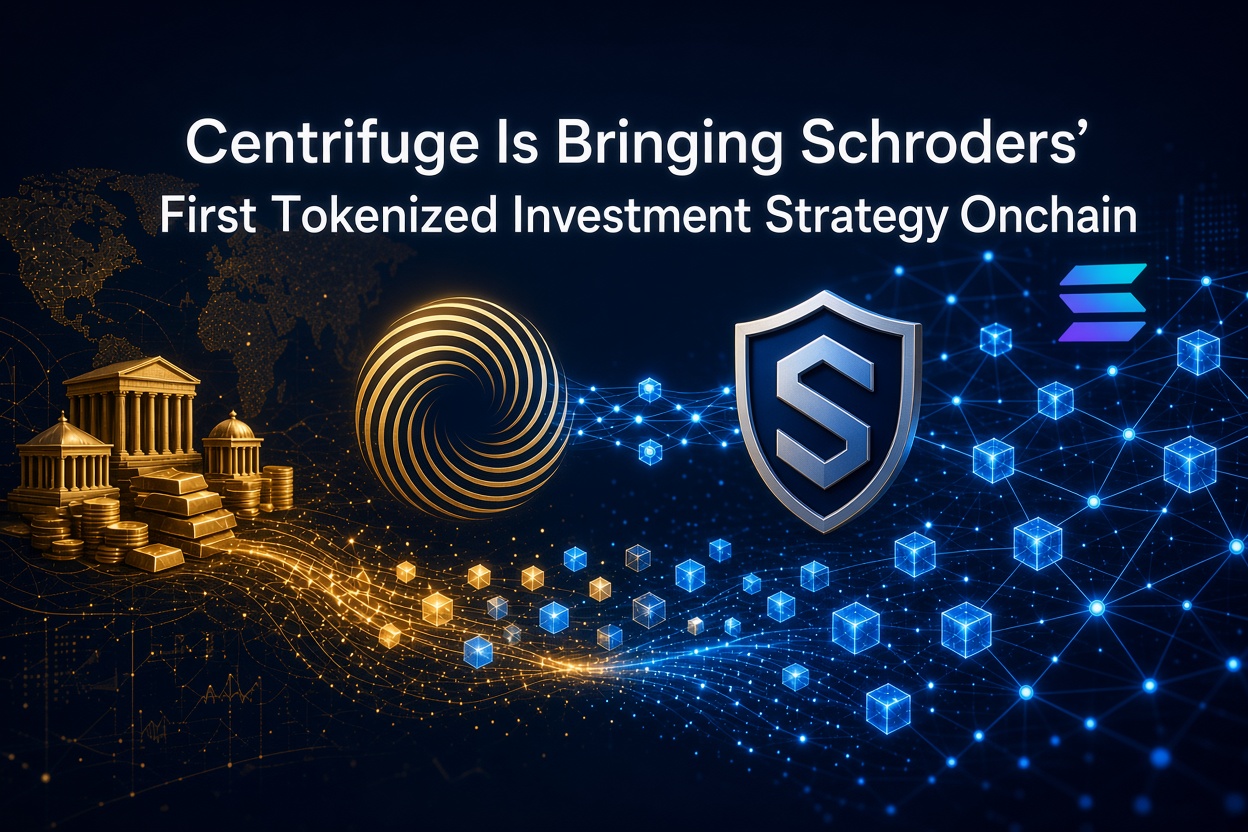
Centrifuge has just placed a major traditional asset manager’s actively managed emerging-markets debt strategy onto public blockchain rails.
The firm announced the launch of $SISF, the tokenized version of the Schroder International Selection Fund Emerging Market Bond fund, now live on Solana.
This marks Schroders’ first tokenized investment strategy and its first deployment on the Solana network.
Schroders manages more than $1 trillion in assets and brings more than 50 years of emerging-markets debt experience, supported by over 40 dedicated specialists covering sovereign, corporate and local-currency bonds.
Until this point, most onchain fixed-income products stayed close to cash and short-duration government paper.
Centrifuge’s move with Schroders deliberately steps into a different risk-and-return profile.
What Exactly Is the SISF Strategy That Centrifuge Tokenized?
The underlying fund invests across government and corporate debt issued in emerging markets.
Returns depend on credit quality, currency movements and broader economic conditions in those economies.
Centrifuge structured the onchain product as a feeder fund with a tokenized share class.
Investors receive blockchain-based shares in the feeder, which itself holds the Schroders strategy; they do not hold the underlying fund shares directly.
This keeps existing valuation, custody and governance arrangements intact while adding onchain issuance and transferability.
How Does Centrifuge’s Infrastructure Support the Launch?
Centrifuge supplies the issuance, management and connectivity layer that lets institutional strategies operate natively on public chains.
The platform already supports hundreds of millions of dollars in tokenized assets.
By pairing that infrastructure with Schroders’ long track record, Centrifuge turns an established active strategy into a programmable building block that can sit inside vaults, serve as collateral or flow into other financial applications.
Anil Sood, Centrifuge’s Chief Strategy and Growth Officer, described the significance clearly: onchain fixed income had largely stayed with cash-like products.
Yet, emerging-markets debt adds a fundamentally different source of risk and return, backed by one of the most experienced managers in the asset class.
Why Did Centrifuge and Schroders Choose Solana?
Solana already hosts more than $4 billion in tokenized real-world assets, giving the new product immediate access to one of the larger RWA ecosystems.
Marita McGinley, Schroders’ Head of Operations for APAC and Digital Assets, noted that the firm is tokenizing this specific strategy and issuing it on Solana as its first deployment on the network.
She added that working with Centrifuge lets Schroders make its emerging-markets expertise available to a new generation of investors while continuing to innovate in delivery.
Nick Ducoff of the Solana Foundation framed the arrival of a manager the size of Schroders as a new stage for onchain capital markets—one that moves past tokenized cash toward sophisticated, actively managed strategies that can be issued, distributed and integrated on public infrastructure.
What Does This Mean for Broader Onchain Fixed Income?
The launch sits inside a wider shift. Asset managers are no longer testing tokenization only with the safest cash products.
They are beginning to place more complex, actively managed strategies on public chains so those strategies can interact directly with investors, applications and liquidity venues.
Centrifuge’s role is to provide the operating model and market connectivity that let firms like Schroders start at institutional scale from day one.
John Mensack, Senior Investment Director for Fixed Income at Schroders, emphasised that emerging-markets debt is an area where experience, local insight and active management matter especially.
Bringing relevant opportunities onchain, he said, helps make the asset class more accessible and ready for the future digital financial ecosystem.
Who Can Access $SISF and What Comes Next?
Current details indicate the product targets professional investors, with daily dealing in USDC and a relatively high minimum.
Exact eligibility, jurisdiction rules and ongoing liquidity will determine how widely the token circulates.
Looking deep into the future, the real test will be whether the shares gain meaningful secondary activity, find use as collateral, and encourage further strategies from the same manager or its peers.
Centrifuge continues to demonstrate that the infrastructure for institutional-grade real-world assets is ready for more ambitious products.
By bringing Schroders’ first tokenized strategy onchain, the platform has expanded the menu of risk and return available inside digital capital markets beyond treasuries and short-duration credit.
The combination of deep traditional expertise and public-chain distribution sets a clear marker for the next phase of onchain finance.
