

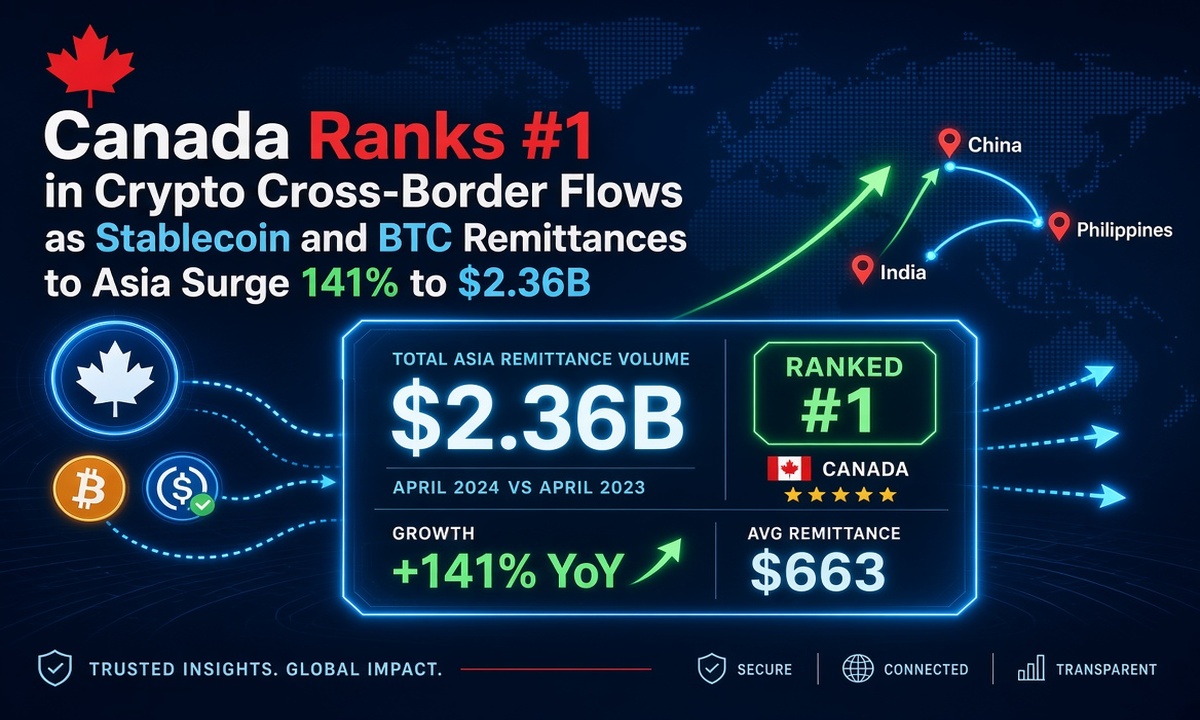
Canadians now lead global rankings for crypto cross-border activity using stablecoin and other cryptocurrencies, according to Chainalysis.
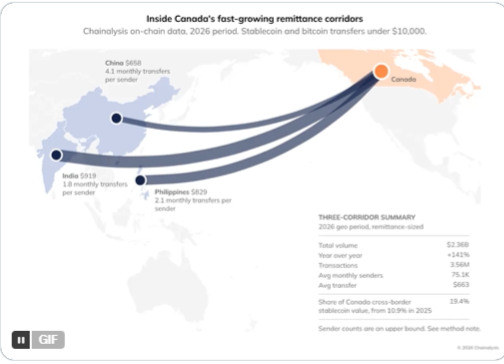
In particular, stablecoin and bitcoin transfers from Canada to India, the Philippines and China climbed 141% year-over-year (YoY) to $2.36 billion in the 12 months ending June 2026.
Nearly one in five dollars of Canada’s outbound cross-border stablecoin value currently flows into those three Asian corridors, up sharply from 10.9% the year before.
The average transfer size sits at $663 across 3.56 million transactions.
Meanwhile, the Canada-to-Philippines corridor alone reached $61 million across more than 73,000 transfers, rising 28% in value and nearly 35% in volume.
These figures focus on remittance-sized movements of bitcoin and stablecoin between personal wallets.
Why Are Canadians Turning to Stablecoin for Cross-Border Payments?
Traditional channels remain expensive. The World Bank places the average cost of sending money from Canada near 6.7%, with banks often charging more than 7%.
In contrast, a stablecoin transfer typically settles for a cent or less.
Families and workers therefore gain a clear cost advantage when they move value on crypto rails instead of relying on banks or legacy remittance firms.
At the same time, Canada’s large foreign-born population—roughly 23%, the highest share among G7 nations—creates steady demand for reliable corridors to Asia.

How Does Stablecoin Activity Compare with Broader Crypto Use in Canada?
Stablecoin now dominates local trading activity. In June 2026, these tokens accounted for 44% of Canadian-dollar order-book volume, up from 30% a year earlier.
That shift shows users increasingly treat stablecoin as practical payment infrastructure rather than pure speculation.
Furthermore, Chainalysis ranks Canada the strongest peer-to-peer (P2P) crypto economy inside the G7, a position supported by both demographic realities and the high friction of conventional money transfers.
What Does the Surge Mean for Remittance Markets and Future Adoption?
The rapid growth highlights a practical use case that extends beyond trading.
Senders gain speed and lower fees, while recipients in India, China and the Philippines receive value that can convert quickly into local currency.
In parallel, the concentration of flows into stablecoin suggests these instruments are becoming the preferred bridge for everyday cross-border needs.
Looking forward, continued cost pressure from traditional providers and rising familiarity with digital wallets could push volumes still higher.
Overall, Canada’s top ranking and the 141% jump in stablecoin-linked remittances to Asia show how digital assets are reshaping ordinary money movement.
Families save money, corridors expand, and stablecoin emerges as the efficient rail of choice.
