


Aerodrome continues to dominate the on-chain equity trading scene on Base.
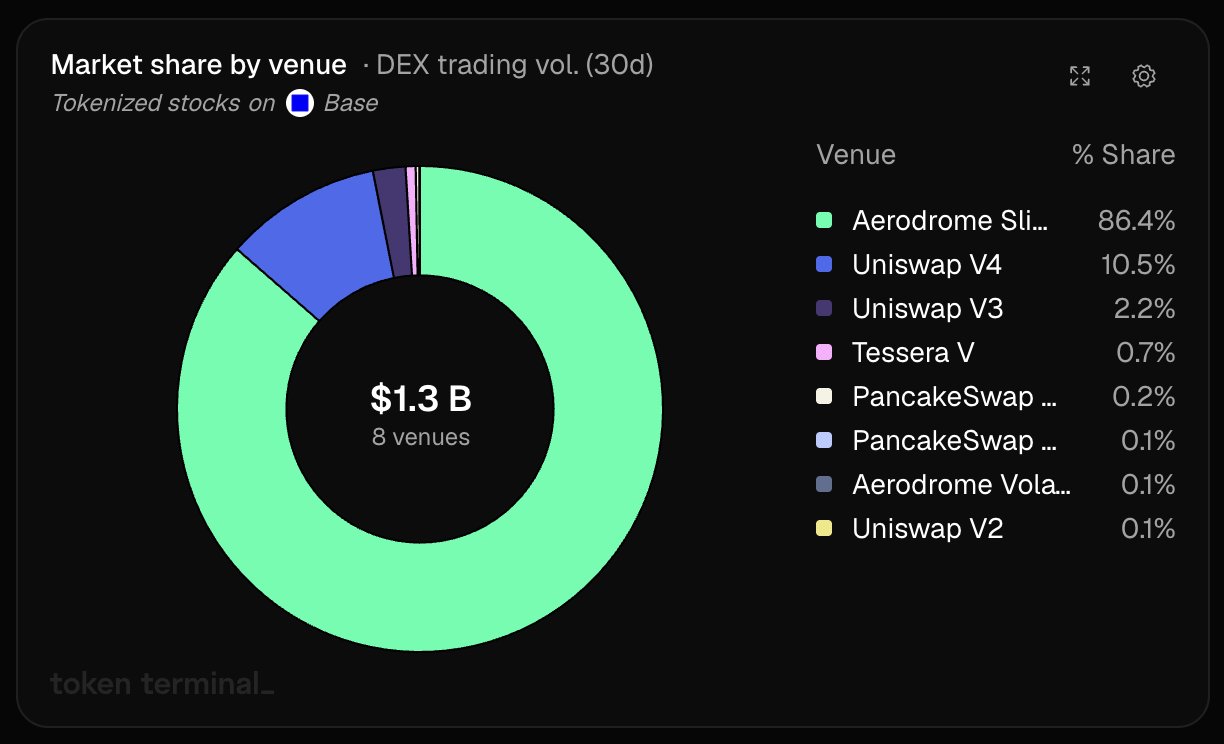
Over the past thirty days, the protocol captured roughly 86% of all tokenized stock spot decentralised exchange (DEX) volume on the network, a market that turned over $1.3 billion in the same window.
That share marks a clear step up from earlier readings in the mid-70s and shows how quickly liquidity can concentrate once a venue becomes the default path for a new asset class.
What makes Aerodrome the go-to venue for tokenized stocks on Base?
Coinbase launched its B20-standard tokenized United States (U.S.) equities on Base in late August, starting with names such as Nvidia, Apple, Meta and Alphabet and later expanding the roster.
Each token stays backed one-to-one by real shares held in regulated custody. Traders who want 24/7 access outside traditional market hours naturally gravitate toward the deepest and most incentivised pools.
Aerodrome’s Slipstream concentrated-liquidity design, combined with targeted emissions that reward LPs in these specific pairs, has kept spreads tight and turnover high.
Uniswap v4 and PancakeSwap capture smaller slices, yet the bulk of flow still routes through Aerodrome.

How did tokenized stock volume on Base reach $1.3 billion so fast?
Daily peaks already hit $100 million in mid-September, and the rolling thirty-day total has kept climbing as more tickers and more users arrived.
Liquidity providers earn a blend of trading fees plus AERO emissions that, at times, delivered three-digit annual percentage returns (APRs) on USDC-paired pools.
That incentive structure pulled capital in early and created a self-reinforcing loop: deeper liquidity attracted more traders, which generated more fees and justified continued emissions.
The result is a compact but highly active on-chain equity market that now operates around the clock for eligible non-U.S. participants.
Can Aerodrome keep this level of market share as more stocks move on-chain?
The current 86% stake looks formidable, yet it remains vulnerable to competition.
New venues or deeper Uniswap v4 pools could chip away at the lead once more names list and once emissions schedules evolve.
Liquidity depth outside the top pairs still looks thin relative to cumulative volume, so large exits can move prices more than traders might expect.
At the same time, Aerodrome’s position as Base’s primary DEX gives it a structural edge in routing and incentives that newcomers will find hard to match overnight.
Watching utilisation rates, oracle reliability and secondary-market spreads will reveal whether the moat holds or narrows.
Aerodrome has turned tokenized stocks into one of Base’s most visible use cases.
The $1.3 billion 30-day volume and the commanding share demonstrate real demand for on-chain equity exposure.
Whether that dominance endures will depend on how well the protocol balances emissions, deepens liquidity across a broader set of names, and responds when rival venues intensify their efforts.
For now, the numbers place Aerodrome firmly at the centre of this emerging market.
