
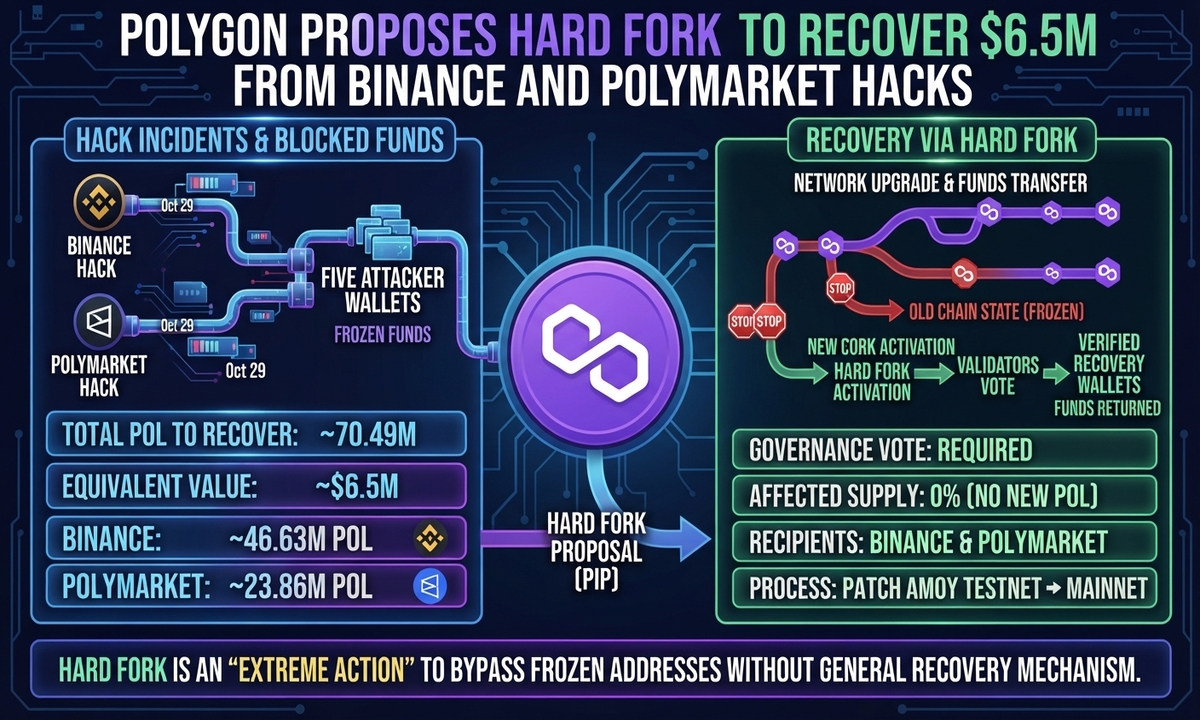
Polygon community member Parvez03 has proposed a hard fork to recover 70.49 million POL linked to the Binance and Polymarket security incidents. The funds, worth approximately $6.5 million, remain in five wallets controlled by the attackers.
Parvez03, a member of the Polygon Labs Validator Support Team, published the proposal on November 4. The plan covers 23.86 million POL linked to Polymarket and another 46.63 million POL associated with Binance. At POL’s October 29 price of $0.0924, the combined funds were worth approximately $6.5 million. As of press time, POL is trading at $0.09664, up 3.68% in the past day.
Under the proposal, Polygon would remove the specified balances from the five wallets. The network would then transfer the same amounts to recovery wallets verified by Binance and Polymarket.
The companies would regain their tokens without needing the attackers’ private keys. Polygon would also maintain the existing POL supply because the upgrade would transfer tokens rather than create new ones.
The proposed changes would affect only the identified POL balances. Other tokens, major network contracts, and previous blockchain transactions would remain unchanged.
Why Polygon Wants to Move the Frozen POL Funds
Polygon’s four block producers have restricted transactions from the five attacker-controlled wallets. However, the restrictions only stop further transfers and cannot return the funds to Binance or Polymarket.
The current system also creates extra work for network operators. Each block producer loads its restriction list when its software starts.
Consequently, operators must restart their systems or make other changes whenever they update the lists. The proposal also reports that the attacker attempted another transaction on October 30.
During the attempt, the attacker offered a transaction fee worth approximately 219,450 POL. Parvez03 also alleges that the attacker approached validators with cash offers to help move the funds.
Polymarket tried to contact the attacker through an on-chain recovery channel. However, the proposal says the attacker did not respond.
Parvez03 argues that a hard fork offers a direct way to recover the tokens without the attacker’s cooperation. However, the proposal treats the intervention as an exceptional measure.
The plan does not seek to give Polygon permanent powers to move users’ funds. Instead, it requires community approval for a one-time recovery involving the five identified wallets.
POL Community to Discuss Recovery Plan
Polygon’s community will discuss the proposal during its Protocol Governance Call on November 5 at 14:30 UTC. Developers can begin preparing the upgrade if members approve the plan.
The development team would then test the changes on Polygon’s Amoy test network. Parvez03 estimates that development and testing would take approximately two weeks after approval.
Binance and Polymarket must verify their recovery wallets and confirm the destination addresses in writing. Validators, exchanges, and infrastructure providers must also install compatible software before activation.
Operators who reject the upgrade could continue following the old network rules. A disagreement between upgraded and outdated nodes could split Polygon into separate chains.
Polygon has not announced an activation block or released the required software. The network must complete governance approval and testing before developers can carry out the recovery.
