

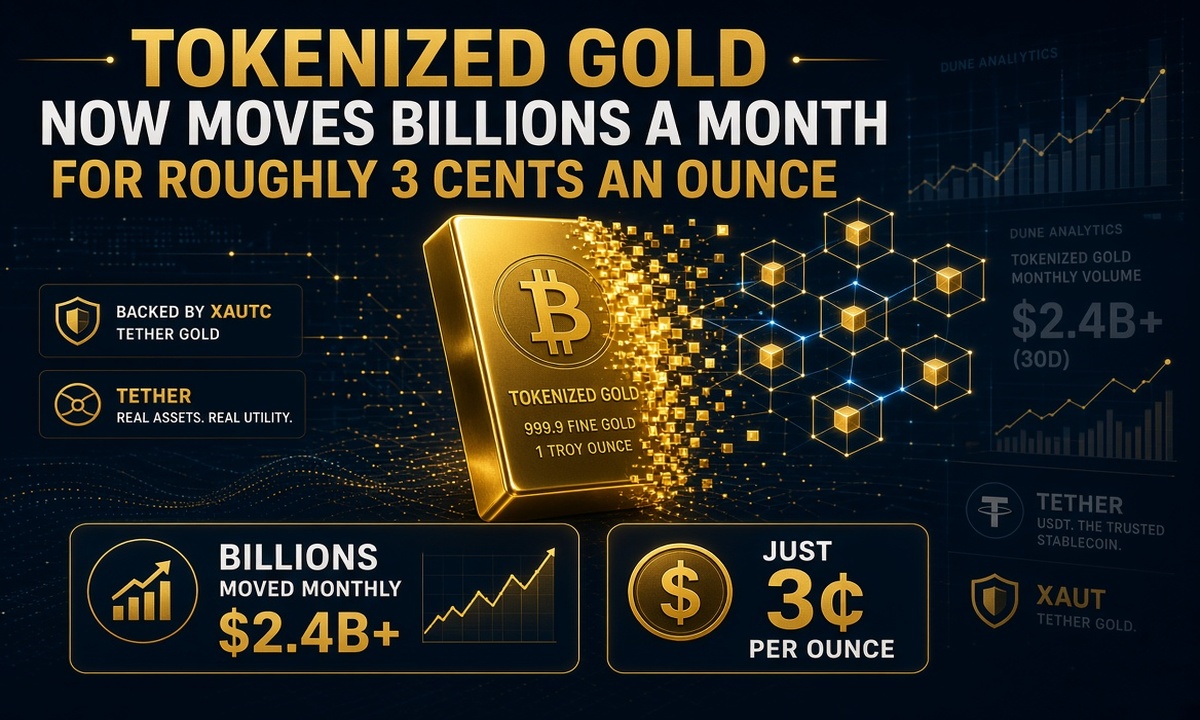
Tokenized gold has quietly rewritten the economics of moving the world’s oldest store of value.
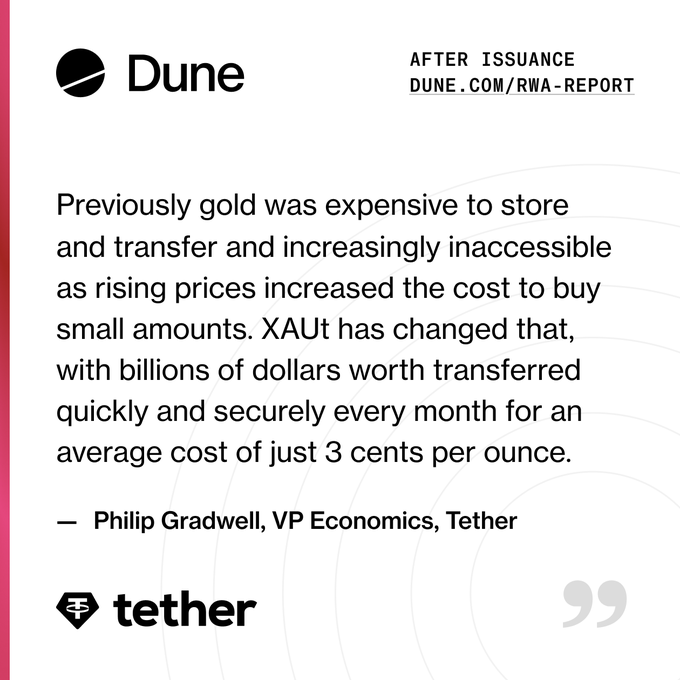
In Dune’s latest RWA report, Philip Gradwell, VP of Economics at Tether, puts the shift in stark terms: XAUt alone now transfers billions of dollars worth of gold every month at an average cost of just three cents per ounce.
Previously, shipping physical gold meant armoured trucks, insurance premiums, vault fees, and settlement delays that could stretch for days.
Meanwhile, fractional ownership remained out of reach for many investors once gold prices climbed. Tokenized gold flips that script.
Holders can send fully backed ounces across blockchains in minutes, often for a fraction of a cent in network fees.
What Exactly Is Tokenized Gold and How Does It Work?
Tokenized gold represents physical bars held in secure vaults, with each token redeemable for a precise quantity of the metal.
Tether Gold (XAUT) and Paxos Gold (PAXG) dominate the space, together accounting for the bulk of the roughly $5–6 billion market.
In addition, independent attestations confirm the underlying reserves, giving holders a transparent claim on real gold rather than a synthetic promise.
Transfers happen on public ledgers. Once the tokens move, ownership updates instantly.
Redemption for physical metal remains available through the issuers, though most activity stays on-chain because the digital version already delivers near-instant settlement and global reach.

Why Does Moving Tokenized Gold Cost Only About 3 Cents an Ounce?
The cost advantage stems from removing intermediaries. Traditional logistics layer on security, insurance, and handling charges that scale with distance and volume.
On-chain transfers, by contrast, primarily incur blockchain gas fees.
Gradwell notes that these fees average out to roughly three cents per ounce across the billions in monthly volume.
Furthermore, the same infrastructure supports both large institutional flows and smaller retail transfers without proportional cost increases.
In particular, the efficiency becomes clear when compared with physical movement or even traditional electronic gold accounts that still rely on bank rails and business-hour settlement.

How Big Is the Market and Who Is Driving the Growth?
Tokenized gold has expanded rapidly. Ounces held on-chain rose 73% over the past year, outpacing the 29% rise in the gold price itself.
Cumulative spot trading volumes exceeded $90 billion in the first quarter of 2026 alone—more than the entire previous year.
At the same time, the broader digital gold category (tokenized plus vaulted products) sits between $45–55 billion and could unlock up to $700 billion in latent demand if trust, access, and utility barriers continue to fall, according to the World Gold Council.
Investors range from crypto-native traders using the tokens as decentralised finance (DeFi) collateral to longer-term holders seeking an efficient alternative to exchange-traded funds (ETFs) or physical bars.
Meanwhile, daily turnover in the leading tokens runs several times higher than many traditional gold ETFs, signalling active rather than purely passive ownership.

What Risks and Practical Considerations Still Matter?
Trust remains the central question for new entrants. Investors should verify attestation reports, understand redemption terms, and assess the jurisdiction and custody arrangements of each product.
Regulatory frameworks are still evolving, particularly around consumer protections and cross-border transfers.
In addition, while on-chain costs are low, users must still manage private keys or custodial arrangements carefully.
Nevertheless, the trajectory is clear. Tokenized gold has already demonstrated that physical metal can move at digital speed and digital cost.
As more platforms accept these tokens as collateral and more traditional institutions explore the rails, the three-cent-per-ounce figure may become the new baseline rather than an outlier.
