
Hong Kong’s regulated stablecoin market continues to take concrete form.
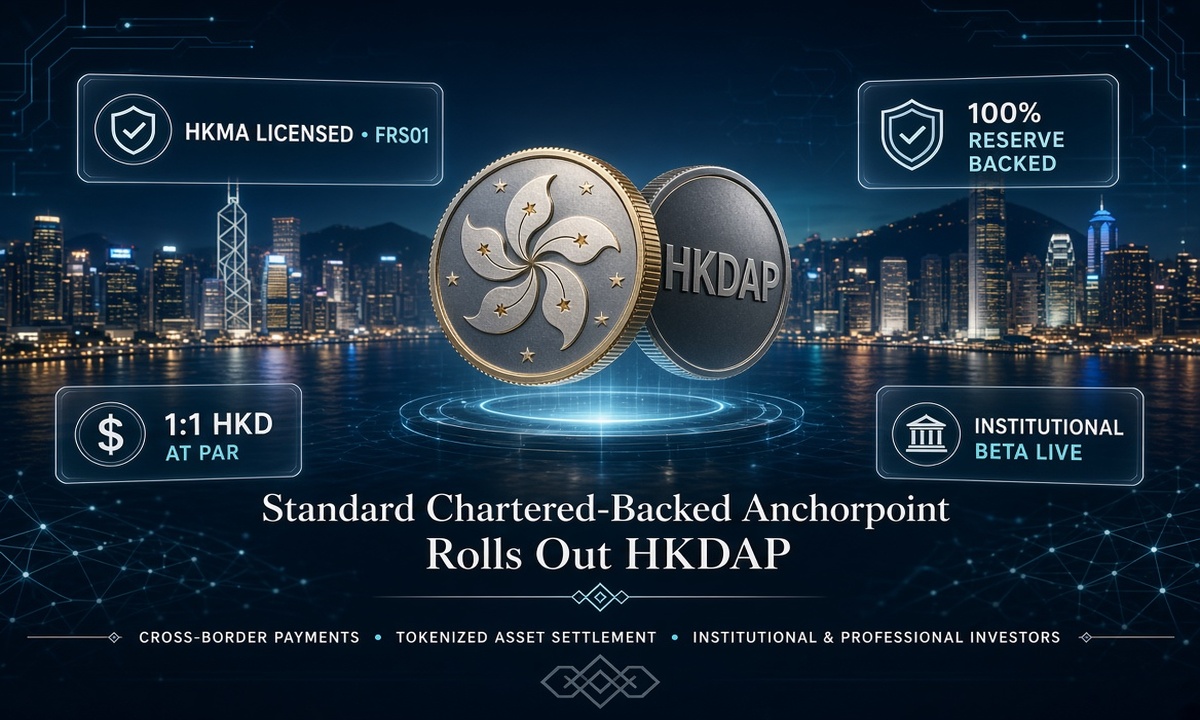
Standard Chartered-backed Anchorpoint Financial Limited is advancing the phased institutional rollout of HKDAP, its Hong Kong dollar-backed stablecoin.
The product targets institutional payments and the settlement of tokenized assets, giving qualified participants a fully regulated on-chain alternative to traditional rails.
Anchorpoint, a joint venture of Standard Chartered Bank (Hong Kong), HKT and Animoca Brands, received one of the first stablecoin issuer licences from the Hong Kong Monetary Authority in April 2026 under the Stablecoins Ordinance.
HKDAP maintains a strict 1:1 peg to the Hong Kong dollar and sits fully backed by high-quality liquid reserves held in trust.
Since August, the issuer has limited access to licensed distributors and professional investors while it builds operational experience.

Why Is Anchorpoint Focusing First on Institutional Users in the Stablecoin Market?
Institutional demand offers clearer compliance pathways and immediate commercial utility.
Standard Chartered became the first bank authorised to distribute HKDAP in late August, joining earlier partners such as HashKey Exchange and OSL.
Eligible clients can already explore tokenised money-market fund subscriptions, intragroup treasury transfers and cross-border settlement.
Meanwhile, the controlled beta keeps operational and custody risks tightly managed before any broader retail opening.
How Does HKDAP Fit into Hong Kong’s Broader Stablecoin Market Strategy?
Hong Kong aims to position itself as a trusted bridge between traditional finance and on-chain markets.
Local-currency stablecoins reduce reliance on foreign-denominated tokens for domestic and regional flows.
In addition, pairing HKDAP with tokenized funds and real-world assets creates programmable settlement that can operate outside conventional banking hours.
Currently the circulating supply remains modest, reflecting the deliberate, phased approach rather than rapid retail distribution.
What Practical Benefits Can Institutions Expect from This Development?
Faster settlement, lower operational friction and improved capital efficiency stand out as early advantages.
Tokenized fund subscriptions can settle more predictably, while corporate treasuries gain an always-on tool for liquidity management.
Furthermore, the regulated status and bank-grade infrastructure help institutions meet internal risk and compliance standards more easily than with unregulated alternatives.
Looking ahead, wider retail availability remains a possibility toward the end of 2026 if market conditions and regulatory comfort allow.
Overall, the measured rollout of HKDAP signals that Hong Kong’s stablecoin market is moving from policy frameworks into live institutional infrastructure.
Careful distribution through licensed channels and a clear focus on real-economy use cases strengthen the city’s credentials as a regulated digital-asset hub.
