


Tokenized gold has climbed to a market value of $5.4 billion, according to fresh on-chain data.
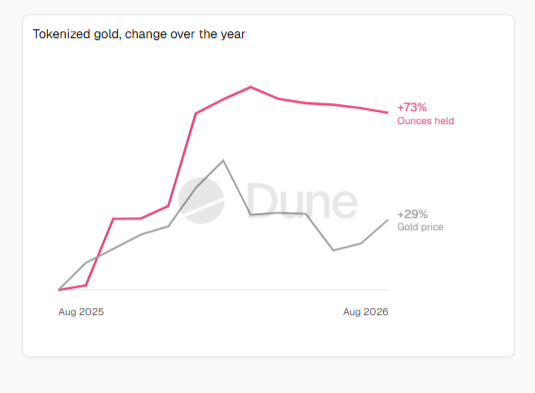
Growth stems far more from actual accumulation of physical ounces than from the metal’s price rise alone.
Ounces held on blockchain jumped 73% year-over-year (YoY), while the gold price itself advanced only 29% over the same stretch.
Roughly 36 tonnes now sit on-chain—equal to about 0.86% of all gold locked inside traditional exchange-traded funds (ETFs) worldwide.
What Is Driving the Surge in Tokenized Gold?
Investors keep adding real ounces rather than simply riding higher prices. Central banks continue buying physical gold at a steady clip, and ETF holders have followed the same path.
Tokenized versions ride alongside that broader demand, offering instant settlement, fractional ownership, and 24/7 transferability that traditional vaults cannot match.
Meanwhile, the on-chain market still represents only a tiny slice of total above-ground gold, leaving ample room for further expansion.
How Does On-Chain Gold Compare to Traditional Holdings?
Thirty-six (36) tonnes may sound modest next to global ETF inventories, yet the growth rate stands out.
Tokenized gold now accounts for nearly the entire tokenized commodities category.
In addition, its share of broader real-world asset (RWA) markets keeps expanding as more capital seeks regulated, allocated exposure.
Still, the figure equals less than 1% of ETF-held gold, showing how early the trend remains.

Why Are Investors Accumulating More Ounces On-Chain?
Holders value the combination of physical backing and blockchain utility. Leading products such as Tether Gold (XAUT) and PAX Gold (PAXG) dominate the space, each representing allocated London Good Delivery bars.
Further, newer platforms have begun accepting these tokens as collateral, unlocking lending and liquidity uses that pure vault storage never offered.
At the same time, transparent minting and redemption data let anyone verify that supply matches reserves.

What Role Do Leading Tokens Play in This Growth?
XAUT and PAXG continue to capture the bulk of market share, together holding the majority of the $5.4 billion total.
Their established custody arrangements and regulatory footing attract both retail and institutional flows.
Beyond that, smaller tokens fill niche chains and use cases, yet the two leaders set the pace for overall ounce accumulation.
Later data releases will show whether secondary products can chip away at that concentration.

Can Tokenized Gold Keep Expanding Alongside Central Banks?
Yes—provided issuers maintain full allocation and clear redemption paths. Central-bank buying and ETF inflows create a supportive backdrop, while on-chain versions add speed and programmability.
Yet, the market must still prove it can scale without compromising the physical integrity that makes gold attractive in the first place.
Observers tracking Dune’s RWA datasets will watch whether ounce growth continues to outpace price gains in the months ahead.
Tokenized gold’s latest milestone shows genuine demand for blockchain-native ownership of a classic safe-haven asset.
The 73% rise in ounces, rather than pure price appreciation, marks the more meaningful signal for long-term adoption.
