

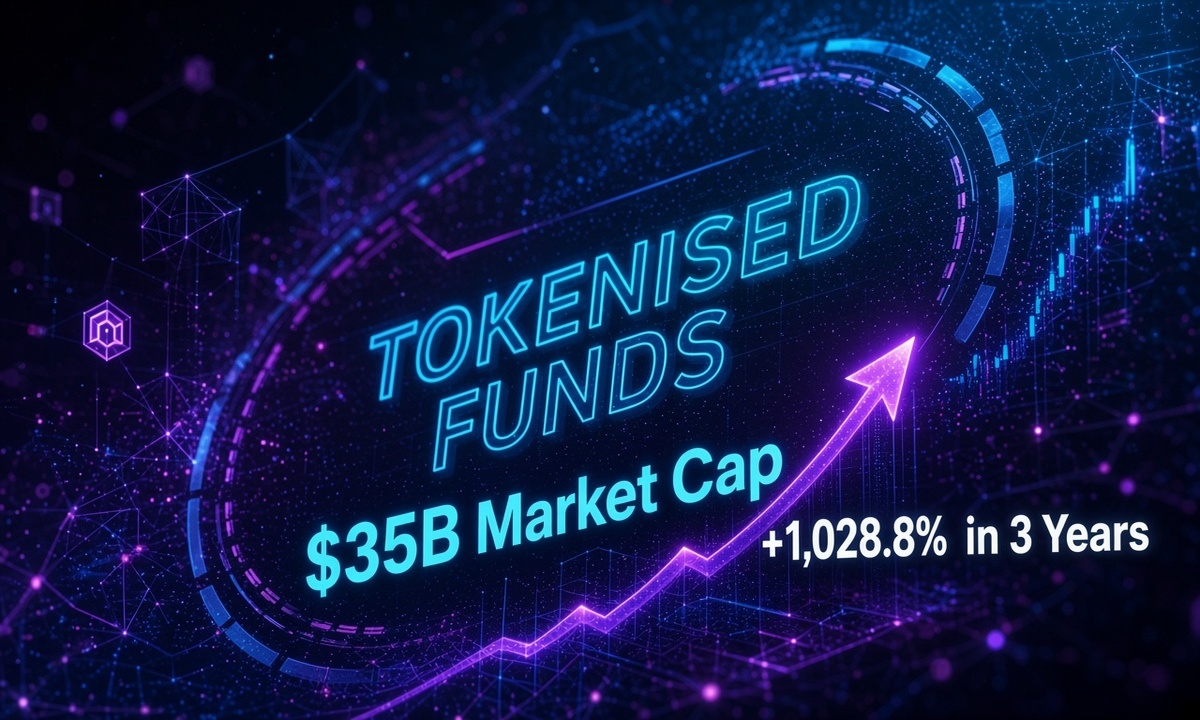
Tokenized funds have crossed a major milestone within the decentralised finance (DeFi) sector.
The sector now sits at a $35 billion market capitalisation after climbing an extraordinary 1,028.8% over the past three (3) years, according to fresh data from Token Terminal.
This rapid expansion places tokenized funds among the strongest-performing categories in on-chain finance.
Meanwhile, traditional asset managers and crypto-native issuers continue pushing more products onto public blockchains.

Who Leads the Tokenized Funds Market by Issuer?
Sky-issued funds currently hold the top position with $4.8 billion in market value. Securitize follows closely at $3.8 billion. Right behind them, funds issued by Ondo, Spiko, and Franklin Templeton each command roughly $2.6 billion.
These five issuers alone account for a substantial share of the entire category. In parallel, the concentration reveals how a relatively small group of platforms drives most of the growth.

Which Blockchains Host the Most Tokenized Funds?
Ethereum remains the clear leader. The network currently hosts $16.8 billion in tokenized funds. BNB Chain ranks second with $4.4 billion, while Stellar holds $3.5 billion.
Beyond the top three, other chains continue gaining ground as issuers seek lower fees and faster settlement.
Still, Ethereum’s deep liquidity and established infrastructure keep it firmly in front.

What Exactly Are Tokenized Funds?
Tokenized funds are traditional investment vehicles—such as money-market funds, treasuries products, or private credit vehicles—represented as blockchain tokens.
Investors gain fractional ownership, 24/7 transferability, and programmable settlement without leaving the on-chain environment.
Specifically, these products combine the regulatory framework of traditional finance with the operational advantages of public blockchains.
In addition, they open new distribution channels for both retail and institutional capital.

Why Has the Sector Grown So Quickly?
Several forces continue to work together to make this metric a possibility. First and foremost, institutional demand for yield-bearing, compliant on-chain products has expanded sharply.
At the same time, clearer regulatory pathways in key jurisdictions have encouraged more asset managers to experiment.
Moreover, the ability to settle trades instantly and use the tokens as collateral inside DeFi protocols adds practical utility that traditional fund shares cannot match.
Notably, the growth trajectory shows no signs of slowing. From a much smaller base three years ago, the category has delivered consistent expansion through multiple market cycles.

What Does This Mean for Investors and Issuers?
For investors, tokenized funds offer access to familiar asset classes with improved efficiency.
For issuers, the model creates new distribution reach and potential fee streams. Simultaneously, the data shows a broader shift: more real-world financial products continue migrating on-chain.
Looking ahead, the $35 billion figure already demonstrates meaningful scale.
Further adoption by large traditional managers could push the total significantly higher in the years ahead.
