


September 2026 closed with a clear ranking of defi protocols that actually convert activity into retained revenue.
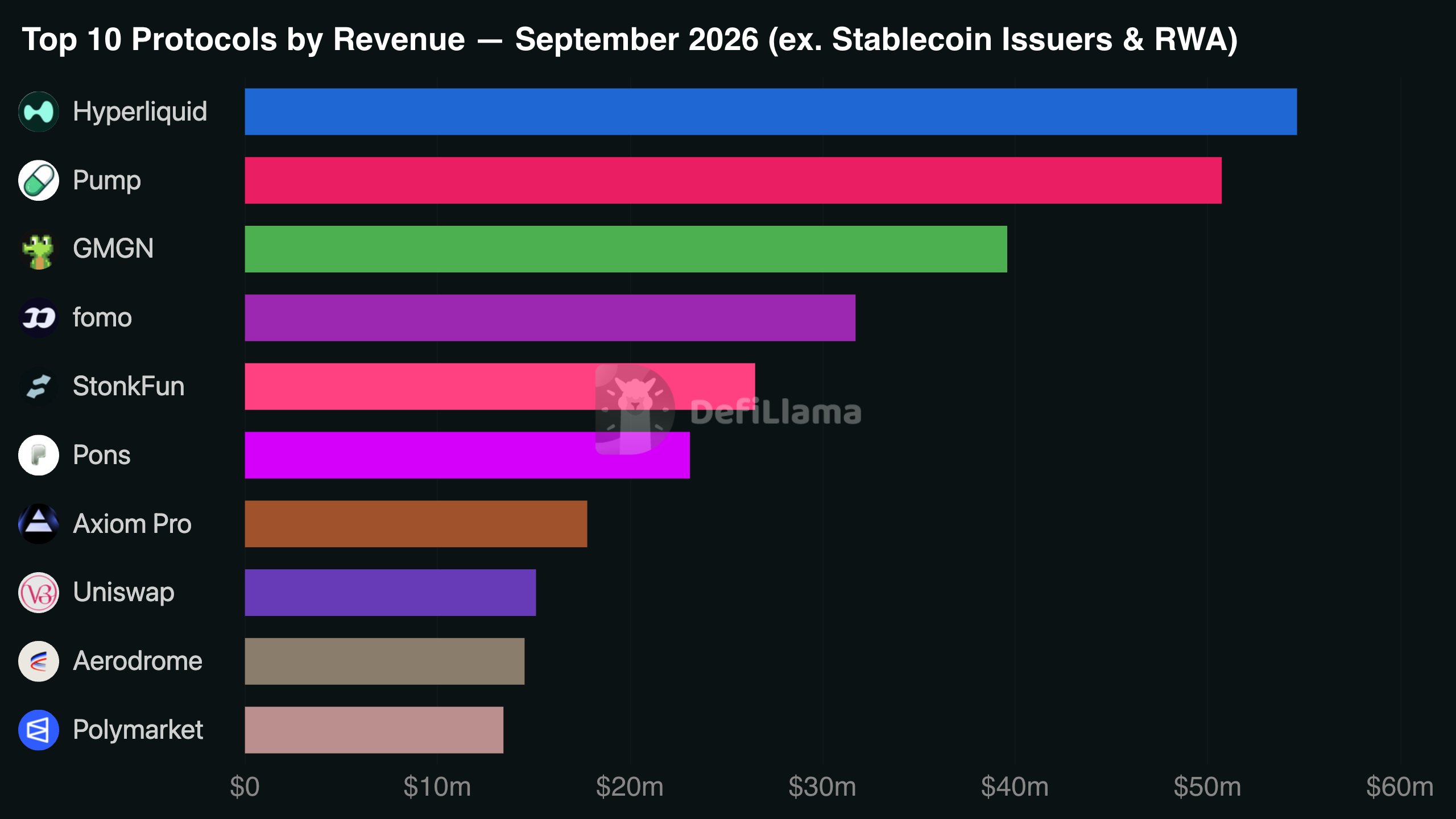
DefiLlama’s snapshot, which excludes stablecoin issuers and real-world asset (RWA) platforms, places Hyperliquid at the top of the leaderboard, followed closely by memecoin launchpads and trading tools that turned speculative volume into cash flow.
Which Protocols Led the Top Revenue-Generating DeFi Protocols List?
Hyperliquid generated the highest revenue of the month, clearing the mid-$50 million range.
The perpetual futures platform continues to monetise high-volume trading while routing the majority of fees into HYPE buybacks.
Pump followed in second place with roughly $50 million-plus. The Solana launchpad collected fees from bonding-curve trades, graduations, and its growing terminal products.
GMGN secured third with about $40 million, driven by its multi-chain trading bot and routing fees.
Further down the list, fomo, StonkFun, and Pons each posted strong double-digit millions.
Axiom Pro, Uniswap, Aerodrome, and Polymarket rounded out the top ten. Combined, these ten protocols produced well over $300 million in retained revenue during the month.
Why Do Launchpads and Trading Terminals Dominate Revenue Rankings?
Speculative activity remains highly profitable. Memecoin creation and rapid trading generate consistent fee streams that traditional decentralised exchanges (DEXs) and lending markets struggle to match in the current cycle.
Hyperliquid’s order-book model captures leverage demand, while platforms like Pump, StonkFun, and Pons monetise the constant cycle of new token launches.
Trading terminals such as GMGN and Axiom Pro sit between users and onchain markets.
They extract value through routing and execution fees without holding large total value locked (TVL) themselves.
This model has proven durable even when broader market sentiment turns cautious.
How Sustainable Is Revenue for These Top DeFi Protocols?
Revenue concentration among a handful of platforms highlights both strength and risk.
Hyperliquid and Pump alone accounted for a large share of the total.
Their ability to retain fees and, in Hyperliquid’s case, recycle them into token buybacks creates a clearer path to long-term value capture than pure incentive-driven volume.
At the same time, launchpad revenue can swing with memecoin cycles.
Traders should watch whether these platforms diversify beyond pure speculation.
Uniswap and Aerodrome continue to earn from established liquidity pools, offering a more steady if smaller base.
Polymarket’s prediction-market fees add another distinct revenue stream tied to real-world events.
What Does the September Ranking Signal for Onchain Business Models?
The data shows that real economic activity continues to generate meaningful cash flow.
Protocols that align fees with user behaviour—whether perpetual trading, token launches, or prediction markets—are currently outperforming those that rely mainly on token emissions.
Investors and builders tracking top revenue-generating DeFi protocols now treat monthly revenue as a sharper signal than TVL alone.
The September leaderboard confirms that certain onchain businesses have moved beyond experimental status and into consistent fee collection.
