

Tether just executed one of its more striking on-chain moves of the year.
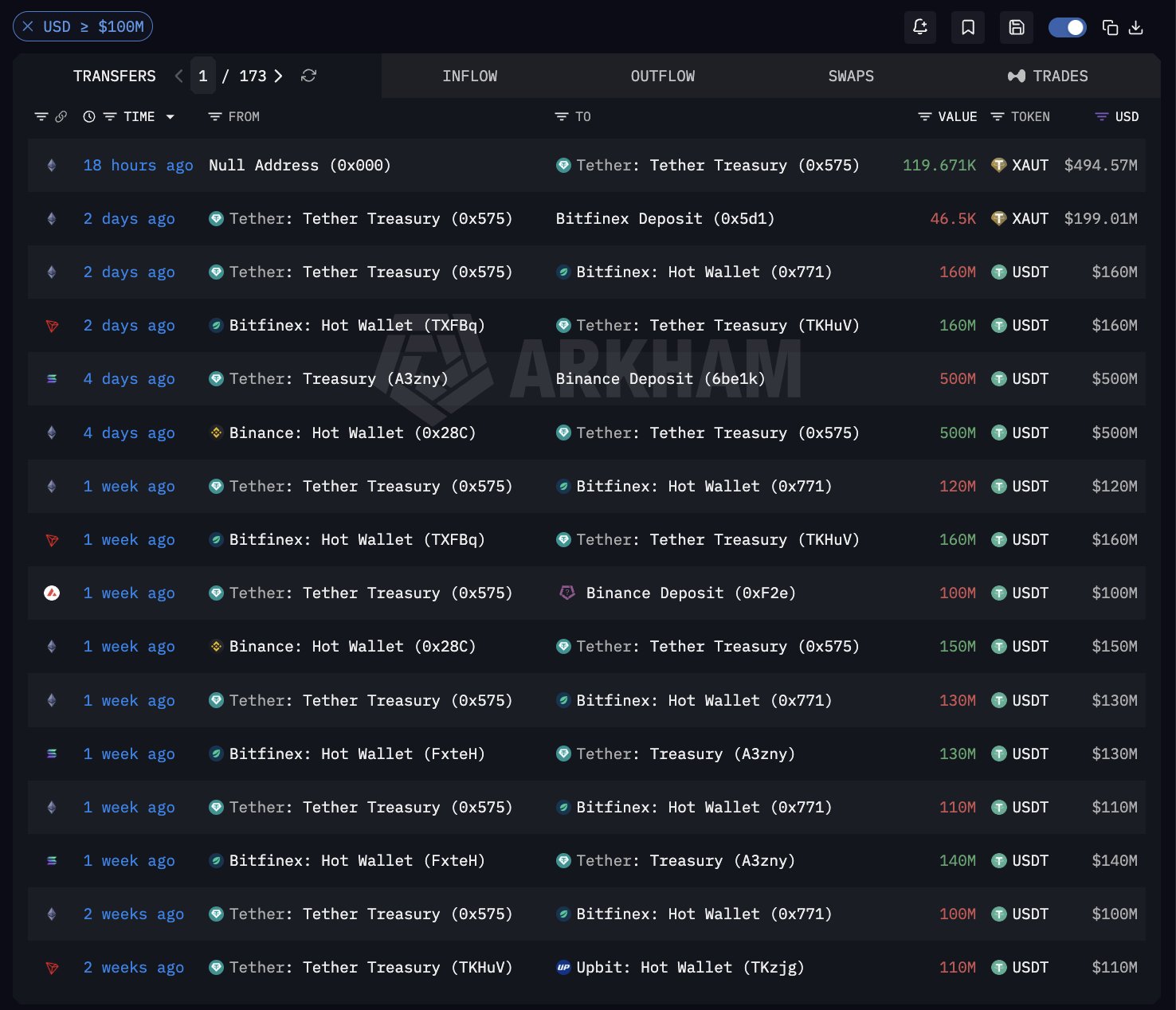
Blockchain intelligence platform Arkham flagged a fresh issuance of roughly $494.6 million in XAUt, the company’s gold-backed token.
Notably, the mint involved XAUt rather than the familiar USDT stablecoin that dominates Tether’s usual activity.
This shift stands out because Tether rarely prioritises its gold product at this scale in a single transaction.
On-chain trackers recorded the creation of tens of thousands of new XAUt tokens, each representing one troy ounce of physical gold held in Swiss vaults under London Good Delivery standards.
What Exactly Is XAUt and How Does It Differ from Tether USDT?
XAUt, also known as Tether Gold, functions as a digital claim on allocated physical gold.
Each token links to a specific bar stored by a Swiss custodian, and holders can verify the serial numbers through Tether’s allocation tool.
In contrast, USDT maintains a fiat-pegged design backed primarily by cash, Treasuries, and other reserves.
The practical difference matters. XAUt gives users direct exposure to gold price movements while retaining blockchain transferability and divisibility.
USDT, meanwhile, aims for dollar stability.
When Tether chooses to expand XAUt supply instead of USDT, it signals a deliberate tilt toward commodity-backed assets rather than pure dollar liquidity.

Why Did Tether Opt for a Large XAUt Mint This Time?
Market observers point to several concurrent factors.
Gold has remained a favoured hedge amid lingering macroeconomic uncertainty, and demand for tokenized real-world assets (RWA) continues to grow.
Tether already holds one of the largest private gold stockpiles in the world, previously estimated in the tens of billions of dollars when combining its USDT gold holdings and pure XAUt reserves.
By minting XAUt at this volume, Tether can meet institutional or high-net-worth requests for gold exposure without relying solely on secondary market purchases.
The move also expands the circulating supply available for trading, lending, or collateral use across supported chains such as Ethereum and others.

What Does a Nearly $500 Million XAUt Issuance Signal?
Large XAUt mints often reflect genuine underlying demand rather than speculative issuance.
Unlike some synthetic gold products, Tether claims full physical backing and regular attestations.
A mint of this size effectively adds hundreds of kilograms of gold to the tokenized market in one step.
At the same time, the decision to skip a comparable USDT issuance may hint at softer near-term demand for additional dollar stablecoin liquidity or a strategic preference for diversifying Tether’s product mix.
Investors watching stablecoin flows should note that gold-backed tokens behave differently during risk-off periods, frequently acting as a store of value rather than pure transactional fuel.
How Does This Fit Tether’s Broader Gold Strategy?
Tether has steadily expanded its gold footprint over recent years.
Beyond holding physical bullion in its reserves, the company has explored gold-backed lending arrangements and previously experimented with gold-collateralised synthetic dollars.
After winding down certain experimental products, Tether has repeatedly emphasised XAUt as a core offering.
This latest mint reinforces that focus. It demonstrates operational capacity to scale tokenized gold quickly while maintaining the 1:1 physical backing model.
For the wider market, it adds weight to the argument that tokenized commodities are moving beyond niche status and into more meaningful on-chain volumes.

Could This Influence Gold or Crypto Market Sentiment?
A single mint rarely moves the broader gold price, yet it does increase the visible, transferable supply of digital gold.
Traders who prefer on-chain settlement now have additional inventory to work with.
In parallel, the absence of a matching USDT mint keeps attention on whether dollar stablecoin growth is moderating or simply pausing.
Market participants must watch secondary XAUt trading volumes and any subsequent redemptions closely.
If the newly minted tokens move into active wallets or lending platforms rather than remaining idle, the issuance will look more like organic demand fulfilment than balance-sheet expansion for its own sake.
Tether’s choice to prioritise gold over its flagship dollar token on this occasion offers a clear data point for anyone tracking the company’s evolving product priorities and the steady maturation of real-world asset tokenization.
