

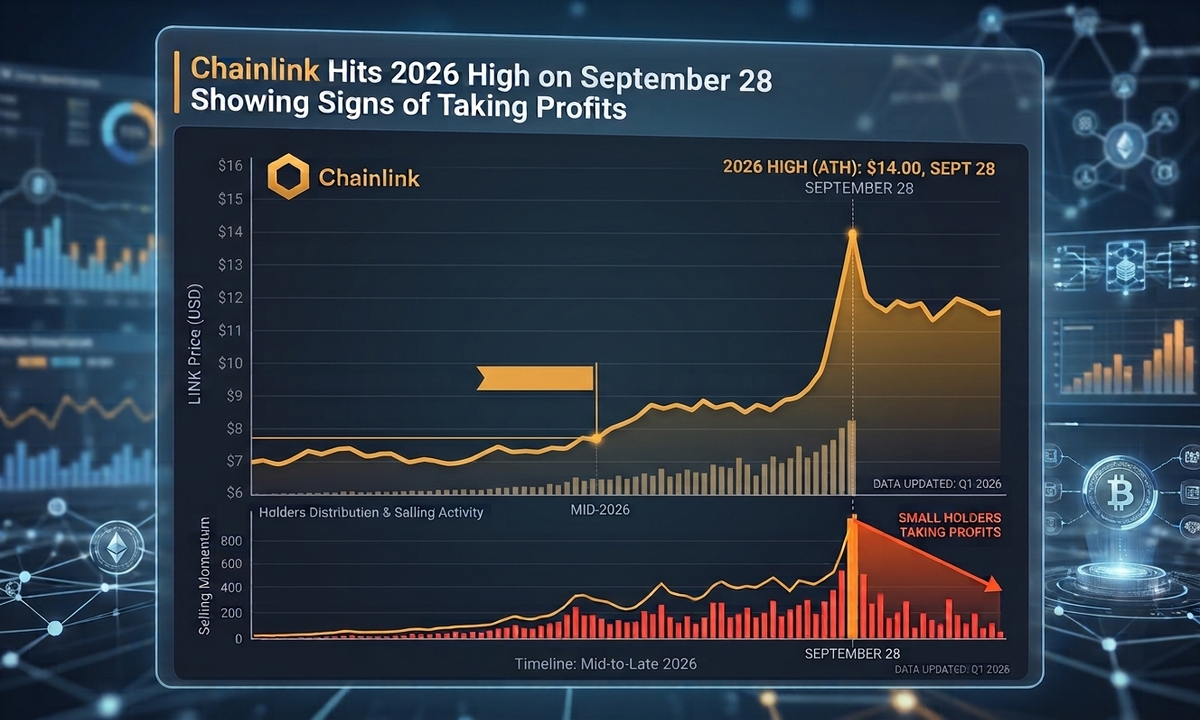
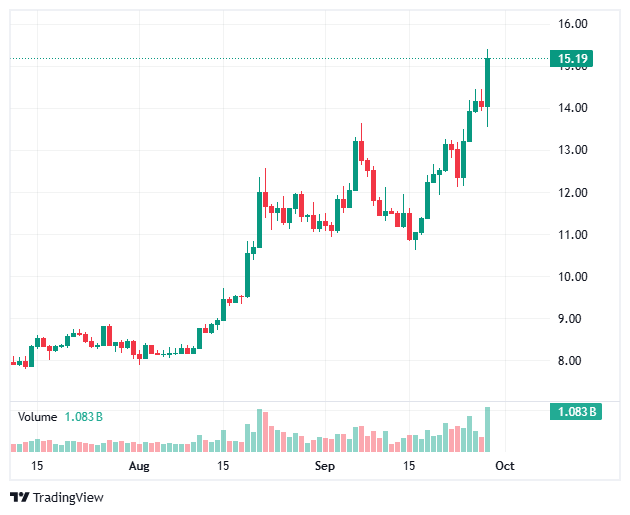
Chainlink just punched through to a fresh 2026 peak of $14.89, something that has been missing for almost ten (10) months. The move caps a sharp climb from under $7 back in June 2026.
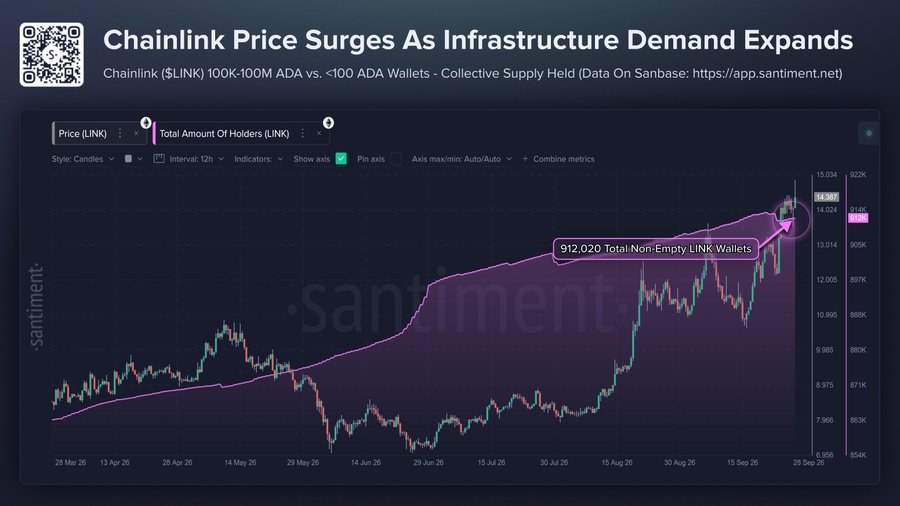
At the same time, the number of non-empty wallets slipped to 912,020. That dip points to smaller holders quietly booking gains while the price runs.
Santiment’s latest on-chain read shows the holder count easing even as price climbs.
Yet, the remaining base still sits near historic highs after steady expansion through the year.
What Does the Drop in Small Holders Actually Signal for Chainlink?
When price rises and some retail wallets exit, stronger hands often step in and absorb the supply.
That pattern can keep the rally healthier than pure fear of missing out (FOMO) chasing.
Chainlink’s holder base expanded for most of 2026, so the recent trim looks more like selective profit-taking than broad distribution.
Meanwhile, the price chart itself tells a clear story: LINK has recovered aggressively while infrastructure demand keeps rising.
The combination of rising price and mild holder contraction often appears when longer-term participants tighten their grip.
How Does the CCIP 2.0 Launch Fit Into This Move?
On the same day, the price tested the new high, Chainlink rolled out CCIP 2.0. The upgrade hands applications more control over cross-chain security while still leaning on Chainlink’s default verifier network.
It also adds faster-than-finality options, modular fees, and native compliance tools through the Automated Compliance Engine.
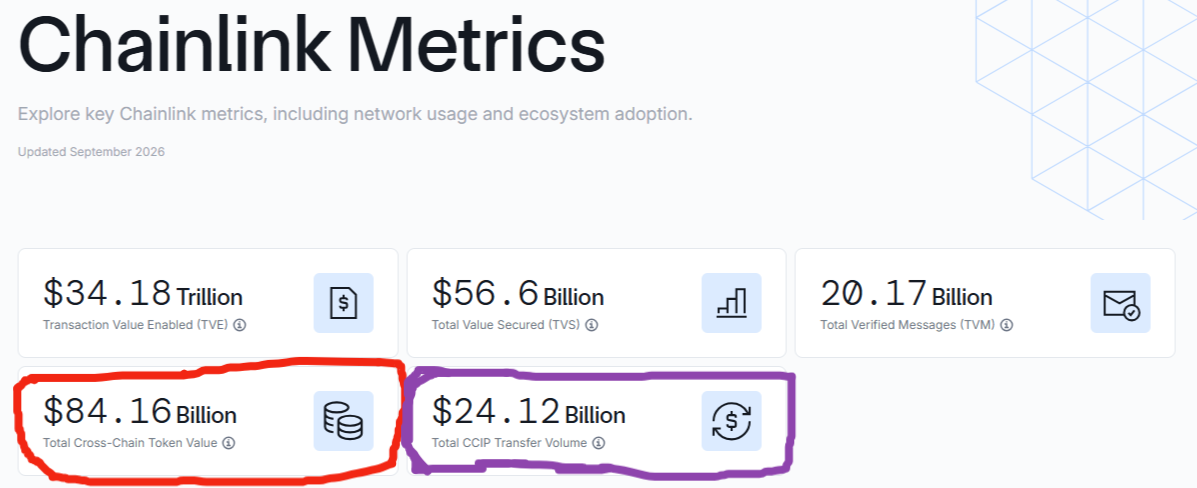
In addition, CCIP already secures more than $24 billion in cumulative transfer volume and over $84 billion in total cross-chain token value.
The timing of the release lands right as LINK tests new yearly highs, giving the market a concrete fundamental catalyst to digest.
Why Are Institutions Still Adding Fuel to Chainlink?
Coinbase recently tapped Chainlink as the oracle layer for its tokenized stocks.
Wyoming expanded its use of Chainlink for the state-backed FRNT stable token, first migrating the asset to CCIP and later adding Proof of Reserve (PoR) for near-real-time transparency.
These integrations keep stacking. They reinforce LINK’s role as the connective tissue between crypto rails, tokenized real-world assets (RWA), and traditional finance.
On top of that, the broader migration of more than $15 billion in token value onto CCIP in recent months shows institutions voting with their infrastructure choices.
Are Small Holders Taking Profits Too Early?
Profit-taking by wallets holding fewer than 100 LINK is not automatically bearish.
Many of those addresses simply locked in gains after a multi-month climb. At the same time, the larger holder cohorts have continued to accumulate or hold steady.
The net effect is a transfer of coins from weaker hands into stronger ones while the network’s real utility expands.
That dynamic has supported previous Chainlink advances and remains visible in the current data.
Chainlink’s dual story of price strength and infrastructure progress remains intact. The 2026 high arrives alongside a major protocol upgrade and fresh institutional pipelines.
Small holders are cashing some chips, yet the broader holder base and real usage metrics continue to point toward sustained demand for the network.
