

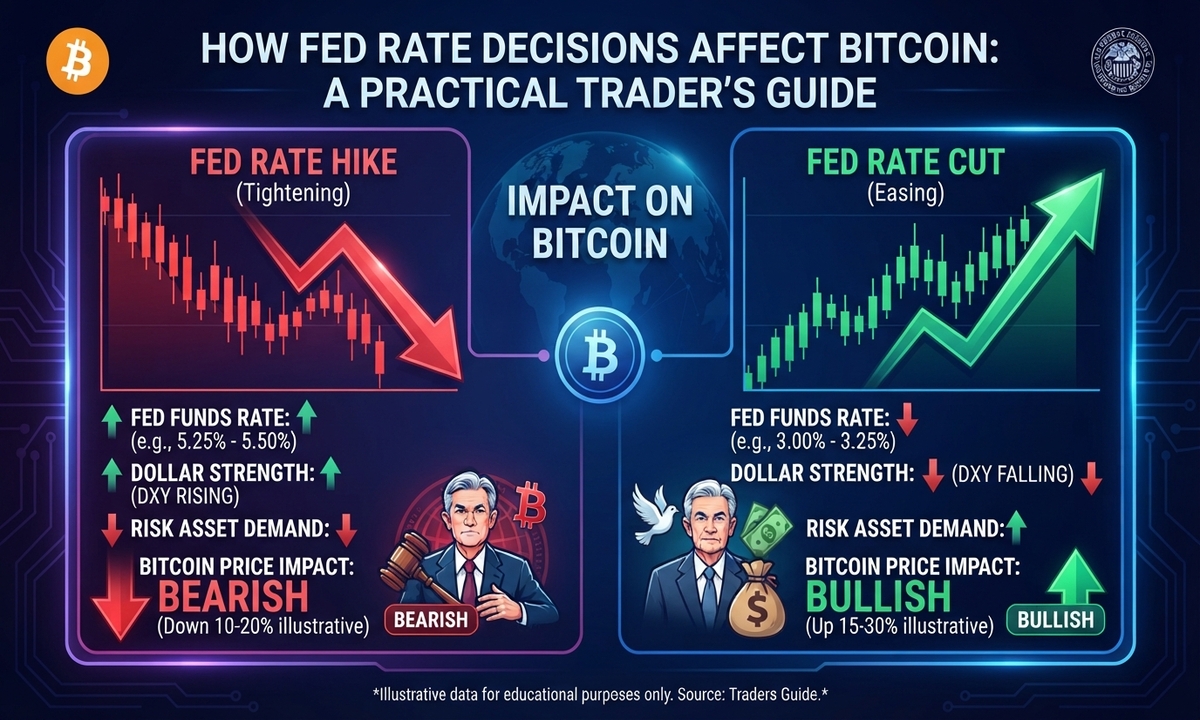
Fed rate decisions rank among the most closely watched events on the Bitcoin calendar.
Traders treat each FOMC (Federal Open Market Committee) meeting as a potential volatility catalyst because the Federal Reserve’s policy stance directly shapes global liquidity, the strength of the dollar, and risk appetite across markets.
Understanding the transmission channels and the typical price patterns helps traders avoid emotional reactions and position more deliberately.
This guide breaks down the practical mechanics, the historical tendencies, and the concrete steps traders use to navigate these events.
The relationship is never mechanical. Bitcoin responds to the full package of information—the rate decision, the statement language, the economic projections, and the chair’s press conference—rather than to any single number.
Why does Bitcoin react to Fed interest rate decisions at all?
Bitcoin trades as a high-beta risk asset. When the Fed tightens policy, it reduces the amount of easy money flowing through the financial system.
Higher rates raise the opportunity cost of holding non-yielding assets and strengthen the dollar, both of which tend to pressure speculative holdings.
Conversely, when the Fed signals easier policy, liquidity expectations improve and investors often rotate back into risk assets, including BTC.
The cryptocurrency therefore inherits sensitivity to the same macro forces that move equities and other growth-oriented markets, even though its long-term narrative remains independent of any central bank.
Does a rate hike always make Bitcoin go down?
No, the market’s reaction depends far more on whether the decision matches, exceeds, or falls short of prior expectations.
A widely anticipated hike that arrives with dovish forward guidance can produce a relief rally. An unexpected hike or a hawkish surprise can trigger sharp selling.
Bitcoin has risen on hike days and fallen on cut days when the surrounding language or the broader macro context told a different story.
Price action after the announcement therefore reflects the surprise component more than the absolute direction of the rate change.
How important is the difference between what the market expected and what the Fed actually does?
The gap between expectations and reality drives most of the immediate volatility.
Traders and algorithms position in advance based on fed-funds futures and survey data.
When the Fed delivers exactly what was priced in, the initial move is often muted.
When the decision or the accompanying language diverges from the consensus, Bitcoin can reprice quickly.
Monitoring the implied probabilities in interest-rate futures in the days leading up to the meeting gives a clear benchmark.
The larger the deviation from that benchmark, the greater the likelihood of an outsized reaction.
What role does the press conference and forward guidance play compared to the rate decision itself?
In many cycles, the press conference and the statement language matter more than the rate decision.
The chair’s comments on inflation progress, the labour market, and the likely path of future policy shape expectations for the months ahead.
A neutral rate decision paired with hawkish remarks can send Bitcoin lower, while a hike accompanied by clear signals of a coming pause can support prices.
Traders therefore treat the entire communication package as the event. The rate number sets the immediate tone; the guidance determines whether the move extends or reverses.

How has Bitcoin historically performed in the hours and days after FOMC meetings?
Intraday volatility almost always rises around the announcement window. Bitcoin frequently experiences a sharp initial spike or drop within the first 15–30 minutes, followed by a period of digestion as traders interpret the full statement and press conference.
Over the subsequent 24–72 hours the direction becomes more selective.
When the Fed delivers a dovish surprise, Bitcoin has often continued higher in the following sessions.
Hawkish surprises have produced extended weakness, though the magnitude varies with the broader market regime and Bitcoin’s own technical posture at the time.
Should traders buy the rumour and sell the news around Fed events?
The classic pattern appears often enough to remain relevant, yet it is not automatic.
In the days leading into a meeting, Bitcoin sometimes rallies on hopes of a dovish outcome.
Once the decision is released, that positioning can unwind, producing a “sell the news” reaction even if the outcome was mildly positive.
The strategy works best when positioning has become crowded and when the actual decision fails to exceed elevated expectations.
When the market is cautious or under-positioned heading into the event, the same news can instead trigger a sustained move in the direction of the surprise.
How do rising rates affect Bitcoin through liquidity, the dollar, and Treasury yields?
Higher rates tighten financial conditions. Liquidity that previously flowed into risk assets becomes more expensive or less available.
A stronger dollar, which often accompanies rising U.S. rates, makes dollar-denominated assets more costly for foreign buyers and can weigh on Bitcoin.
Rising treasury yields also increase the relative attractiveness of safe, yield-bearing instruments compared with non-yielding Bitcoin.
These three channels—liquidity, dollar strength, and yield competition—operate simultaneously and explain much of the medium-term pressure that tighter policy exerts on the asset.
What should a trader actually watch on FOMC day (beyond the headline rate)?
Beyond the rate decision itself, watch the updated Summary of Economic Projections, the dot plot when available, and the precise wording around inflation and employment.
The market’s immediate reaction in the dollar, Treasury yields, and equity index futures provides useful confirmation of how the broader complex is interpreting the news.
Bitcoin’s own order-book depth and funding rates on perpetual futures also offer real-time clues about leveraged positioning.
Traders who monitor these cross-asset and positioning signals gain context that the headline rate alone cannot supply.
Is Bitcoin more sensitive to hawkish language than to the actual rate change?
In recent cycles, yes. Once the market has priced a particular rate path, incremental changes in language about the future trajectory often produce larger moves than the mechanical adjustment of the target range.
Hawkish surprises in the press conference or the statement have repeatedly triggered sharper and more persistent selling than the rate decision in isolation.
Dovish shifts in tone, even without a change in the rate itself, have likewise supported Bitcoin more reliably than modest cuts that still carried cautious guidance.
Language that alters the expected duration of restrictive policy therefore carries heavy weight.

How can traders manage risk and position themselves around Fed meetings without getting chopped up?
Reduce size ahead of the event rather than trying to predict the exact outcome.
Many traders cut exposure or shift to options structures that define maximum loss.
Avoid heavy leverage into the announcement window, because spreads widen and stop-loss cascades become more common.
After the decision, wait for the initial volatility spike to settle and for the press conference to clarify the tone before adding risk.
Use the broader market’s reaction—dollar, yields, and equities—as a filter for whether Bitcoin’s move is likely to extend.
Clear invalidation levels and pre-defined position sizes keep the event from turning into an outsized portfolio drawdown.
Fed rate decisions will continue to move Bitcoin because they alter the liquidity backdrop in which all risk assets trade.
Traders who treat the entire communication package as the event, respect the role of expectations, and manage position size around the volatility window place themselves in a stronger position than those who react solely to the headline number.
The edge lies less in forecasting the exact decision and more in preparing for the range of possible market responses.
