
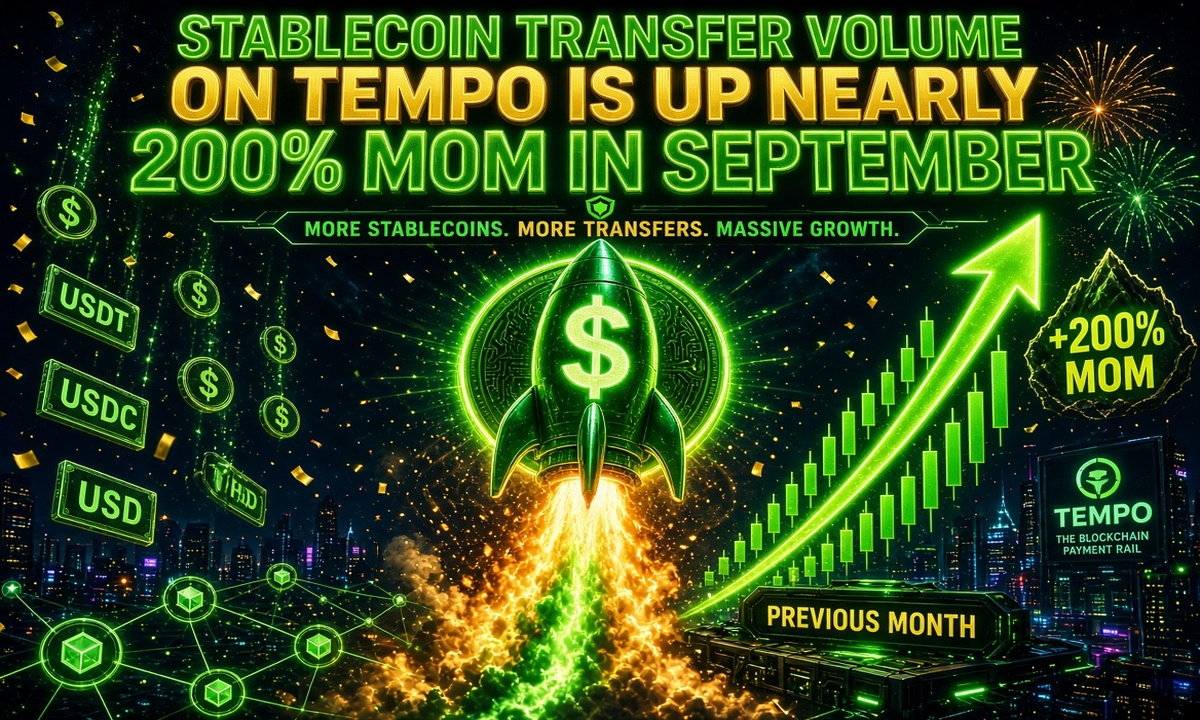
Stablecoin transfer volume on Tempo has surged nearly 200% month-over-month (MoM) in September, and the month is not yet finished.
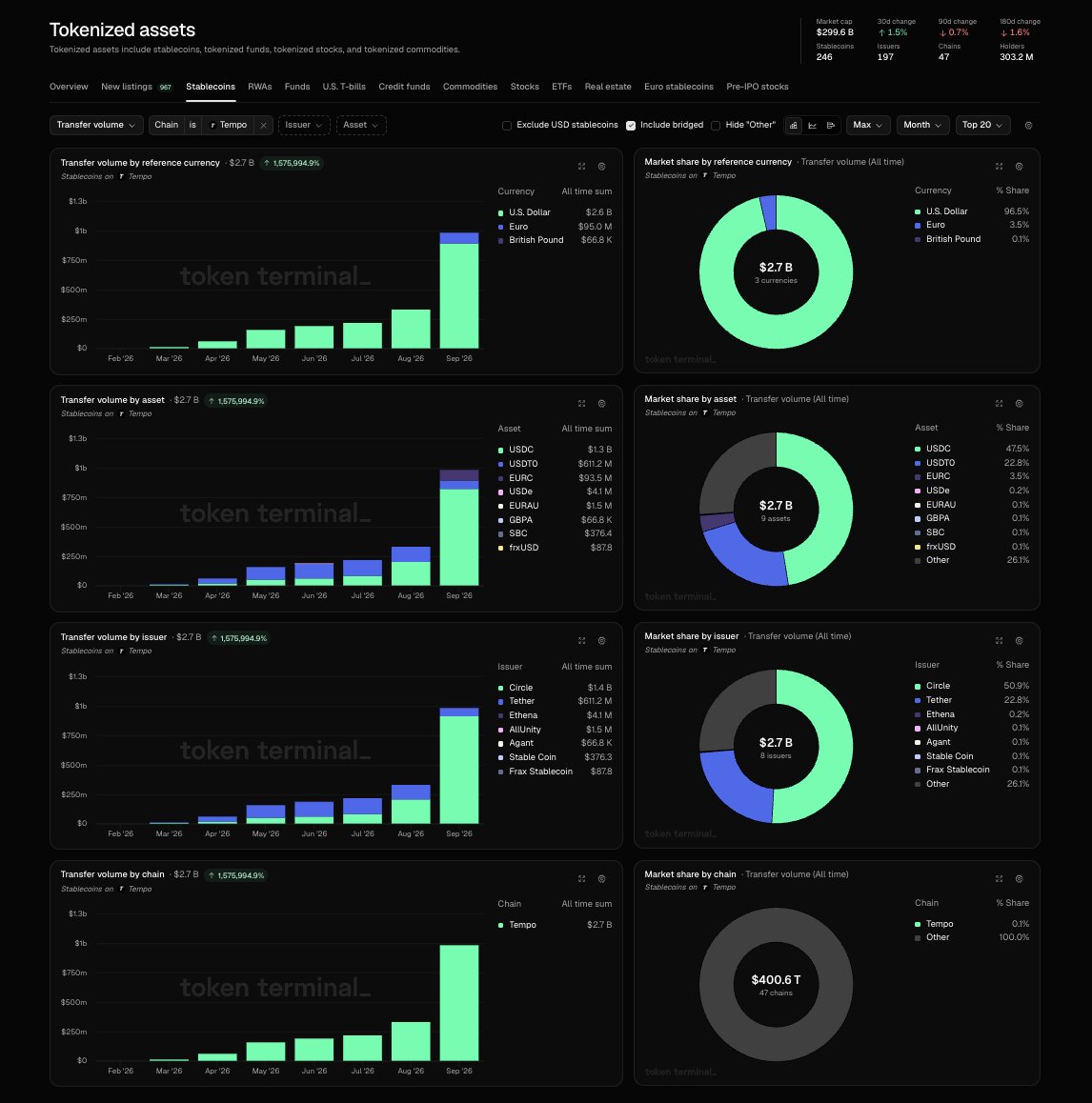
Token Terminal data shows USDC, USDT0, and EURC currently leading the activity as the network steadily builds its role as a shared settlement layer for stablecoins denominated in multiple currencies.
The jump stands out because Tempo itself is still a young chain. Mainnet only went live in mid-March 2026.
In the months since launch, the network has already processed more than a billion dollars in cumulative stablecoin transfers, and the latest monthly acceleration suggests that enterprise payment flows are finding a reliable home on the chain.
Stablecoin Transfer Volume: What the Numbers Reveal About Tempo’s Trajectory
Token Terminal tracks asset transfer volume across stablecoins on Tempo and surfaces the nearly 200% month-over-month rise for September.
The dashboard lets users filter by chain, metric, and time interval, and the current reading already places September well ahead of August even before the final days of the month arrive.
Meanwhile, USDC, USDT0, and EURC account for the largest shares of that volume. Their combined activity points to growing multi-currency usage rather than reliance on a single dollar stablecoin.
In parallel, the chain continues to attract transfer activity that looks more like real payment settlement than speculative trading.
How Tempo Positions Itself as a Payments Layer
Tempo is a payments-first Layer 1 blockchain incubated by Stripe and Paradigm.
It runs as a fully Ethereum Virtual Machine (EVM)-compatible network with sub-second deterministic finality and no native gas token.
Users pay fees directly in supported stablecoins through a built-in fee mechanism.
Dedicated payment lanes reserve blockspace for transfer activity so fees remain predictable even when other network traffic rises.
Beyond those design choices, the chain supports the TIP-20 token standard, which extends ordinary ERC-20 functionality with payment-friendly features such as memos and compliance hooks.
The combination makes Tempo especially attractive for enterprises that need reliable, low-cost movement of stablecoins across borders or between systems.
Stablecoin Transfer Volume: Why Multi-Currency Settlement Matters
A shared settlement layer that handles USDC, USDT0, EURC and other stablecoins in the same environment reduces friction for companies operating across regions.
Instead of managing separate rails for different currencies, payment platforms can settle on one network.
Looking ahead, the rising volume of non-USD stablecoins such as EURC signals that Tempo is beginning to serve that broader use case.
The same infrastructure that moves dollars can also move euros or other fiat-pegged assets without forcing users onto multiple chains.
That flexibility helps explain why transfer volume is accelerating so quickly in September.
The Broader Context of Stablecoin Transfer Growth
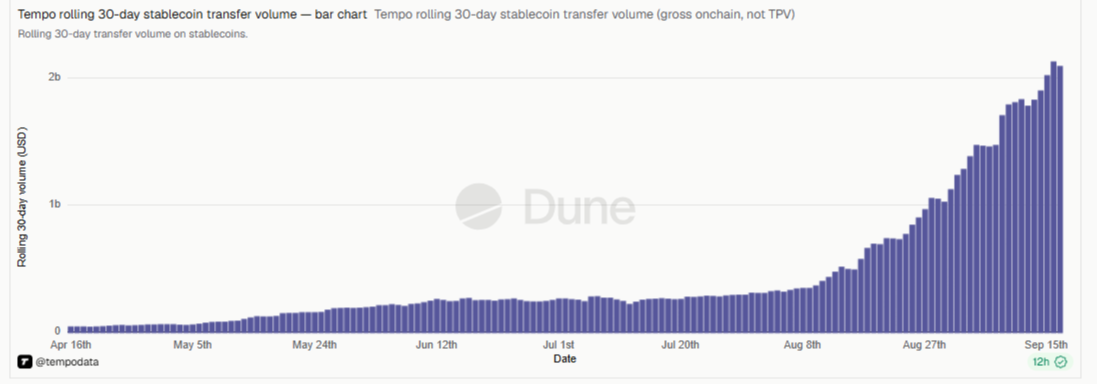
Earlier in the summer, Tempo already crossed $1 billion in rolling 30-day stablecoin transfer volume and posted weekly highs above $175 million.
Cumulative volume since mainnet launch has exceeded 1.2 billion dollars. Enterprise names that appear among the network’s users and partners include companies that routinely move large payment volumes.
In addition, the Machine Payments Protocol (MPP) running on Tempo enables machine-to-machine transfers with attribution memos, opening another channel for automated stablecoin activity.
Together, these factors create a foundation that supports both human-driven and automated payment flows.
What Is Driving the Nearly 200% MoM Increase?
The rise reflects a combination of new enterprise integrations, expanding multi-currency usage, and the network’s design advantages for payments.
Stablecoin transfer volume measures the total value of on-chain movements of supported stablecoins.
When more companies route payouts, remittances, or treasury movements through Tempo, that metric climbs.
Token Terminal’s dashboard captures the month-over-month change in real time and shows the lead of USDC, USDT0, and EURC.
Why Are USDC, USDT0, and EURC Leading on Tempo?
These three tokens currently generate the highest transfer volumes.
USDC remains the dominant dollar stablecoin on many chains, USDT0 brings additional dollar liquidity, and EURC introduces euro-denominated activity.
Their combined presence demonstrates that Tempo is functioning as a multi-currency settlement venue rather than a single-asset network.
Is Tempo Primarily a Payments Chain or a General-Purpose Blockchain?
Tempo is purpose-built for stablecoin payments.
While it remains fully EVM-compatible and can run ordinary smart contracts, its core features—stablecoin gas fees, dedicated payment lanes, sub-second finality, and TIP-20 enhancements—target payment workloads.
That focus differentiates it from general-purpose Layer 1s that prioritise DeFi or NFT activity.
How Does Tempo’s Fee Model Affect Transfer Volume?
Fees are paid in stablecoins rather than a volatile native token.
This removes one common friction point for payment companies that prefer to keep all accounting in fiat-pegged units.
Predictable, sub-cent costs further encourage high-frequency transfer activity, which in turn lifts overall stablecoin transfer volume.

Can the Current Growth Rate Continue?
September’s nearly 200% month-over-month rise is still incomplete, so the final figure could move higher or moderate.
Sustained growth will depend on continued enterprise adoption, additional stablecoin listings, and the ability of the network to maintain low fees and fast settlement under heavier load.
Historical milestones such as the earlier $1 billion 30-day mark suggest the trajectory has room to expand, yet volume always remains sensitive to real usage rather than speculation alone.
The latest Token Terminal reading shows that Tempo is converting its payments-first design into measurable on-chain activity.
Stablecoin transfer volume is rising quickly, multi-currency settlement is taking shape, and the network continues to attract the kind of enterprise flows that turn infrastructure into a working settlement layer.
Stakeholders tracking the evolution of on-chain payments will find the September numbers worth watching as the month closes.
