
Uniswap continues to set the pace for onchain trading activity across multiple networks.
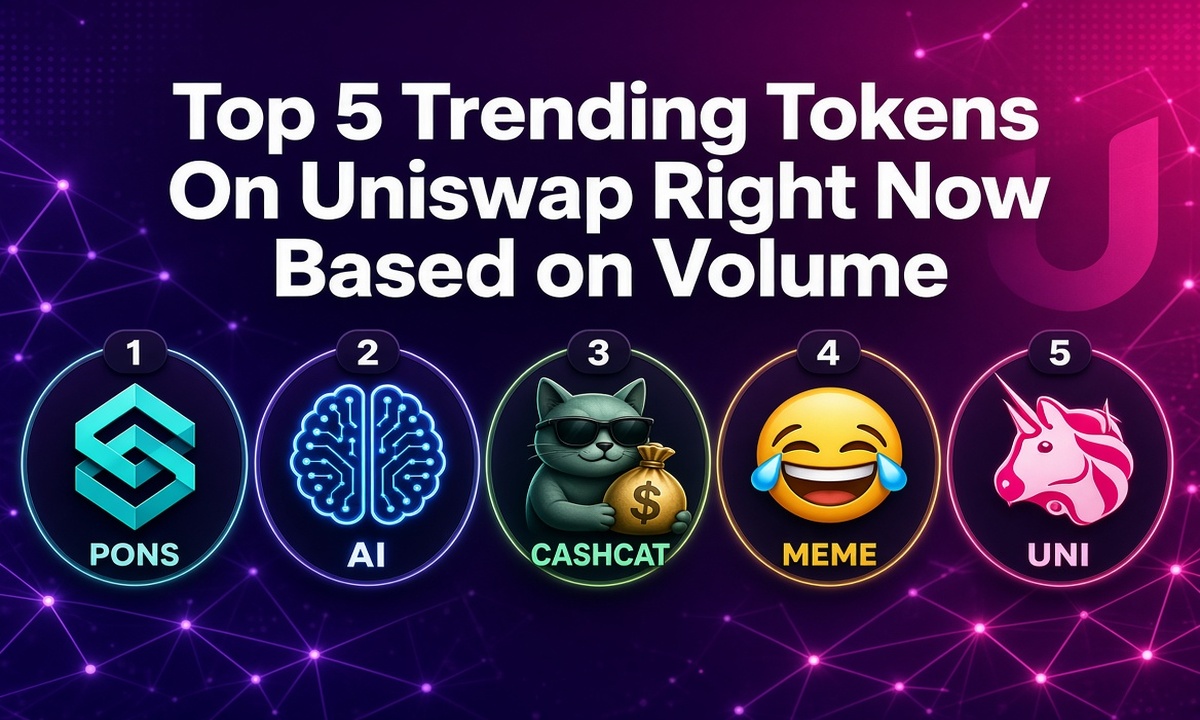
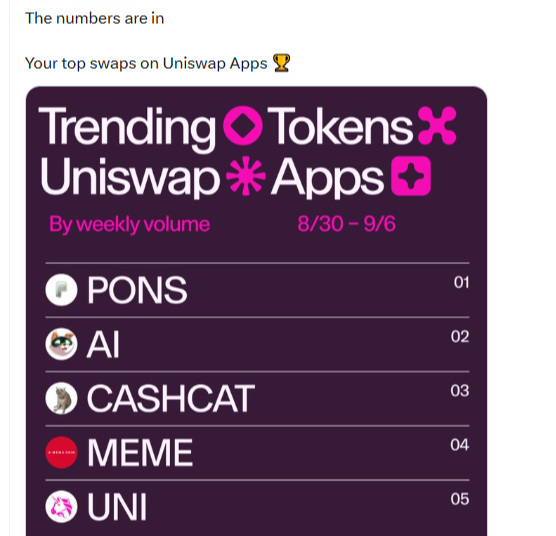
Recent weekly data from Uniswap Apps reveals a clear ranking of tokens that attracted the heaviest volume between August 30 and September 6, 2026.
The list excludes ETH, WBTC, and stablecoins, so it surfaces pure demand for specific assets.
The top five tokens are PONS, AI, CASHCAT, MEME, and UNI.
Each one tells a different story about current market energy, yet all of them moved significant capital through Uniswap interfaces during that window.
Traders who watch Uniswap closely notice how volume clusters around fresh narratives and established protocol tokens.
Robinhood Chain activity plays a large role in several of these names.
Meanwhile, Uniswap’s own token still claims a solid spot. The ranking offers a useful snapshot of where attention and capital currently flow.
AI and MEME also secured strong positions, showing that pure narrative-driven tokens remain active participants alongside more structured assets.
What is PONS and why is it dominating Uniswap volume?
PONS sits at the top of the Uniswap Apps volume ranking for the measured week.
The token belongs to the Pons launchpad, a non-custodial platform built specifically for Robinhood Chain.
Users create fixed-supply tokens in a single transaction, and those tokens trade against WETH before graduating into locked Uniswap pools.
Platform fees then feed back into PONS through automated buybacks.
Volume dominance stems from the sheer number of new launches and secondary trading that settle on Uniswap.
Robinhood Chain has become a busy venue for Uniswap V4 activity, and Pons captures a large share of that flow.
High daily fee generation on the launchpad further reinforces trading interest in PONS itself.
Market participants treat the token as a direct play on launchpad activity rather than a pure meme.
Uniswap Labs’ recent purchase of PONS for long-term alignment added another layer of attention.
What is CASHCAT and how does it relate to Robinhood Chain?
CASHCAT ranks third on the Uniswap volume list. The token is a community-driven memecoin native to Robinhood Chain.
Its name references the early internal mascot and working title that Robinhood founders once used before the company settled on its current brand.
The project describes itself as fan fiction with a ticker and maintains no official connection to Robinhood Markets.
Robinhood Chain launched in early July 2026 as an Arbitrum-powered Layer 2 focused on tokenized equities and broader DeFi use cases.
CASHCAT emerged shortly afterward and became one of the first breakout assets on the network.
Traders flocked to it during the chain’s early growth phase, and volume remains elevated on Uniswap pools.
The token carries a fixed one-billion supply, zero transaction taxes, and burned liquidity provider tokens.
Its continued presence in the top volume ranks shows that pure meme demand still coexists with the chain’s original tokenised-asset thesis.
Why did Uniswap Labs buy PONS tokens?
Uniswap Labs acquired an undisclosed amount of PONS in early September 2026.
The Pons team described the purchase as a move toward long-term alignment.
Uniswap itself quote-posted the announcement, signaling public support. Neither side disclosed the exact size, price, or wallet details.
The decision makes strategic sense once you examine the infrastructure relationship.
Tokens that graduate from the Pons launchpad move into Uniswap V4 pools.
Robinhood Chain already accounts for a substantial portion of overall Uniswap V4 volume.
Holding PONS gives Uniswap Labs exposure to the fee and activity engine that currently feeds a large share of its own trading venues.
The purchase also deepens coordination between the leading decentralised exchange (DEX) and the dominant launchpad on a fast-growing chain.
Market reaction was immediate, with PONS reaching new highs in the days that followed.
How do the tokenomics and buyback-and-burn of PONS work?
PONS launched with a maximum supply of one billion tokens.
The launchpad charges a one-percent pool fee on trades.
Creators receive the larger share of that fee, while the protocol takes the remainder.
Roughly 80% of the protocol’s portion automatically buys PONS on the open market and permanently burns it.
The remaining portion covers infrastructure and team costs.
This design creates a direct link between platform usage and token scarcity.
Higher launch and trading volume generates more fees, which accelerate buybacks and burns.
On-chain data shows that a meaningful percentage of the original supply has already been removed.
Because the buyback mechanism runs continuously, circulating supply contracts as activity grows.
Holders therefore benefit from both demand for the launchpad and the resulting reduction in available tokens.
The model differs from pure meme structures that lack any revenue feedback loop.
Is the current Uniswap top-volume ranking driven by memecoins or real utility?
The ranking mixes both forces. PONS carries clear utility as the value-accrual token of a high-fee launchpad that settles into Uniswap pools.
Its buyback-and-burn design and recent institutional interest from Uniswap Labs give it infrastructure characteristics.
CASHCAT leans more heavily toward pure narrative and meme demand. AI and MEME follow a similar path.
AI draws traders who respond to artificial-intelligence themes that have circulated widely this year, while MEME captures broad speculative interest in classic meme culture.
Both tokens generated enough weekly volume on Uniswap Apps to secure second and fourth place respectively, proving that narrative-driven assets still command serious capital even when more structured tokens lead the board.
UNI sits in a different category altogether. It represents ownership and governance of the Uniswap protocol itself, so its volume reflects broader confidence in the exchange’s continued growth across chains.
Uniswap volume rankings often surface this blend.
Fresh chains and launchpads generate intense short-term meme activity, while protocol tokens and utility-linked assets capture sustained flow.
The current list shows Robinhood Chain meme energy still running strong through CASHCAT, AI, and MEME, yet the top spot belongs to a token with measurable fee revenue and a structural relationship to Uniswap.
Traders who track these rankings gain insight into both speculative heat and deeper infrastructure trends.
Uniswap remains the primary venue where these competing narratives meet actual capital.
The top five tokens for the latest measured week illustrate how launchpad infrastructure, meme culture, AI-themed speculation, and protocol ownership currently compete for attention.
Volume data updates frequently, so the ranking will shift as new launches appear and older narratives cool.
Careful observers keep watching both the pure trading numbers and the underlying mechanics that drive them.
