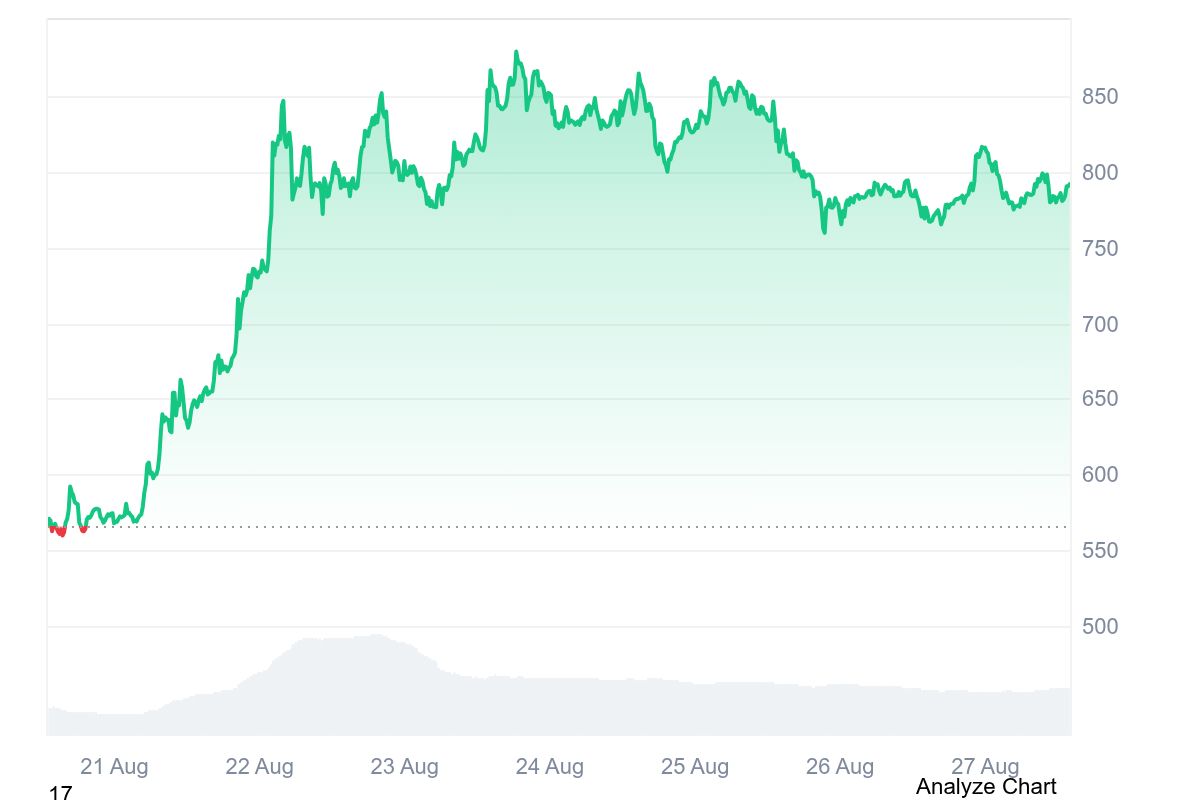


ZCash (ZEC) captured attention across crypto markets in late August 2026 after posting gains that multiple trackers placed above 40 percent for the week.
Some measurements showed 48 to 62 percent advances from earlier levels near $500 to $570.
Prices climbed toward multi-year highs near $880 to $888 before cooling into the mid-700s.
The move unfolded against a backdrop of renewed interest in financial privacy, institutional filings, and protocol recovery.
Readers keep asking the same practical questions, so the sections below walk through each one while connecting the dots of the rally.
Why did ZCash (ZEC) surge more than 40% in the past week / August 2026?
The climb started with a clear catalyst when Grayscale advanced filings to convert its existing Zcash Trust into a spot exchange-traded product.
That step signalled potential easier institutional access and lifted expectations around liquidity.
At the same time, futures open interest nearly doubled, climbing toward 1.8 billion dollars while daily futures volume reached several billion.
Leverage amplified the upward pressure once key levels broke.
In parallel, Cypherpunk Technologies expanded its mining footprint, claiming a meaningful share of network hashrate and accumulating a sizeable ZEC treasury.
Broader market appetite for privacy assets also returned after months of quieter trading.
The network had already moved past a difficult June episode through the Ironwood upgrade, restoring confidence that further supported buying.
These threads intertwined and produced the rapid percentage gains.
What is ZCash (ZEC) and how does it work?
ZCash is a Proof-Of-Work (PoW) cryptocurrency that launched in October 2016 with a design inspired by Bitcoin yet focused on optional privacy.
It carries a hard cap of 21 million coins and relies on the Equihash Algorithm for mining.
Users can choose transparent addresses that behave much like Bitcoin addresses or shielded addresses that hide details through zero-knowledge (zK) proofs.
The network records every transaction on a public ledger, yet shielded activity conceals the sender, receiver, and amount while still proving validity.
Development continues through coordinated upgrades that improve performance and security.
This dual approach lets people decide how much privacy they need for any given transfer.
How private is ZCash really? What is the difference between shielded and transparent transactions?
Transparent transactions publish the same visible data that appears on Bitcoin explorers.
Shielded transactions, by contrast, rely on zk-SNARKs to confirm that coins move correctly without revealing the parties or the value. Fully shielded transfers (z-to-z) keep the most information private on-chain.
Still, network-level metadata such as Internet Protocol (IP) addresses can create risks if users skip additional protections like a Virtual Private Network (VPN) or Tor.
Wallet defaults matter: some platforms still favour transparent addresses, while dedicated ZCash wallets increasingly encourage shielding.
Privacy therefore depends on consistent choices rather than automatic protection.

What was the Orchard vulnerability and the Ironwood upgrade?
In June 2026, a researcher using advanced artificial intelligence (AI) tools identified a serious soundness flaw in the Orchard shielded pool that could have allowed undetectable counterfeiting.
The disclosure triggered a sharp price drop and intense scrutiny. Developers responded with coordinated patches and proposed a clean transition.
Ironwood, also known as NU6.3, activated in late July. It retired the old Orchard pool, introduced a new shielded environment, and created a controlled turnstile for migration.
Users can now verify the circulating supply independently on a local node. The upgrade restored technical credibility and helped set the stage for the later recovery.
Is there a ZCash ETF? What is the status of Grayscale’s Zcash Trust conversion?
Grayscale already operates a Zcash Trust that gives certain investors exposure without direct custody.
In August 2026, the firm filed additional amendments aimed at converting that trust into a spot ETF expected to trade on NYSE Arca under a ticker such as ZCSH.
The filings kept the conversion process alive and generated fresh speculative interest.
No final regulatory approval had cleared at the time of the price peak, yet the mere progress revived the institutional narrative.
Market participants watched volume and open interest closely for signs that the product could eventually broaden access.

What is ZECs total / circulating supply, tokenomics, and next halvings?
ZCash mirrors Bitcoin’s fixed maximum of 21 million coins. Circulating supply in late August 2026 sat near 16.8 to 17 million.
New coins enter through mining rewards that follow a halving schedule, with the next major reduction expected around late 2028.
Community processes also explore adjustments. Holders prepared votes on whether to smooth issuance instead of sharp halvings and whether to shorten target block times from 75 seconds toward 25 seconds.
These discussions leave the overall supply cap intact while refining how rewards flow over time.
Who founded ZCash and how is it governed / funded?
Cryptographer Zooko Wilcox and a team of researchers brought ZCash to market through what became the Electric Coin Company.
The project draws on earlier academic work known as Zerocash. The independent Zcash Foundation supports ecosystem development, while community grants fund additional work.
Recent governance experiments give coinholders direct input through formal votes on protocol changes.
Funding historically came from a portion of block rewards allocated to development entities, with ongoing conversations about long-term sustainability.
This multi-layered structure keeps the project advancing without a single corporate owner.

Can ZCash transactions be tracked or traced?
Transparent activity remains fully visible and labelable by analytics platforms.
Fully shielded transfers hide the core details on-chain, and no public method currently breaks that encryption.
Even so, analysts have attributed large volumes of historical activity through patterns outside pure shielding.
Users seeking stronger privacy combine shielded addresses with network protections and careful wallet hygiene.
Partial shielding or mixing transparent and private steps can reduce effectiveness. Consistent full shielding plus external safeguards delivers the highest practical privacy.
Is ZCash a good investment after the recent rally? What are the main risks?
As of August 2026, ZCash is among the digital assets investors can consider for their trading portfolios.
Supporters point to growing demand for financial privacy in an AI-driven world, the potential ETF pathway, rising shielded adoption, and institutional accumulation by firms such as Cypherpunk.
Grayscale research has highlighted the asset’s relatively small market share within the broader currency sector and the upside if privacy features gain wider use.
On the other side, elevated futures leverage that can reverse quickly, lingering regulatory caution around privacy coins, the residual memory of the Orchard episode, and the historical volatility that has marked ZEC for years.
Position sizing and personal risk tolerance matter more than short-term percentage moves.

How do I buy, store, mine, or useZEC?
Major exchanges such as Bitrue, Binance, Gemini, Coinbase, YoBit, KuCoin, Kraken, Bitget, and OKX list ZEC and support both transparent and, in some cases, shielded transfers.
Decentralised exchanges (DEXs) such as PancakeSwap and Uniswap support the trading of ZEC as well.
Dedicated wallets that fully support the latest shielded pools make self-custody practical.
Mining remains possible with appropriate Equihash hardware, though profitability fluctuates with price, difficulty, and electricity costs.
When sending to exchanges users often need destination tags or memos so the receiving platform credits the correct account.
Real-world use includes peer-to-peer payments and any merchant services that accept the coin. Testing small amounts first remains the safest habit.
The August explosion of ZCash therefore reflected more than a single headline. Grayscale’s filings, leveraged futures activity, mining expansion, and the restored confidence after Ironwood all converged inside a market that had begun rediscovering privacy.
Understanding the technology, the supply rules, the governance path, and the practical limits of shielding gives readers a clearer map of both the opportunity and the remaining uncertainties.
Primary sources from protocol teams, regulatory filings, and independent researchers continue to offer the most reliable ground for ongoing evaluation.