

The conversation around artificial intelligence in blockchain has shifted to primarily include AI agents in crypto worlds.
While earlier waves focused on compute networks and model marketplaces, attention now centres on AI agents — autonomous software entities that can act, transact, and interact on-chain with limited human oversight.
Investors and builders increasingly ask whether tokenised versions of these agents represent a meaningful evolution or simply the latest narrative cycle.
This article examines the technology, the economic models, the risks, and the open questions surrounding AI agents in crypto.
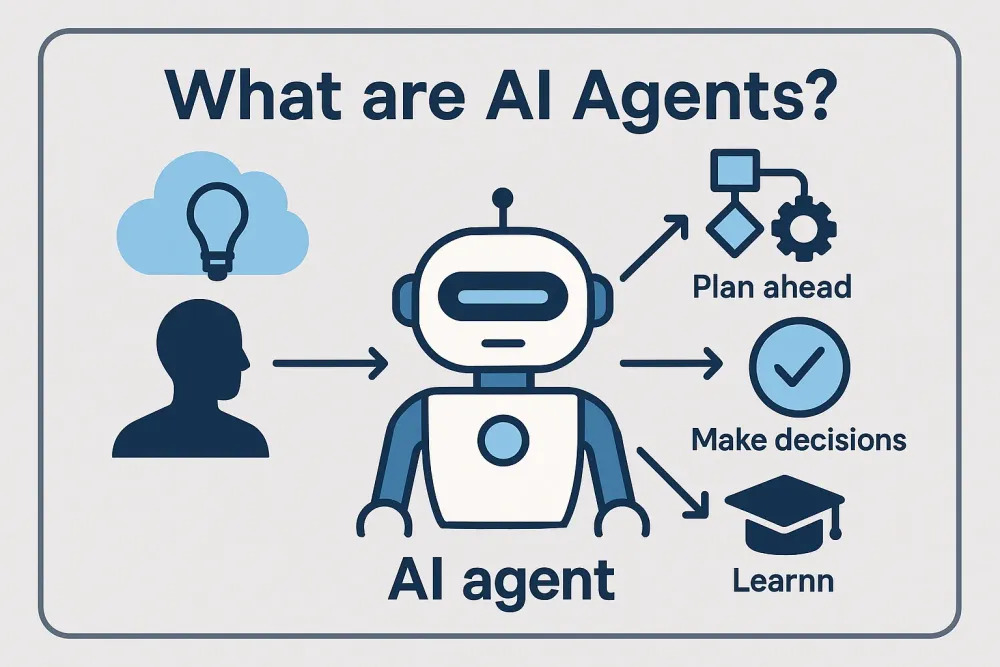
What Exactly Are AI Agents in Crypto?
An AI agent is a software program designed to pursue goals with a degree of independence.
In the crypto context, these agents can hold wallets, sign transactions, interact with smart contracts, gather information, and execute strategies without constant human input.
Tokenised AI agents take this concept further by attaching a native token to the agent or to a platform that creates and manages such agents.
Moreover, the token often serves multiple purposes. Holders may gain access to the agent’s services, share in any revenue the agent generates, or participate in governance over its parameters.
In some systems, every new agent receives its own token, creating a direct market for that specific agent’s performance and popularity.
How Do Tokenised AI Agents Differ from Traditional AI Tokens?
Traditional AI tokens usually power broader infrastructure such as decentralised GPU networks or data marketplaces.
Tokenised agents, by contrast, focus on the autonomous entity itself. The economic value centres on the agent’s ability to perform useful tasks — trading, content creation, research, or customer support — rather than on raw computing capacity.
Furthermore, the token model frequently includes mechanisms for revenue sharing or performance-based rewards.
Meanwhile, traditional AI tokens more often function as payment or staking instruments for network resources.
This distinction matters because agent tokens introduce a closer link between real-world activity and token demand.
Why Are AI Agents Attracting Attention Right Now?
Several forces converge to elevate the topic. First and foremost, advances in large language models and multi-agent systems have made more capable autonomous software practical.
Secondly, blockchain provides a natural environment for agents that need to hold assets, execute payments, and interact with other programs in a transparent manner.
Moreover, existing platforms have begun launching tools that allow users to create, deploy, and monetise agents with relatively low friction.
Also the broader AI narrative continues to draw capital and attention. When combined with crypto’s ability to create liquid markets around digital entities, the result is a compelling story for both builders and speculative participants.
What Are the Main Use Cases Currently Emerging?
Early applications span several areas. Trading agents attempt to execute strategies across decentralised exchanges.
Content and social agents generate posts, manage communities, or create media. Research agents gather and synthesise information.
Some platforms also experiment with agents that provide personalised services or act as on-chain representatives for users.
Notably, the most visible activity often involves agents that generate engagement or speculative interest rather than purely utilitarian functions.
This pattern raises questions about long-term sustainability versus short-term narrative strength.
What Risks and Limitations Do AI Agents Face?
Technical limitations remain significant. Current agents can still produce errors, hallucinate information, or behave unpredictably when faced with novel situations.
Security risks also increase when autonomous programs control funds. Smart-contract vulnerabilities, prompt injection attacks, and poorly designed incentive structures can lead to losses.
Moreover, many tokenised agents launch with limited real utility and rely heavily on marketing.
In such cases, the token functions more as a speculative instrument than as a claim on productive activity.
Regulatory uncertainty adds another layer of complexity, particularly when agents engage in financial activities.
How Can Investors Evaluate Tokenised AI Agents?
A practical evaluation begins with clarity of purpose. Ask whether the agent performs a verifiable and useful task.
Examine the token’s role — does it enable access, capture revenue, or simply exist for trading?
Review the transparency of the underlying model and the quality of any open-source components. Track actual usage metrics rather than social metrics alone.
Furthermore, assess the team’s technical background and the realism of their claims.
Projects that overstate current capabilities while under-delivering on live performance often reveal themselves through gaps between documentation and reality.
Is This Narrative Sustainable or Temporary Hype?
Both elements exist simultaneously. Genuine progress in multi-agent systems and on-chain autonomy creates a foundation for lasting applications.
At the same time, the speed of token launches and the intensity of marketing create conditions ripe for short-term speculation.
History shows that narratives often expand faster than underlying technology, leading to periods of excess followed by consolidation.
Ultimately, the projects that survive will likely be those that demonstrate measurable economic activity rather than pure story-telling.
Tokenised agents that generate consistent value for users stand a better chance of enduring beyond the current attention cycle.

Frequently Asked Questions About AI Agents in Crypto
What makes an AI agent “tokenised”?
A tokenised agent links a cryptocurrency to the agent or its platform, usually for access, rewards, governance, or revenue sharing.
Can AI agents currently manage funds safely?
Most still require careful oversight. Fully autonomous fund management carries elevated risk due to potential errors and security vulnerabilities.
How do AI agent tokens generate value?
Value can arise from usage fees, performance incentives, staking rewards, or speculative demand. Sustainable models depend on real activity rather than narrative alone.
Are AI agents the same as trading bots?
Trading bots represent one narrow application. AI agents aim for broader autonomy across multiple tasks and environments.
Should beginners invest in AI agent tokens?
Only after thorough research and with capital they can afford to lose. The sector remains early, experimental, and highly volatile.
Final Perspective
Tokenised AI agents occupy an intriguing position at the intersection of two powerful technologies.
They offer a vision of software that can act independently within economic systems, yet they also inherit the risks of both artificial intelligence and speculative crypto markets.
Progress will depend less on marketing volume and more on demonstrated usefulness, robust design, and clear economic incentives.
Investors and observers who focus on those fundamentals will navigate the space more effectively than those who chase the loudest narrative of the moment.
